Skip to main content
Contents Dark Mode Prev Up Next \(
\newcommand{\lt}{<}
\newcommand{\gt}{>}
\newcommand{\amp}{&}
\definecolor{fillinmathshade}{gray}{0.9}
\newcommand{\fillinmath}[1]{\mathchoice{\colorbox{fillinmathshade}{$\displaystyle \phantom{\,#1\,}$}}{\colorbox{fillinmathshade}{$\textstyle \phantom{\,#1\,}$}}{\colorbox{fillinmathshade}{$\scriptstyle \phantom{\,#1\,}$}}{\colorbox{fillinmathshade}{$\scriptscriptstyle\phantom{\,#1\,}$}}}
\)
Section A.12 Structural Ambiguity
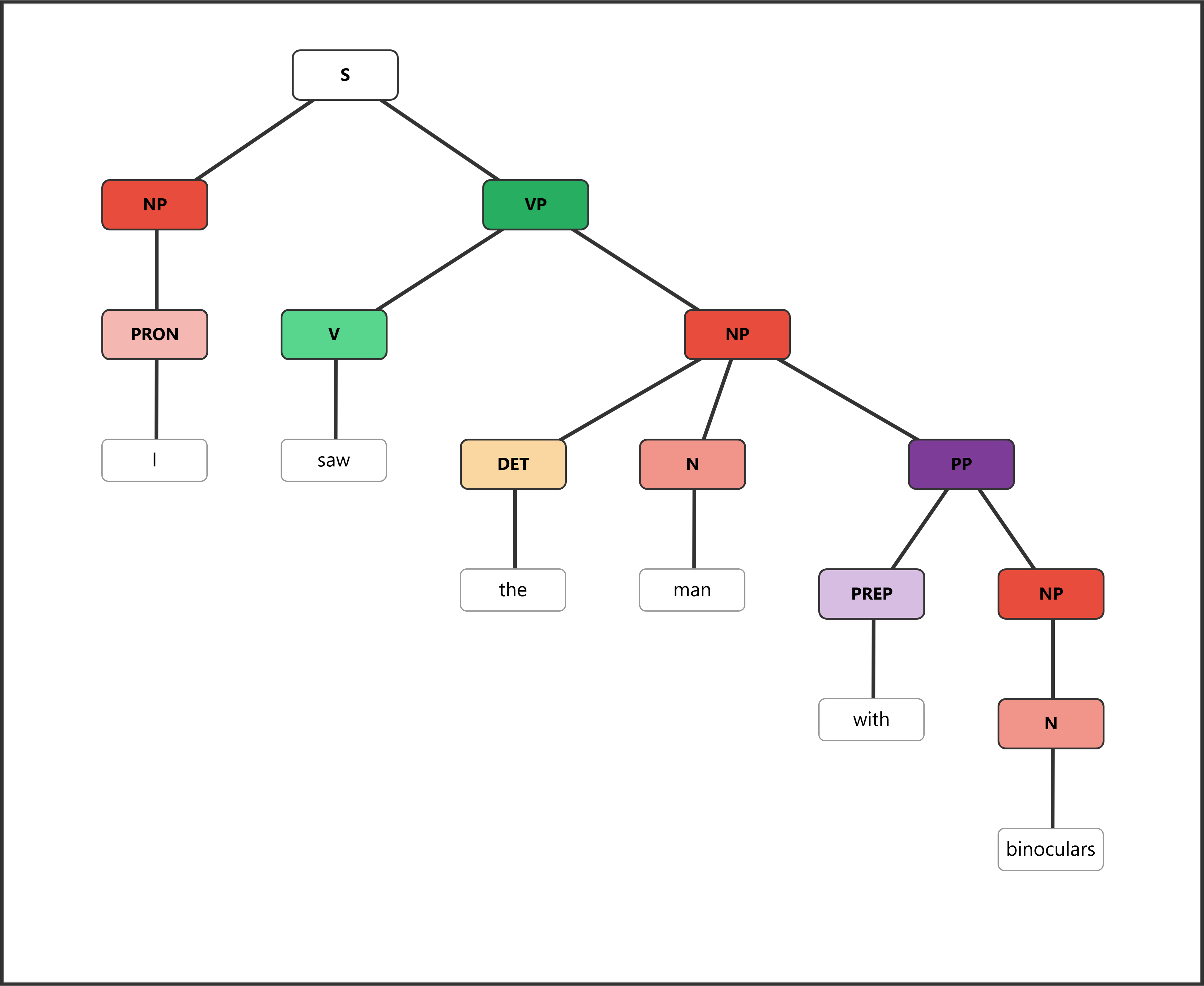
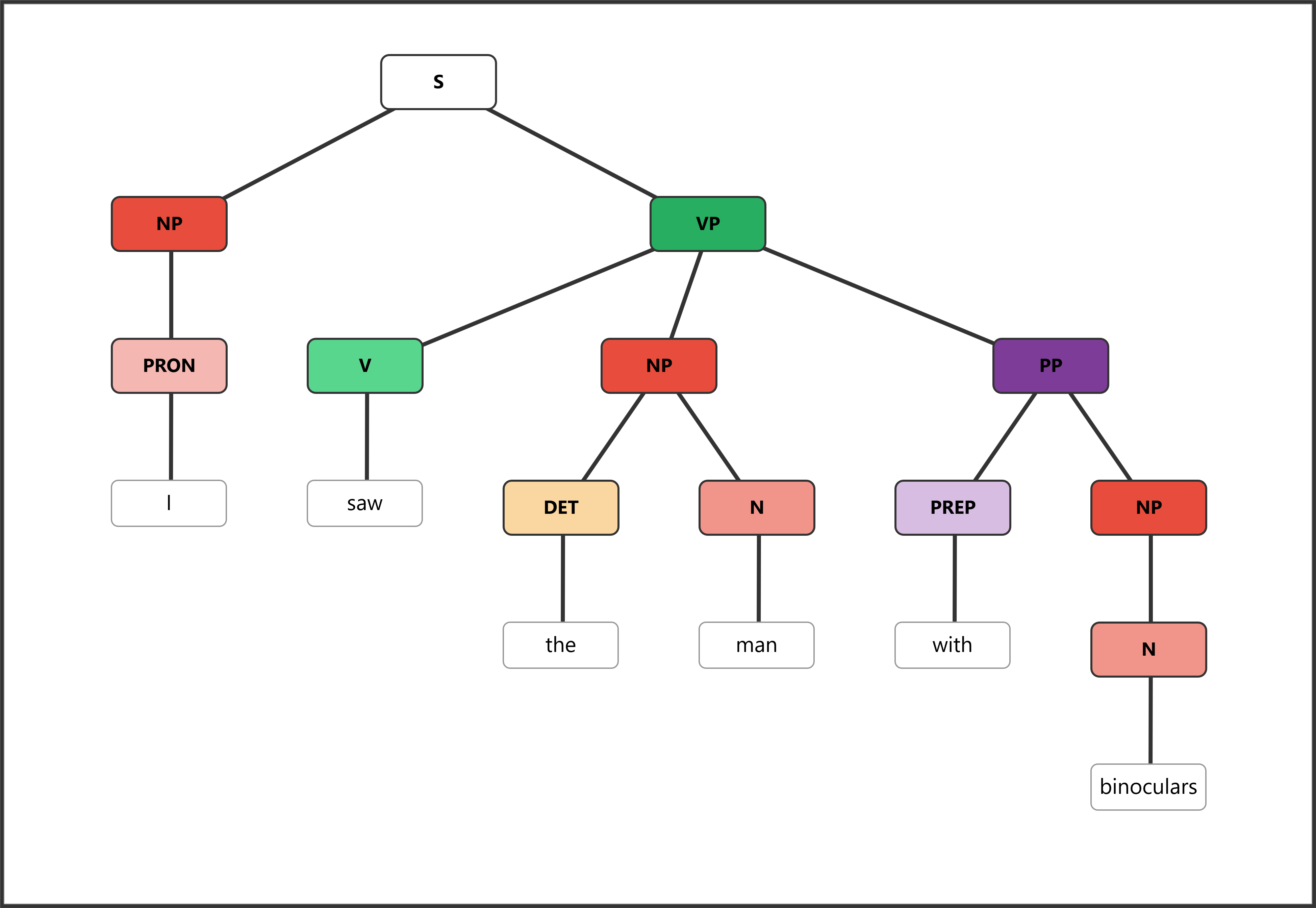
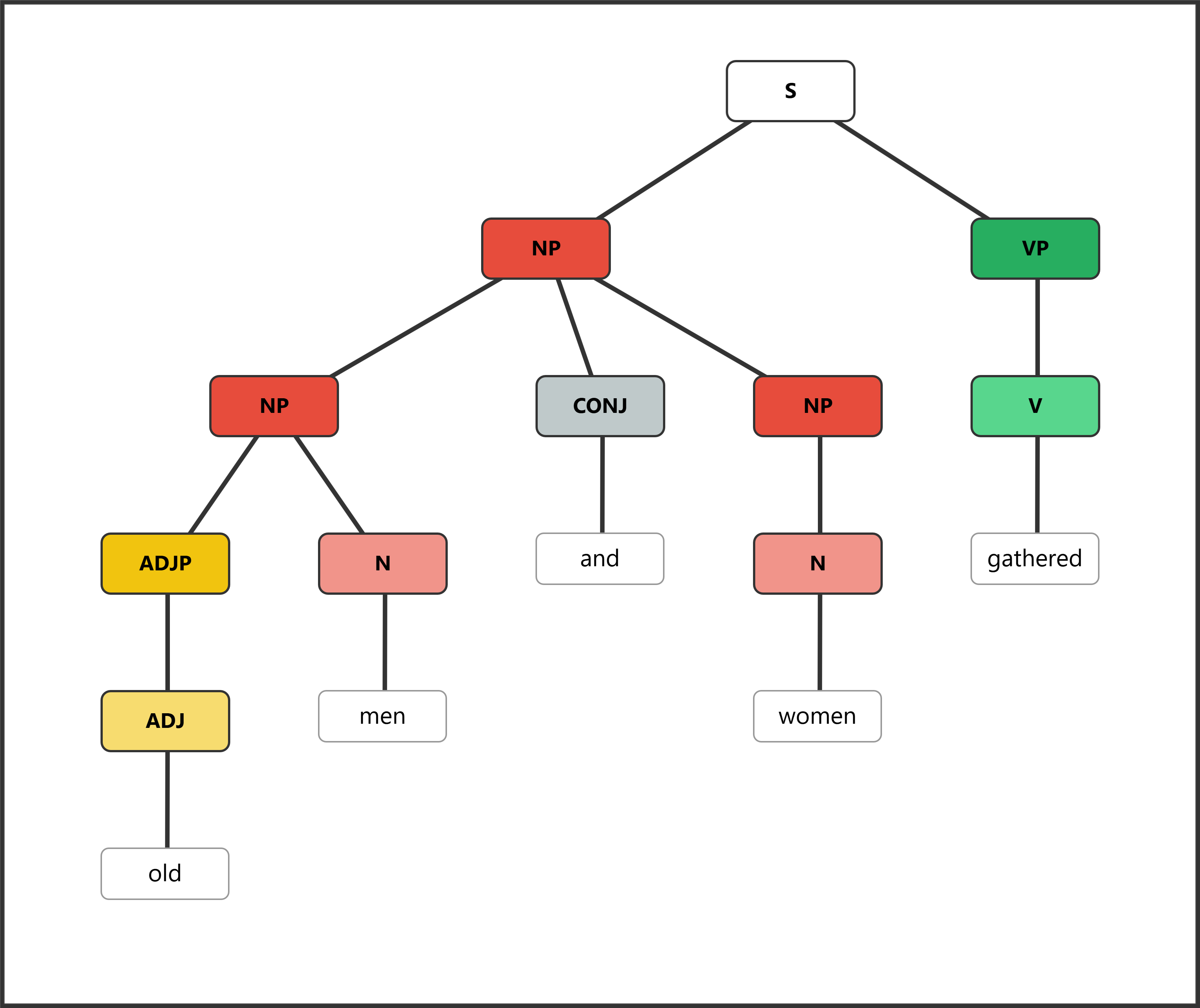
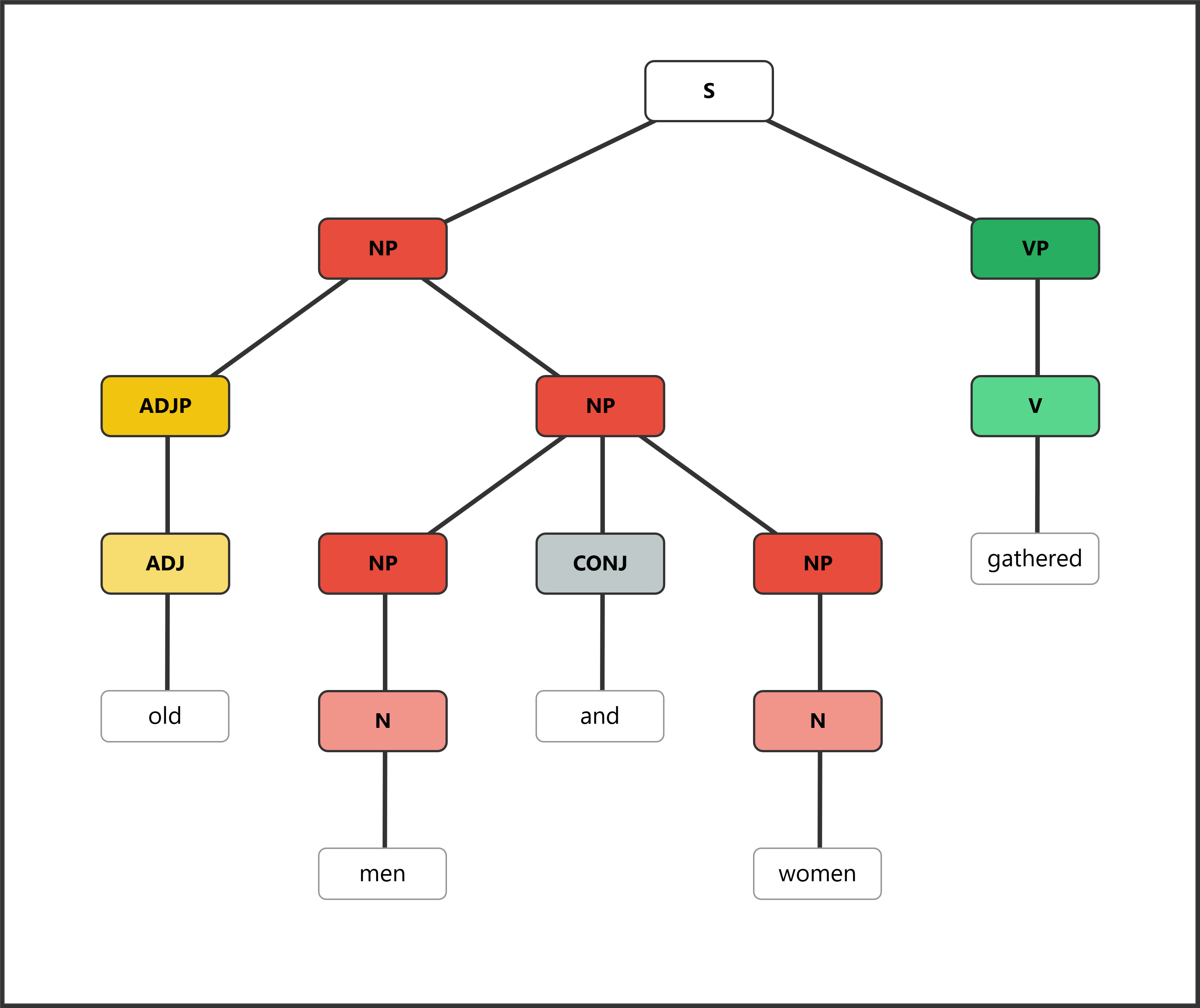
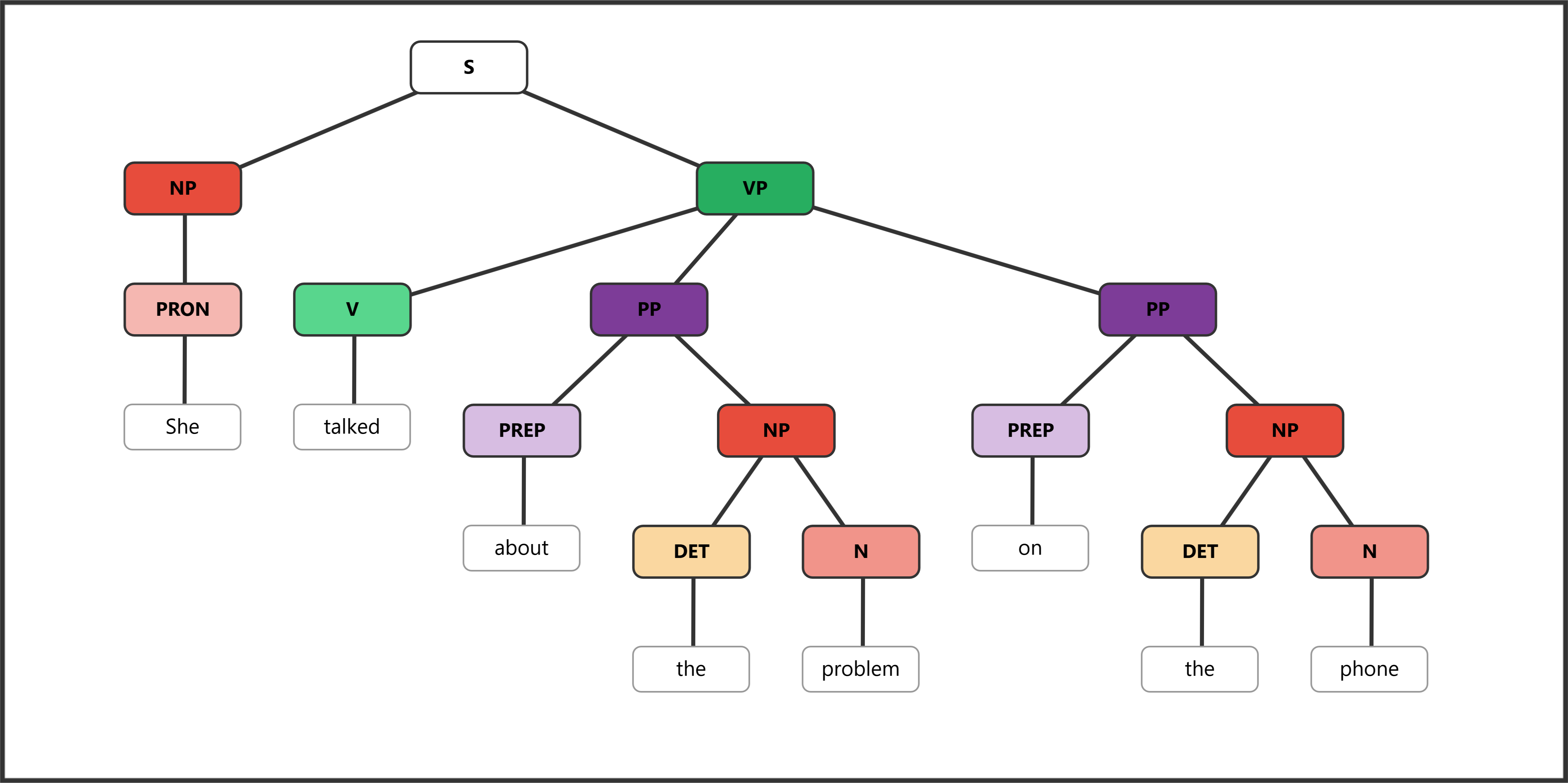
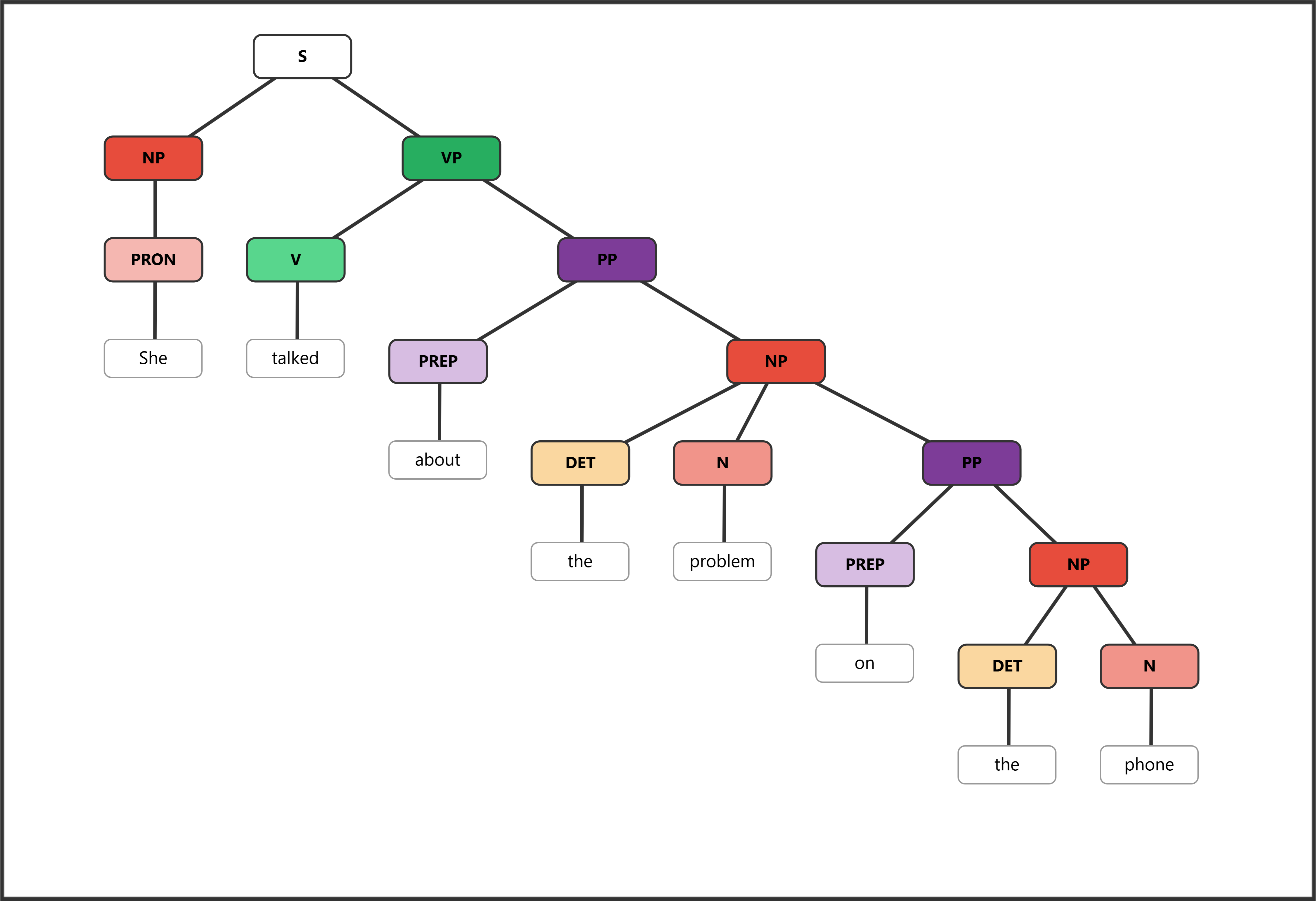
This section presents paired diagrams showing how the same sentence can have two different structural analyses, leading to two different meanings. Each pair shares the same words but differs in how phrases attach.
Figure A.12.1. PP Attaches to NP: I saw the man with binoculars (the man has binoculars)
Figure A.12.2. PP Attaches to VP: I saw the man with binoculars (I used binoculars)
Figure A.12.3. Adjective Scope — Reading 1: old men and women (only men are old)
Figure A.12.4. Adjective Scope — Reading 2: old men and women (both are old)
Figure A.12.5. Adjunct PP Modifies VP: She talked about the problem on the phone (she used the phone to talk)
Figure A.12.6. PP Modifies NP: She talked about the problem on the phone (the problem is on the phone)