Section 10.9 Aspect: The Shape of Events
If tense tells you when an event happens, aspect tells you something different: it tells you how the event is shaped in time. Think of tense as placing a dot on a timeline, and aspect as describing the dot itself—is it a single point, a stretch, a stretch that reaches up to the present, or a stretch that is still ongoing? Two sentences can share the same tense but have completely different aspects: She worked (past simple) presents a completed event as a whole, while She was working (past progressive) zooms in on the action as it unfolds. The event may be identical in real-world terms; the aspect shapes how the speaker presents it.
Aspect describes the internal temporal structure of events—whether they’re completed, ongoing, repeated, or have current relevance. English has four aspects.
Here is a quick overview before we examine each in detail:
-
Simple: presents events as complete wholes. The train arrives at noon. He walked to the store.
-
Progressive: presents events as ongoing. The children are playing outside. She was reading when the lights went out.
-
Perfect: connects a past event to a later time. We have finished the project. By June, she had saved enough money.
-
Perfect progressive: combines duration with connection to a later time. They have been practicing all week. He had been driving for hours before he stopped.
Simple Aspect.
The simple aspect presents events as complete wholes, without internal structure:
-
She works at a bank. (present simple—habitual)
-
She worked at a bank. (past simple—completed)
-
She will work at a bank. (future simple—predicted)
Progressive Aspect.
The progressive aspect (be + -ing) presents events as ongoing, in progress:
-
She is working right now. (present progressive)
-
She was working when I called. (past progressive)
-
She will be working at noon. (future progressive)
Uses of progressive:
-
Actions in progress: I’m reading a book.
-
Temporary situations: She’s living in Boston this year.
-
Future arrangements: We’re meeting tomorrow.
-
Background to another event: I was sleeping when the phone rang.
Stative verbs typically resist progressive:
-
I am knowing the answer.→ I know the answer. -
She is loving chocolate.→ She loves chocolate.
Perfect Aspect.
The perfect aspect (have + past participle) connects a past event to a later time (often the present):
-
She has worked here for ten years. (present perfect)
-
She had worked there before moving. (past perfect)
-
By then, she will have worked here a decade. (future perfect)
Uses of present perfect:
-
Past action with present relevance: I’ve finished my work. (so I’m free now)
-
Experience up to now: She has visited Paris twice.
-
Continuing situation: He has lived here since 2010.
-
Recent past: They have just arrived.
Past perfect positions events before another past reference point:
-
When I arrived, she had already left.
Perfect Progressive Aspect.
The perfect progressive (have + been + -ing) combines perfect and progressive meanings:
-
She has been working all morning. (present perfect progressive)
-
She had been working when I called. (past perfect progressive)
-
By noon, she will have been working for six hours. (future perfect progressive)
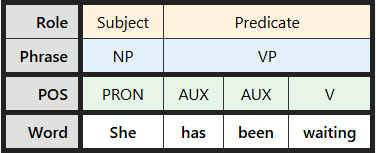
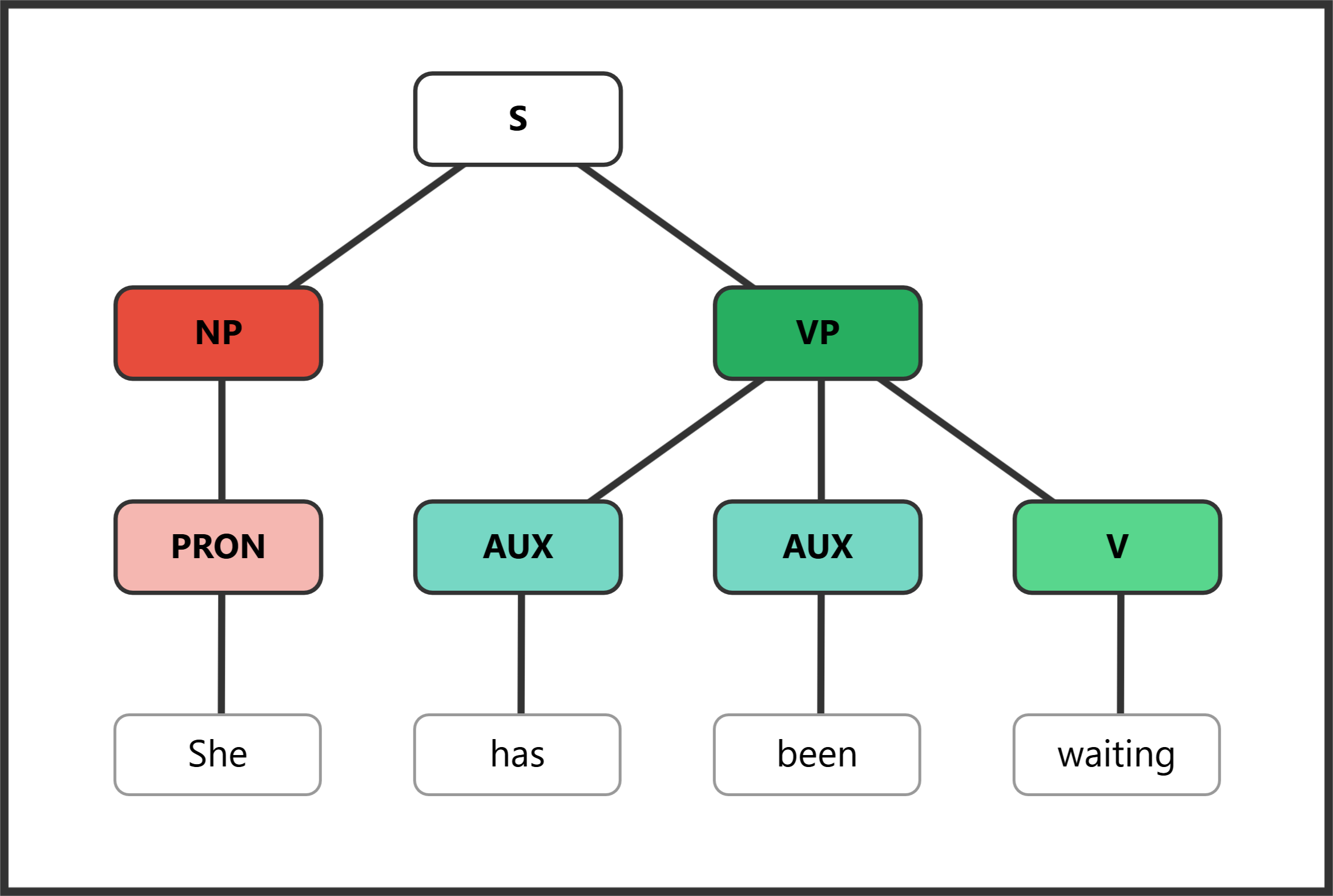
[S [NP [PRON She]] [VP [AUX has] [AUX been] [V waiting]]]
Uses:
-
Duration of ongoing activity: I’ve been waiting for an hour.
-
Explanation for current state: She’s tired because she’s been running.

