Section 5.3 Phrases and Headwords
Before examining individual word classes, we need to understand how words combine into larger units called phrases. In grammar, a phrase is a group of words that functions as a single unit within a sentence. Every phrase is built around one essential word—its head—and may include other words that modify or complete it.
The Head of a Phrase.
The head is the most important word in a phrase—the word that determines what kind of phrase it is and cannot be removed without destroying the phrase. Think of the head as the nucleus around which everything else orbits.
Consider this noun phrase:
“the tall student from Ohio”
Which word is essential? We can remove words one by one:
-
the tall student from Ohio → tall student from Ohio (still works)
-
tall student from Ohio → student from Ohio (still works)
-
student from Ohio → student (still works)
-
student → ??? (remove student and nothing remains)
The word “student” is the head. Every other word in the phrase—“the”, “tall”, “from Ohio”—is optional. But “student” is required. Because the head is a noun, the whole phrase is a noun phrase (NP).
Modifiers.
Modifiers are the optional words that add information about the head. They come in two types:
Pre-modifiers appear before the head:
-
In “the tall student”, both “the” and “tall” are pre-modifiers
Post-modifiers appear after the head:
-
In “student from Ohio”, the phrase “from Ohio” is a post-modifier
Modifiers expand the head, making it more specific. “Student” could be anyone; “the tall student from Ohio” narrows our focus to one particular person.
Four Major Phrase Types.
Each of the four open word classes serves as the head of a corresponding phrase type:
| Phrase Type | Abbreviation | Head | Example |
|---|---|---|---|
| Noun phrase | NP | Noun | the tall student from Ohio |
| Verb phrase | VP | Verb | read the book carefully |
| Adjective phrase | AdjP | Adjective | very proud of her work |
| Adverb phrase | AdvP | Adverb | quite slowly |
Understanding phrase structure is essential for grammatical analysis. When we diagram sentences or analyze syntax, we work with phrases, not just individual words.
Visualizing Phrase Structure.
We can represent phrase structure using tree diagrams. Here’s a simple noun phrase:
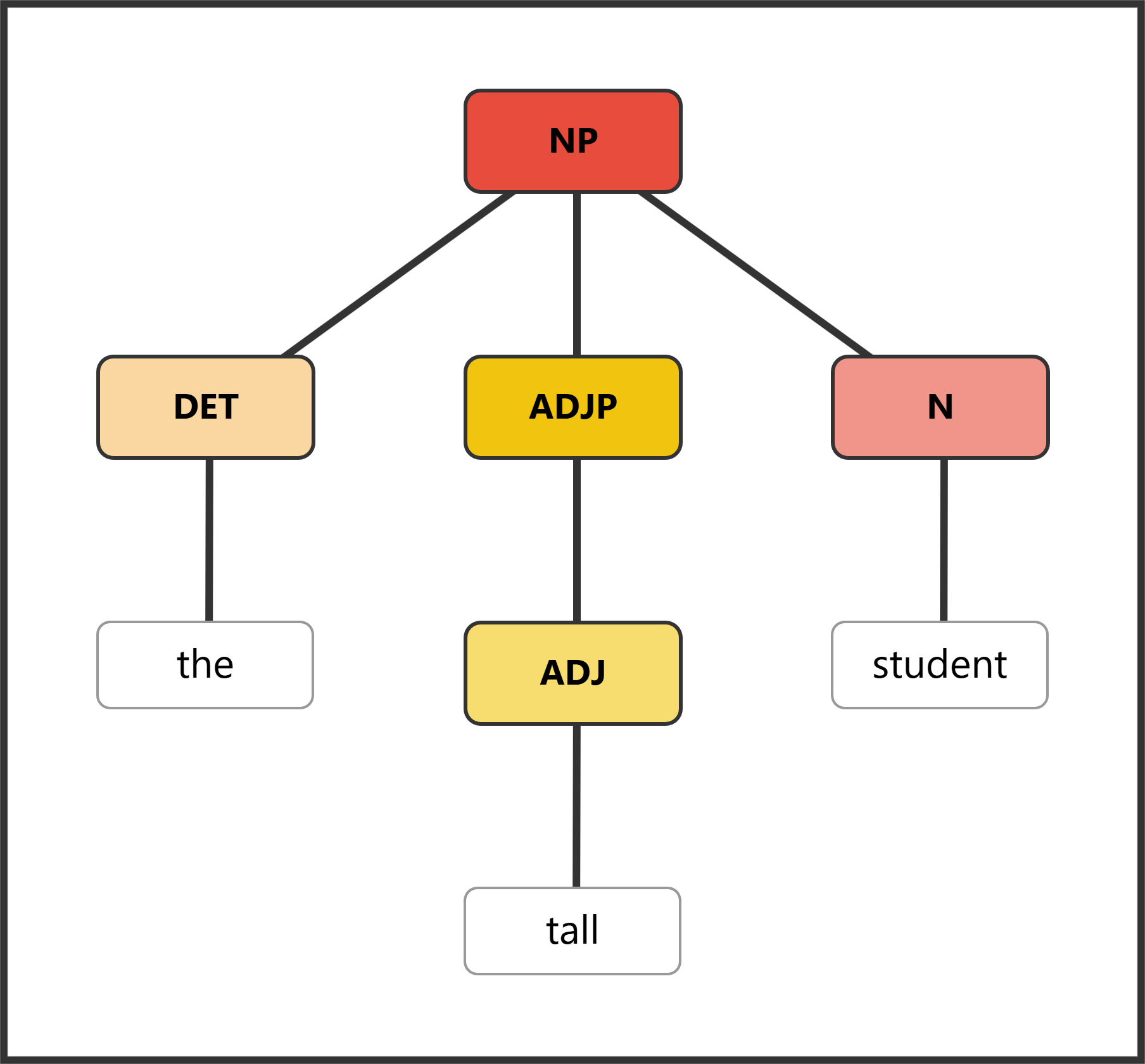
[NP [DET the] [ADJP [ADJ tall]] [N student]]
The tree shows that “the”, “tall”, and “student” combine to form a single NP. The head noun “student” determines the phrase type; the determiner and adjective are its pre-modifiers.
A more complex noun phrase adds a post-modifier:
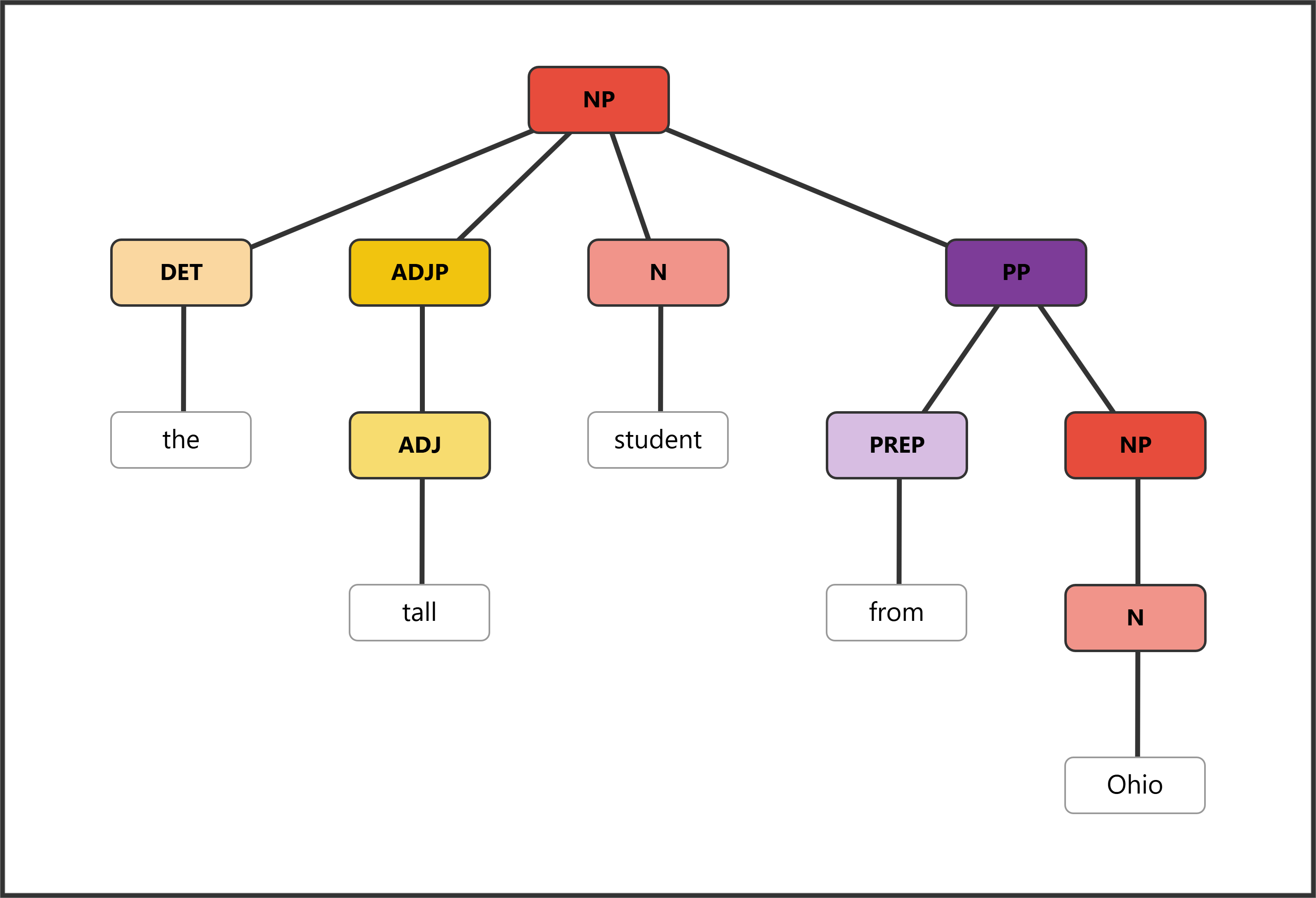
[NP [DET the] [ADJP [ADJ tall]] [N student] [PP [PREP from] [NP [N Ohio]]]]
Notice that the post-modifier “from Ohio” is itself a phrase—a prepositional phrase (PP) containing its own NP. Phrases can nest inside other phrases, creating hierarchical structures.
Identifying the Head.
When you encounter a phrase, use this process to identify its head:
-
Ask: "Which word is essential—which word cannot be removed?"
-
Confirm: "What part of speech is that word?"
-
Label the phrase accordingly (NP if noun, VP if verb, etc.)
Let’s practice:
“extremely proud of her achievement”
-
Remove extremely: proud of her achievement (still works)
-
Remove of her achievement: extremely proud (still works)
-
Remove proud: extremely of her achievement (broken)
The head is “proud”, an adjective. This is an adjective phrase (AdjP).
“very quickly”
-
Remove very: quickly (still works)
-
Remove quickly: very (incomplete)
The head is “quickly”, an adverb. This is an adverb phrase (AdvP).
Why Phrase Structure Matters.
Understanding phrases helps you:
-
Analyze sentence structure. Sentences are built from phrases, and phrases from smaller phrases. Seeing these building blocks clarifies how sentences work.
-
Identify grammatical functions. Phrases, not just words, perform grammatical roles. The phrase “the tall student from Ohio” serves as a subject—not just the word “student”.
-
Understand ambiguity. Many ambiguous sentences can be explained through different possible phrase structures.
-
Write more effectively. When you can see the structure of your sentences, you can vary and control them more deliberately.
In the following sections, we’ll examine each word class in detail. For each class, we’ll begin by exploring how it forms phrases, then present the tests for identifying it.

