Section 9.5 Simple Sentences
A simple sentence contains one independent clause—a subject-predicate unit that expresses a complete thought.
The simple sentence is the grammatical baseline. Now that we have examined how phrases and clauses differ, and how conjunctions can join phrases within a single clause, we can define the simple sentence precisely. An independent clause contains a subject and a finite verb and does not begin with any word that would subordinate it to another clause. It stands on its own. Everything that follows in this chapter involves either joining two independent clauses (compounding) or embedding a dependent clause within or beside an independent one (subordination). The simple sentence is the starting point for all of it.
The labeling table and tree diagram below show the structure of a simple sentence — The students studied:
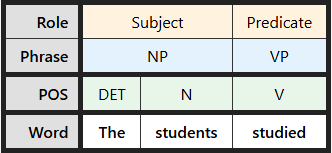
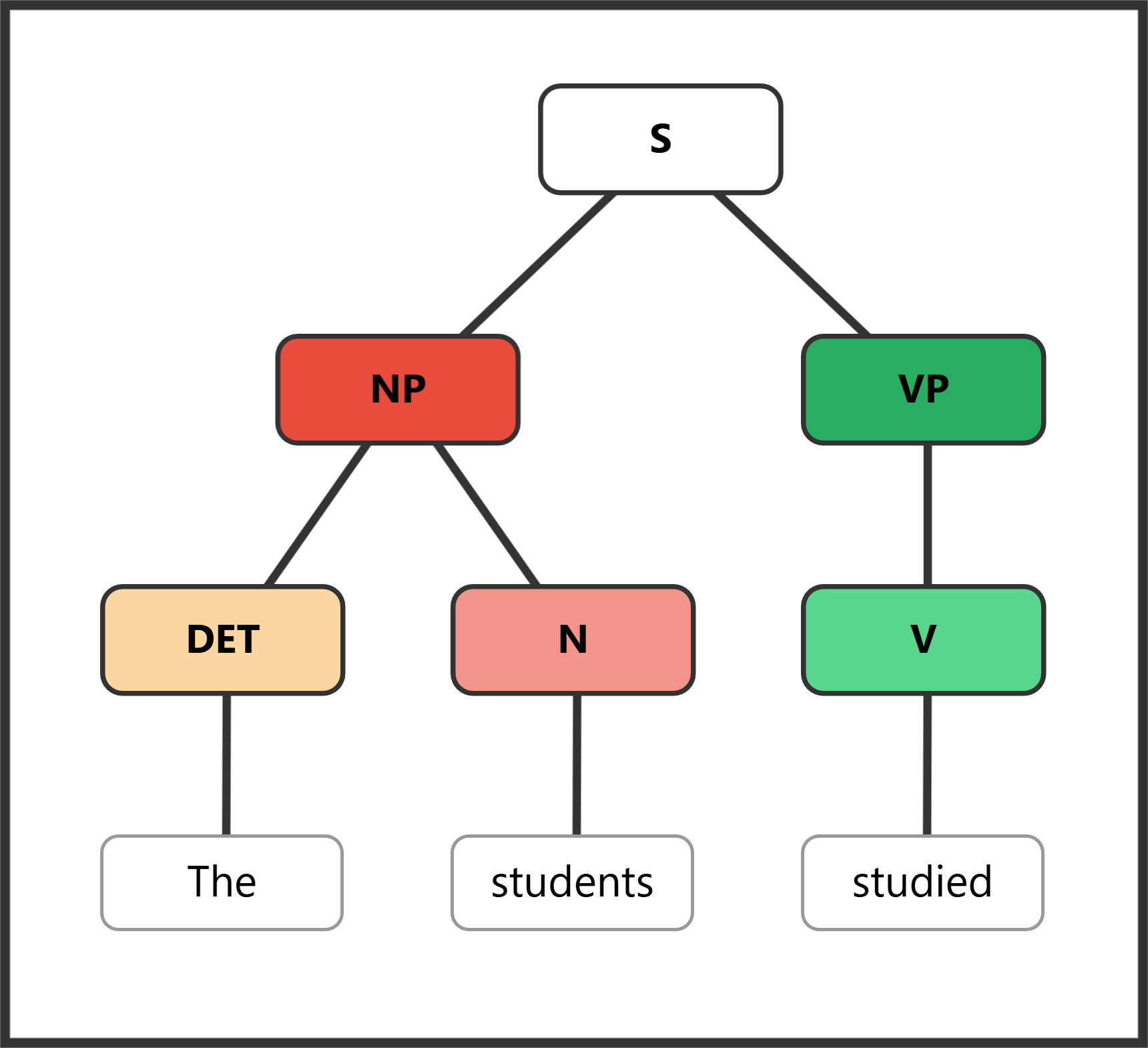
[S [NP [DET The] [N students]] [VP [V studied]]]
The key word is independent. An independent clause can stand alone as a grammatically complete sentence: it has a subject, a predicate, and it does not begin with a subordinating word that would make it lean on something else for completion. Compare The students studied (independent—complete on its own) with when the students studied (dependent—waiting for a main clause to complete it). That small grammatical change—adding when—removes the clause’s independence entirely. The distinction between independent and dependent clauses is the organizing principle of this chapter; every sentence type we examine is defined by how many of each it contains.
A simple sentence, then, is defined not by its length but by its clause count: exactly one independent clause, no matter how elaborate that clause might be.
“The students studied.”
“My neighbor’s talented daughter won the competition last week.”
Simple sentences can be long if they have compound subjects, compound predicates, or extensive modification:
-
Compound subject: “Marcus and Elena traveled to Spain.” (still simple—one predicate)
-
Compound predicate: The dog barked and chased the squirrel. (still simple—one subject)
-
Heavy modification: The exhausted marathon runner from Kenya collapsed at the finish line. (still simple—one clause)

