Section 14.5 Pronoun Nominals
Pronouns are the most compact nominals—single words that replace entire noun phrases. Chapter 6 covered pronouns as a form class. Here the focus is on their nominal function: pronouns fill the same argument positions as full NPs, but they carry information about person, number, gender, and case in a single word.
Case and Position.
English pronouns change form based on their nominal position (case):
| Position | Case | Example |
|---|---|---|
| Subject | Subjective (I, she, he, they) | She arrived. |
| Direct/Indirect Object | Objective (me, her, him, them) | I saw her. |
| Object of Preposition | Objective | He spoke to them. |
| Subject Complement | Subjective (formal) or Objective (informal) | It is I. / It’s me. |
| Possessive | Possessive (my/mine, her/hers) | Her book / The book is hers. |
Key Points.
-
Pronouns are the only English nominals that change form based on their syntactic position (case marking).
-
In formal usage, subject complements take subjective case: It is I. In informal speech, objective case is standard: It’s me.
-
See Chapter 6 for the full pronoun classification (personal, demonstrative, indefinite, relative, interrogative, reflexive).
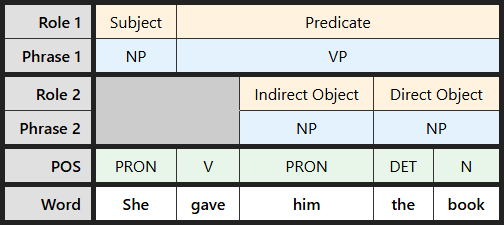
Labeling Table: She gave him the book.
The sentence She gave him the book packs three nominals into a single short clause—a subject pronoun, an indirect object pronoun, and a direct object noun phrase. The labeling table below makes this triple visible:
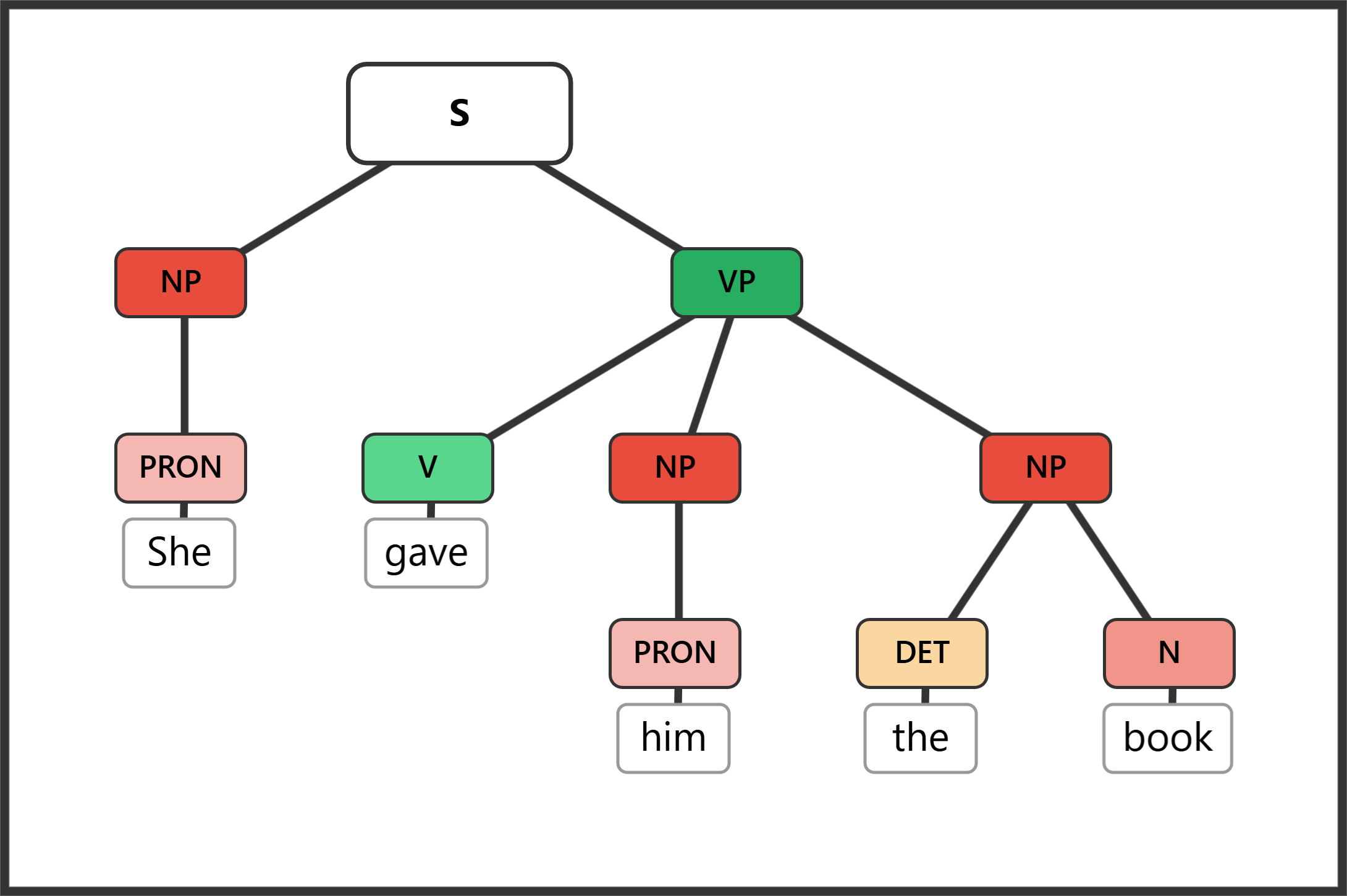
[S [NP [PRON She]] [VP [V gave] [NP [PRON him]] [NP [DET the] [N book]]]]
Notice that all three nominals are NPs at the phrase level even though one of them is a single pronoun and another is a determiner-plus-noun. Position—not internal complexity—is what makes each nominal what it is. Notice too the case shift: she in subject position and him in object position are the same person, but English requires different forms.

