Section 13.13 Homework: Adjectivals
Subsection 13.13.1 Identification and Classification
| Adjectival Forms | Example |
|---|---|
| Adjective Phrase (ADJP) | the tall man, very interesting |
| Noun Adjectival | the coffee table, government report |
| Prepositional Phrase (PP) | the book on the shelf |
| Relative Clause (RC) | the student who won |
| Participial Phrase (VP) | the woman singing, the report written |
| Infinitive Phrase (VP) | a book to read |
Instructions.
For each sentence, identify the underlined adjectival and classify its form (adjective phrase, prepositional phrase, relative clause, participial phrase, infinitive phrase, or noun).
Example (completed).
The extremely talented musician performed last night.
-
Form: adjective phrase
-
Modifies: musician
Exercises.
Exercise 1. The book on the top shelf belongs to my professor.
Form:
Modifies:
Exercise 2. The woman who won the award gave an inspiring speech.
Form:
Modifies:
Exercise 3. The broken window needs to be repaired immediately.
Form:
Modifies:
Exercise 4. I need something to eat before the meeting.
Form:
Modifies:
Exercise 5. The government report was released yesterday.
Form:
Modifies:
Exercise 6. The students waiting in line seemed impatient.
Form:
Modifies:
Exercise 7. We found a very comfortable chair at the antique store.
Form:
Modifies:
Subsection 13.13.2 Restrictive vs. Non-Restrictive
Instructions.
The commas have been removed from the following sentences. For each, determine whether the modifier is restrictive (R) or non-restrictive (NR), explain your reasoning, and rewrite the sentence with correct punctuation if needed.
Example (completed).
My sister who lives in Portland is visiting next week.
-
Type: Non-restrictive (NR)
-
Reasoning: The speaker has only one sister, so the clause adds extra information rather than identifying which sister.
-
Rewrite: My sister, who lives in Portland, is visiting next week.
Exercises.
Exercise 8. The students who completed the extra assignment received bonus points.
Type:
Reasoning:
Rewrite:
Exercise 9. The Eiffel Tower which was built in 1889 attracts millions of visitors.
Type:
Reasoning:
Rewrite:
Exercise 10. The car that I bought last year already needs repairs.
Type:
Reasoning:
Rewrite:
Exercise 11. Professor Adams who teaches linguistics won a research award.
Type:
Reasoning:
Rewrite:
Subsection 13.13.3 Sentence Combining
Instructions.
Combine each pair of sentences using a relative clause or participial phrase.
Example (completed).
Sentences: I met a professor. She specializes in linguistics.
Combined (relative clause): I met a professor who specializes in linguistics.
Exercises.
Exercise 12. Combine with a relative clause: This is the book. I told you about it.
Exercise 13. Combine with a relative clause: The scientist won a Nobel Prize. Her research changed medicine.
Exercise 14. Combine with a participial phrase: The students were exhausted from the exam. They went home early.
Exercise 15. Combine with a participial phrase: The letter was written in 1945. The letter was found in the attic.
Subsection 13.13.4 Diagramming Adjectivals
Instructions.
For each sentence, complete the labeling table (Role, Phrase, Word, POS), write the bracket notation, and draw a tree diagram. Pay special attention to adjectival elements: relative clauses (RC), adjective phrases (ADJP), and prepositional phrases (PP) modifying nouns.
Exercises.
Exercise 16. The student who won the award celebrated.
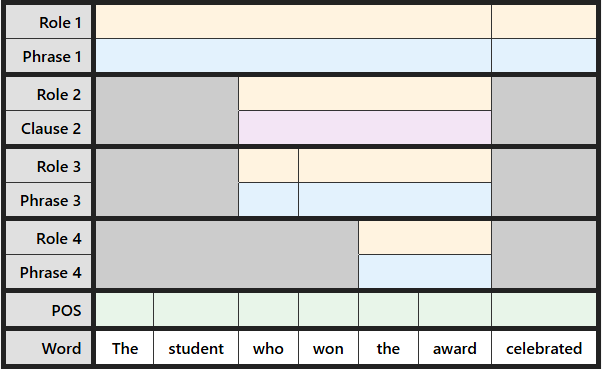
-
Bracket notation: _____
-
Diagram:
Exercise 17. The students selected for the team celebrated.
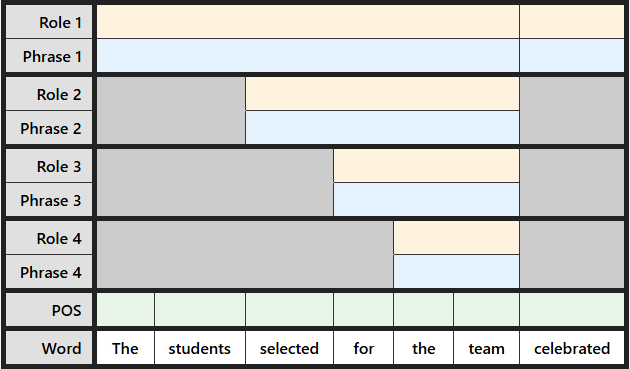
-
Bracket notation: _____
-
Diagram:
Exercise 18. The team has a plan to win the tournament.
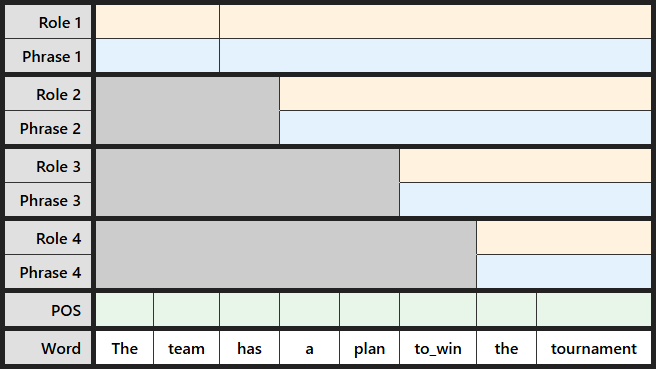
-
Bracket notation: _____
-
Diagram:
Exercise 19. Running water flowed through the pipe.
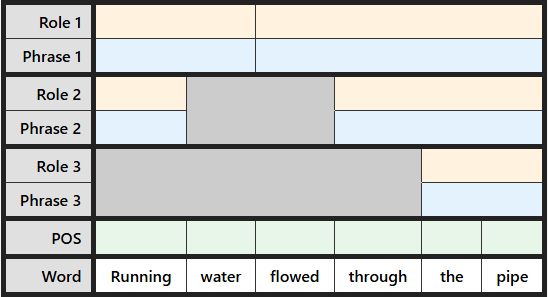
-
Bracket notation: _____
-
Diagram:
Exercise 20. The woman wearing the red coat smiled.
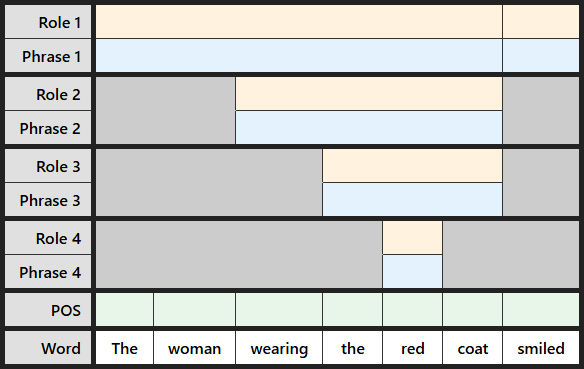
-
Bracket notation: _____
-
Diagram:
Subsection 13.13.5 Error Correction and Analysis
Instructions.
Read the sentences and answer the questions.
Dangling Participle Correction.
Exercises.
Exercise 21. Correct each dangling participle by rewriting the sentence:
a) Walking through the park, the flowers were beautiful.
Corrected:
b) Having finished the report, the computer was shut down.
Corrected:
c) Exhausted from the journey, the bed looked inviting.
Corrected:
Meaning Analysis.
Exercise 22. Explain the difference in meaning between these two sentences. What does each sentence imply about how many brothers the speaker has?
a) My brother who lives in Chicago is a doctor.
b) My brother, who lives in Chicago, is a doctor.
Sentence (a) implies:
Sentence (b) implies:
Total estimated time: 40 minutes

