Section 6.2 Determiners
Determiners introduce noun phrases and help specify reference—they help listeners identify which entity or entities the speaker means.
Determiners as Reference-Setting Words.
Think of a noun like “dog” as naming a general concept—the category of all dogs. By itself, “dog” is abstract and unanchored. It doesn’t tell us which dog, how many dogs, or whose dog. Determiners are the words that take this general noun concept and pin it down to something specific. They are reference-setting words: they establish the link between a word and the particular entity (or entities) the speaker has in mind.
Determiners do several kinds of semantic work. They signal definiteness—whether the listener should already know the referent “the” or is hearing about it for the first time “a”. They indicate quantity—how many entities are involved (some, many, every, three). They mark possession—who the entity belongs to or is associated with (my, their, the professor’s). And they express proximity—whether the entity is near or far from the speaker (this, that).
Without determiners, listeners cannot tell which entity the speaker means or how many are involved. Consider how dramatically the meaning changes when we put different determiners before the same noun:
-
Dog barked.(ungrammatical in standard English—which dog? how many?) -
The dog barked. (a specific, identifiable dog—the listener knows which one)
-
A dog barked. (some dog, not previously identified—introducing a new referent)
-
My dog barked. (the dog belonging to the speaker)
-
Every dog barked. (all dogs in the relevant group, without exception)
-
That dog barked. (a specific dog at some distance from the speaker)
The noun “dog” stays the same in every sentence, but the determiner transforms the meaning entirely. This is a remarkable amount of work for such small words. Determiners carry minimal content meaning on their own—you cannot picture “the” or “a” or “every”—but they do essential grammatical work. They are the words that turn a bare concept into something a listener can locate in the real world.
What Determiners Do.
When you hear “I saw a dog,” the determiner “a” signals that the dog is being introduced for the first time (indefinite reference). When you hear “I saw the dog,” “the” signals that you should already know which dog (definite reference).
Determiners answer questions like:
-
Which one? (the, this, that)
-
How many? (three, several, many)
-
Whose? (my, the professor’s)
-
Which subset? (some, any, every, no)
Types of Determiners.
Articles—the most common determiners:
-
Definite article the: The referent is identifiable to the listener
-
Indefinite articles (a, an): The referent is being introduced or is unspecified
Demonstratives—point to specific entities:
-
Near: this, these (close to speaker)
-
Far: that, those (farther from speaker)
Possessives—indicate ownership or relationship:
-
Pronoun forms: my, your, his, her, its, our, their
-
Noun + ’s: John’s, the dog’s, my sister’s
Quantifiers—indicate amount or quantity:
-
Universal: all, every, each, both
-
Existential: some, any, no
-
Degree: many, much, few, little, several, enough
Numbers:
-
Cardinal: one, two, three...
-
Ordinal: first, second, third...
Interrogative/Relative: which, what, whose
Determiner Position.
Determiners occupy a specific position in the noun phrase—they come first, before any adjectives. This consistent position makes them easy to identify:
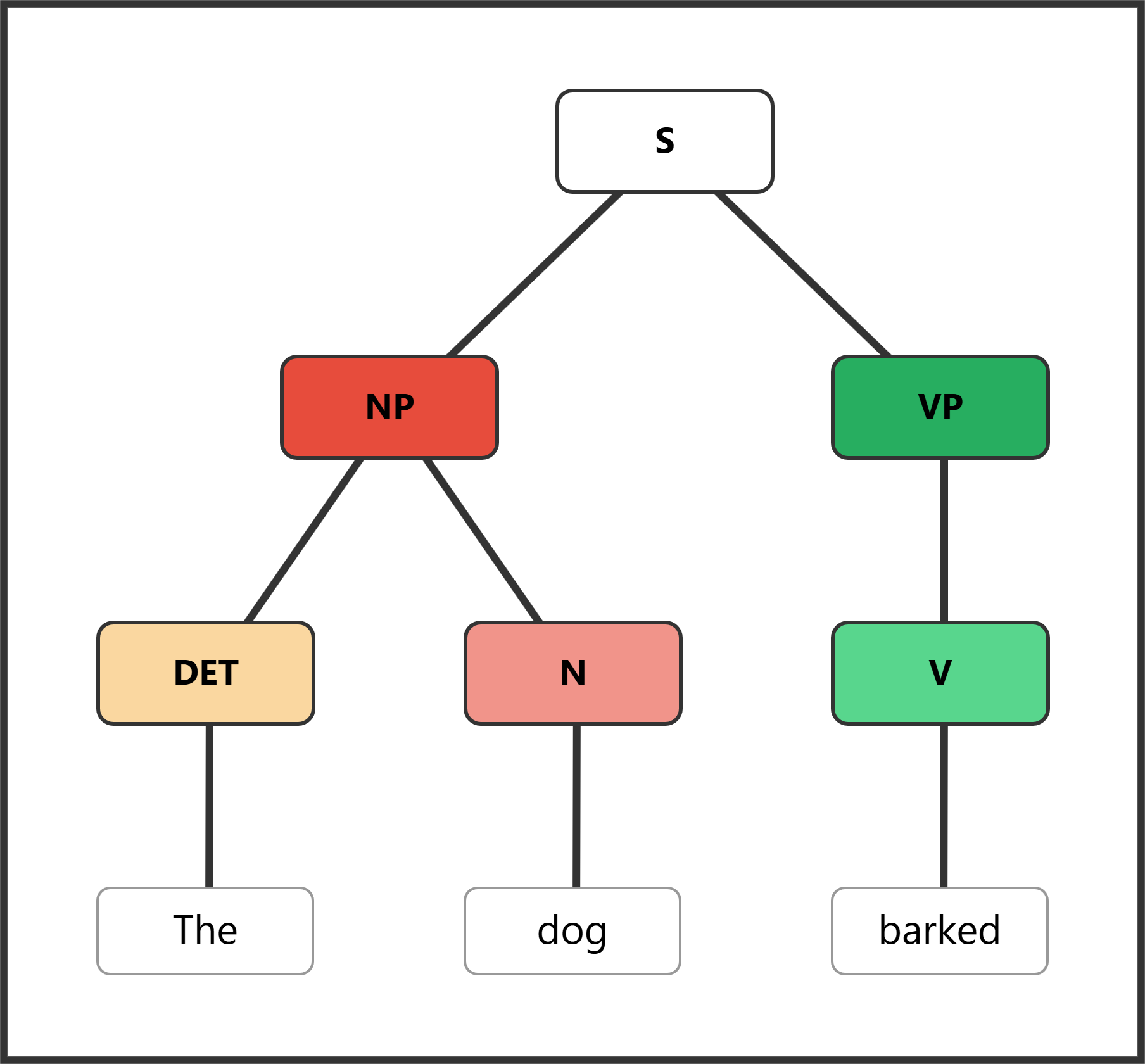
[NP [DET the] [N dog]]
Determiner position in the noun phrase.
The pattern is consistent: Det + (Adj) + N
-
the big dog
-
my old friend
-
some fresh bread
Important: Most determiners are mutually exclusive—you cannot stack them:
-
the my book -
this the student -
a every dog
Nouns usually take just one determiner. However, in some cases two determiners can appear together in the same noun phrase:
-
all the students (two determiners: all + the)
-
both my parents (two determiners: both + my)
-
the first three chapters (article + ordinal + cardinal)
Words like “all” and “both” are the most common determiners that can combine with another determiner. A tree diagram shows how both determiners appear within the noun phrase:
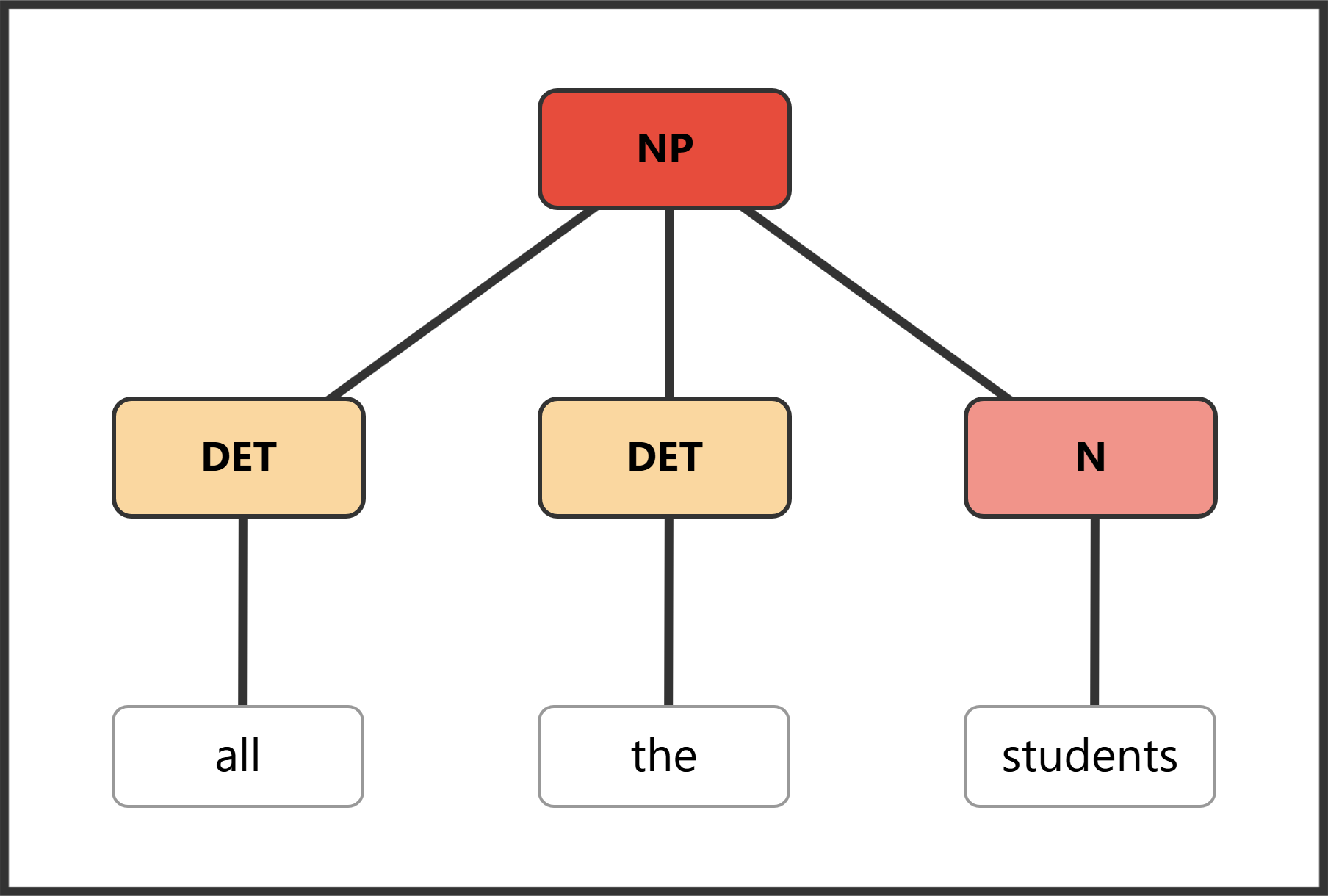
[NP [DET all] [DET the] [N students]]
A noun phrase with two determiners.
Determiners vs. Adjectives.
Determiners and adjectives both appear before nouns, but they differ systematically:
| Feature | Determiners | Adjectives |
|---|---|---|
| Class membership | Closed | Open |
| Position | First (before adjectives) | After determiners |
| Function | Specify reference | Describe qualities |
| Stacking | Limited combinations | Multiple allowed |
| Obligatoriness | Often required | Always optional |
| Gradable | Usually not |
Usually yes very tall |
Compare:
-
The is required for singular count nouns in many contexts:
Book is on table. -
Interesting is always optional: The book is on the table.
How to Tell Determiners from Adjectives.
Because determiners and adjectives both appear before nouns, students sometimes confuse them. Two simple tests reliably distinguish the two categories.
Test 1: Adjectives are gradable—determiners are not. You can modify adjectives with degree words like “very”, “extremely”, and “rather”. You cannot do this with determiners. If a word before a noun can be modified by “very”, it is an adjective, not a determiner:
-
very tall ✓ — tall is an adjective
-
extremely happy ✓ — happy is an adjective
-
rather old ✓ — old is an adjective
-
very the✗ — the is a determiner -
extremely my✗ — my is a determiner -
very this✗ — this is a determiner -
rather every✗ — every is a determiner
This test works because adjectives describe qualities that exist on a scale (tall, taller, tallest), while determiners set reference and have no scale to intensify.
Test 2: Determiners always come before adjectives in a noun phrase. The word order within a noun phrase is fixed: Det + Adj + N. If a word must appear first—before any adjectives—it is a determiner:
-
the tall man ✓ — not
tall the man -
my old friend ✓ — not
old my friend -
some fresh bread ✓ — not
fresh some bread -
every single student ✓ — not
single every student
Notice that you can stack multiple adjectives between the determiner and the noun “the tall, friendly, old man”, but the determiner must always come first. If you find yourself unable to move a word after an adjective—if it insists on occupying the first position—that word is a determiner.
Using both tests together provides a reliable method. If a pre-noun word is not gradable with “very” and must come before all adjectives, it is a determiner. If it is gradable and can follow a determiner, it is an adjective.
Count vs. Mass Nouns and Determiners.
Determiner choice interacts with whether a noun is count (discrete entities) or mass (undifferentiated substance):
| Determiner | Count Singular | Count Plural | Mass |
|---|---|---|---|
| a/an | ✓ a book | ✗ | ✗ |
| the | ✓ the book | ✓ the books | ✓ the water |
| this/that | ✓ this book | ✗ | ✓ this water |
| these/those | ✗ | ✓ these books | ✗ |
| some | ✗ | ✓ some books | ✓ some water |
| many | ✗ | ✓ many books | ✗ |
| much | ✗ | ✗ | ✓ much water |
These patterns are systematic—native speakers follow them automatically.
Determiners or Pronouns?
Some words can be either a determiner or a pronoun depending on how they are used in a sentence. For example, possessive forms like “her” and “his”, and demonstratives like “this” and “that”, can appear as determiners (before a noun) or as standalone pronouns. See section 6.3 on pronouns for more details on how these overlapping forms work.

