Section 13.9 Infinitive Phrase Adjectivals
In Chapter 12 you saw infinitive phrases functioning as adverbials of purpose (She came to help). In Chapter 14 you will see them as nominals (subjects and objects). Here the focus is on their adjectival use. When an infinitive phrase appears after a noun and modifies it—answering the question which one? or what kind?—it is functioning as an adjectival. This is a common pattern, especially with abstract nouns and indefinite pronouns.
Formation.
Adjectival infinitive phrase = to + base verb + (complements/modifiers). The infinitive phrase follows the noun it modifies:
-
a book to read (which book?)
-
the decision to leave (which decision?)
-
something to eat (which thing?)
-
the first person to arrive (which person?)
-
a place to stay (which place?)
-
the ability to learn (which ability?)
Common Patterns.
Adjectival infinitives appear most often with:
-
Abstract nouns: the decision to resign, the need to act, the right to vote, the ability to adapt
-
Indefinite pronouns: something to eat, nothing to fear, someone to trust
-
Ordinals and superlatives: the first person to arrive, the best way to learn
Adjectival vs. Adverbial Infinitives.
How do you tell an adjectival infinitive from an adverbial one? The test is the same as for PPs: does it modify a noun or a verb?
-
She has a book to read. — to read modifies book (which book?) → adjectival
-
She came to read. — to read modifies came (why did she come?) → adverbial
Labeling Table.
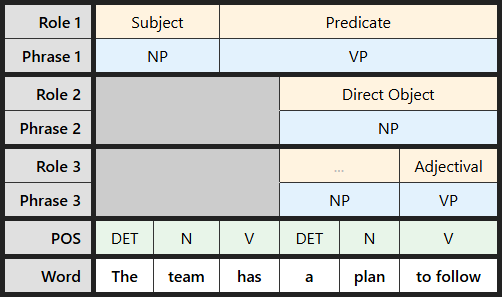
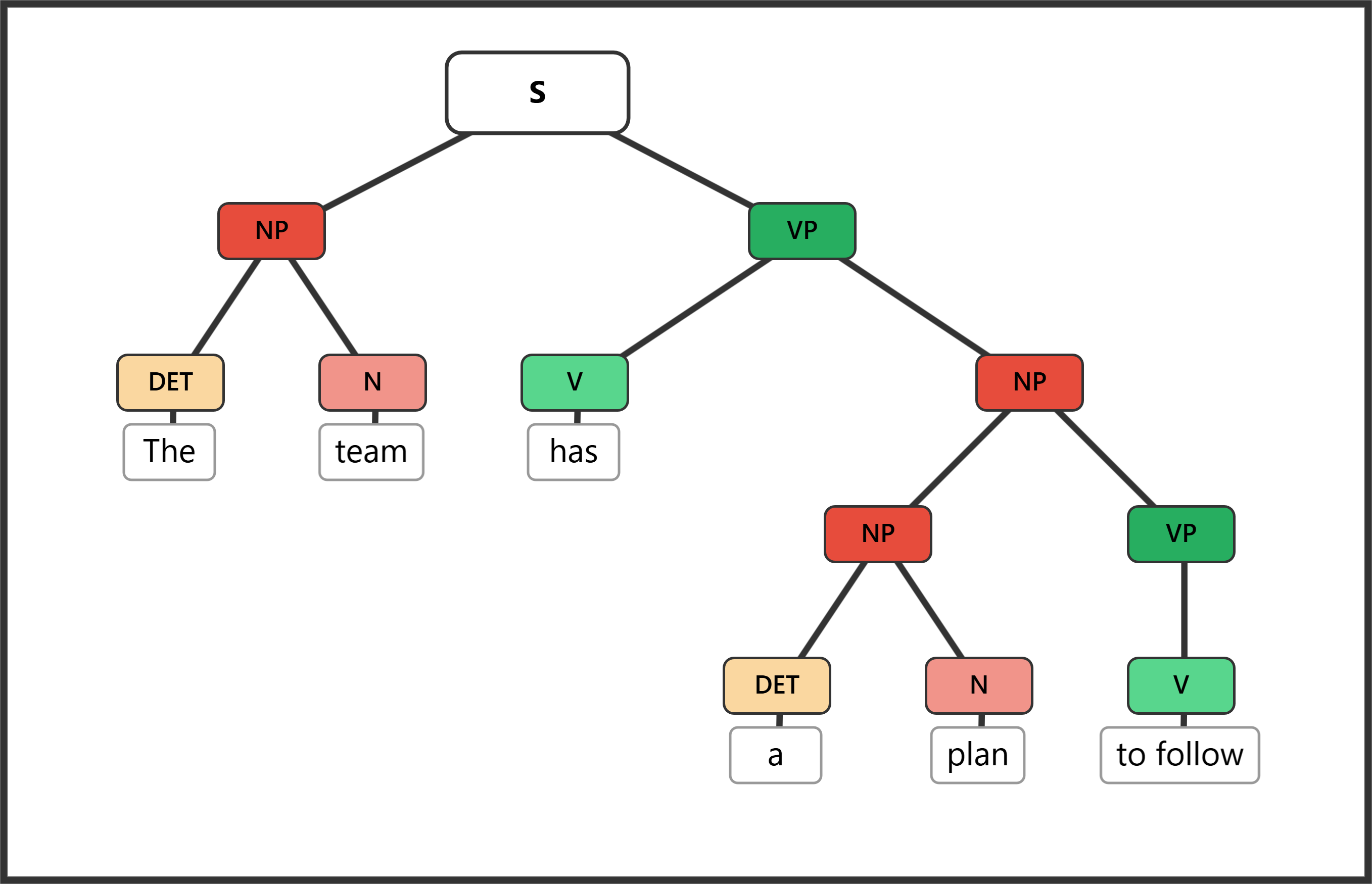
[S [NP [DET The] [N team]] [VP [V has] [NP [NP [DET a] [N plan]] [VP [V to follow]]]]]
The infinitive phrase to follow modifies the noun plan—it tells us which kind of plan, not why the team has it.
Key Points.
-
Adjectival infinitives always follow the noun they modify (post-modification).
-
They are especially common with abstract nouns, indefinite pronouns, and ordinals/superlatives.
-
The same infinitive form can be adjectival, adverbial, or nominal depending on context—always check what it modifies.
-
In diagrams, the infinitive phrase nests inside the NP it modifies.

