Section 14.6 Present Participle Phrase Nominals (Gerunds)
A present participle is the -ing form of a verb. Present participle phrases can fill several functions across English: in Chapter 12 you saw them as adverbials (Walking home, she thought about her day); in Chapter 13 you saw them as adjectivals (the running water); here the focus is on their nominal use—when a present participle phrase fills a subject, object, or complement position. When a present participle phrase functions nominally, it is traditionally called a gerund phrase; we use both names, but treat present participle phrase as the primary term so that one form name covers all three functions.
Because present participle phrases retain their verbal character, they can take their own objects and modifiers, which means a present participle phrase can be quite long even though it fills a single argument slot.
Formation.
A nominal present participle phrase consists of the -ing form plus any complements and modifiers:
Present Participle Phrase = (Possessive) + -ing Verb + (Complements/Modifiers)
-
Swimming is fun. (simple)
-
Swimming laps is good exercise. (with direct object)
-
His swimming improved. (with possessive)
-
Their constantly complaining annoys everyone. (with possessive and adverbial modifier)
Functions.
As subject:
-
Running marathons requires dedication.
-
Finishing on time seemed impossible.
As direct object:
-
She enjoys cooking elaborate meals.
-
He avoided making promises.
As object of preposition:
-
She succeeded by working hard.
-
He’s interested in learning languages.
As subject complement:
-
His favorite activity is reading.
-
The challenge was convincing the board.
Possessive Before a Nominal Present Participle.
Formal usage prefers a possessive form before a nominal present participle (the older grammar tradition calls this the possessive-with-gerund rule):
-
I appreciated his helping us. (formal)
-
I appreciated him helping us. (informal)
Both are acceptable in modern English, though the possessive is preferred in formal writing.
Labeling Table: Running every morning is healthy.
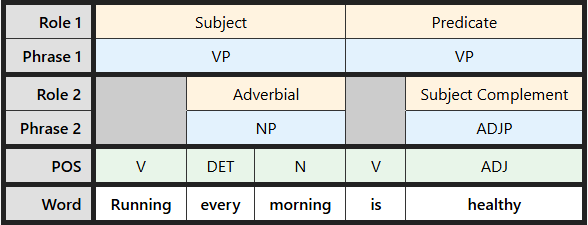
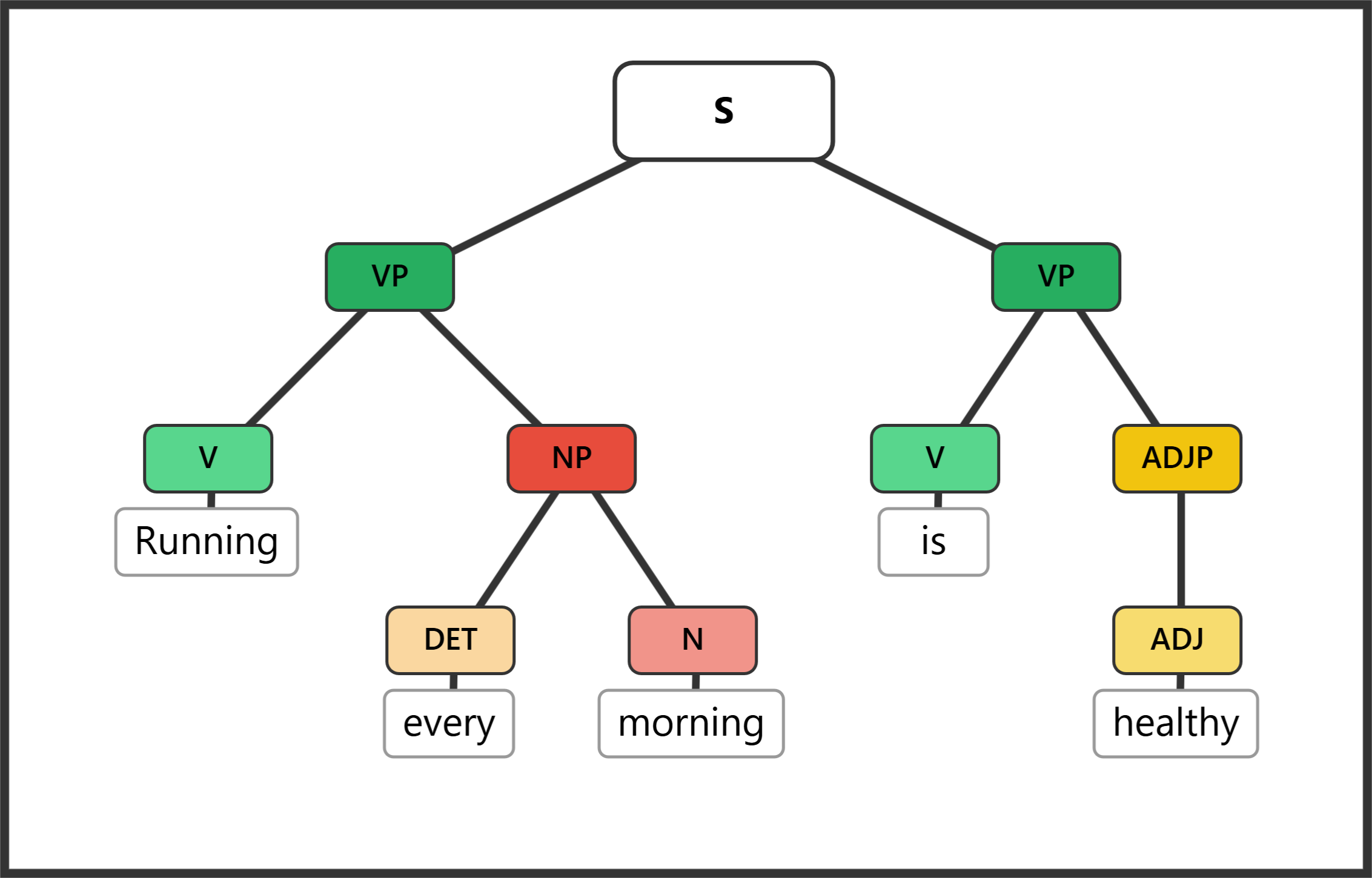
[S [VP [V Running] [NP [DET every] [N morning]]] [VP [V is] [ADJP [ADJ healthy]]]]
The present participle phrase Running every morning fills the subject slot—a position normally occupied by a noun phrase. Its form is verbal (a VP headed by an -ing verb), but its function is nominal.
Key Points.
-
The same -ing form serves three functions across English: adverbial (Chapter 12), adjectival (Chapter 13), and nominal (this chapter). When a present participle phrase functions nominally, it is also called a gerund phrase.
-
Nominal present participle phrases can fill subject, direct object, indirect object, object of preposition, and subject complement positions—including object of preposition, which infinitive phrases cannot fill.
-
In diagrams, the form is a VP headed by an -ing verb. The nominal function is expressed by the role label, not by a special phrase node.

