Section 11.7 Defining and Identifying Voice
Every transitive verb involves at least two participants: someone who performs the action and someone or something that receives it. In earlier chapters you learned to call these the subject and the direct object, but those are grammatical roles—labels for positions in a sentence. The same participants can be arranged differently. The dog bit the man puts the doer first. The man was bitten by the dog rearranges things so the receiver comes first. The event is identical; the framing is not. That rearrangement is what voice describes.
Semantic Roles: Actor and Patient.
To talk about voice precisely, you need two terms that describe participants by what they do in the event, not by where they appear in the sentence:
-
The actor is the entity that performs or initiates the action.
-
The patient is the entity that is affected by or undergoes the action.
In The dog bit the man, the dog is the actor (it does the biting) and the man is the patient (he receives the bite). These semantic roles stay the same regardless of how the sentence is structured. What changes between active and passive voice is which semantic role fills the grammatical subject position.
Active Voice.
In active voice, the actor occupies the subject position. This is the default, unmarked voice in English—the one speakers use unless they have a reason to do otherwise:
-
The dog bit the man. (actor = subject)
-
Maria wrote the report. (actor = subject)
-
Someone stole my bicycle. (actor = subject)
-
The committee reviewed the proposal. (actor = subject)
-
Lightning struck the old oak tree. (actor = subject)
The pattern is straightforward: actor (doer) appears as the subject, the verb follows, and the patient (receiver) appears as the direct object.
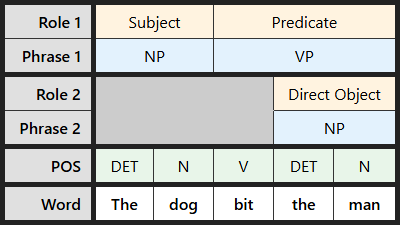
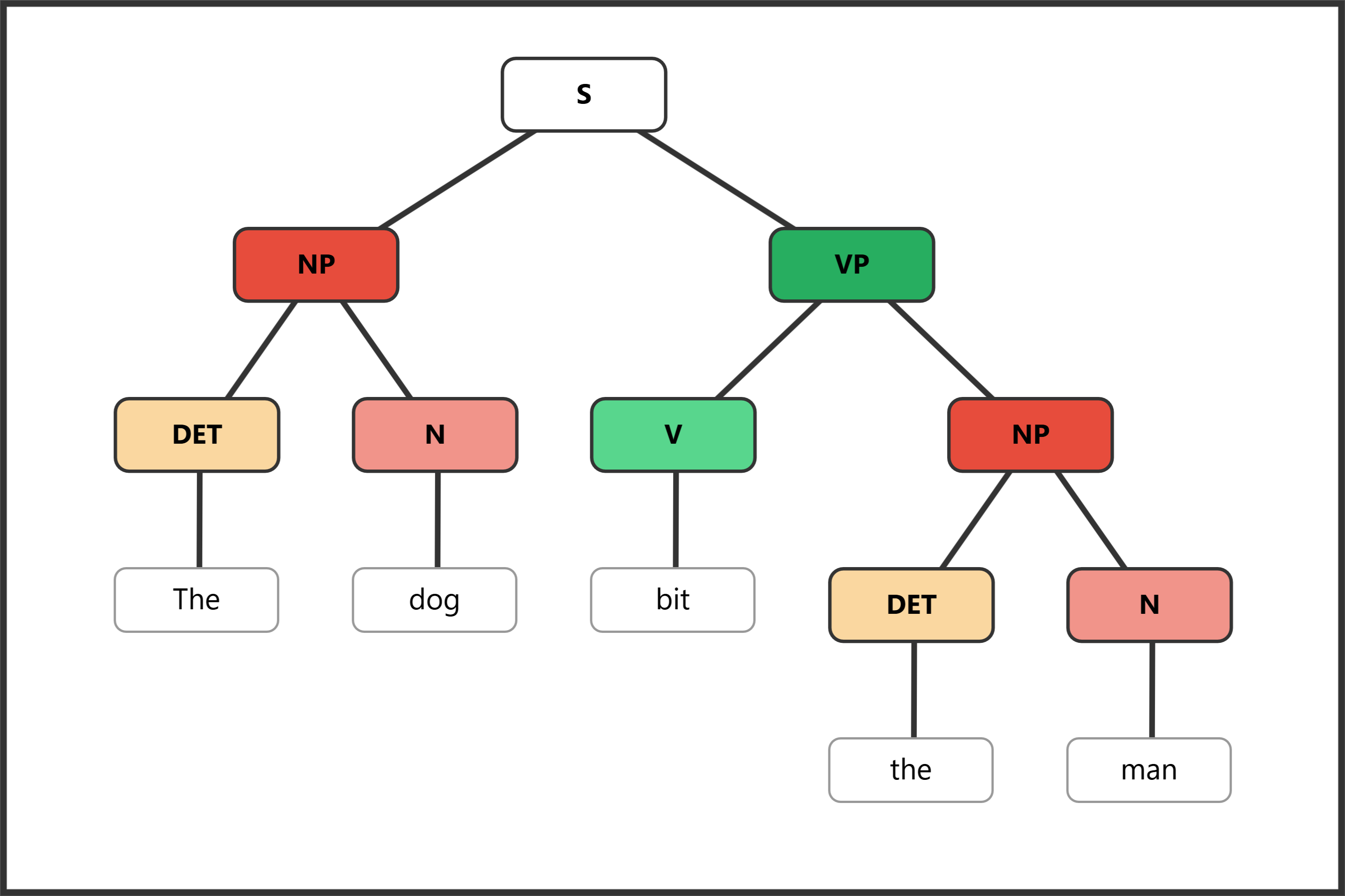
[S [NP [DET The] [N dog]] [VP [V bit] [NP [DET the] [N man]]]]
Passive Voice.
In passive voice, the patient occupies the subject position. The actor may appear in a by-phrase after the verb, or it may be omitted entirely:
-
The man was bitten by the dog. (patient = subject, actor in by-phrase)
-
The report was written by Maria. (patient = subject, actor in by-phrase)
-
My bicycle was stolen. (patient = subject, actor omitted)
-
The proposal was reviewed by the committee. (patient = subject, actor in by-phrase)
-
The old oak tree was struck by lightning. (patient = subject, actor in by-phrase)
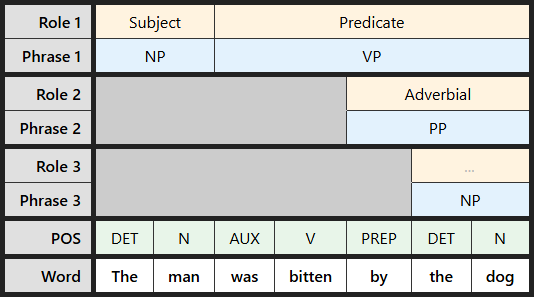
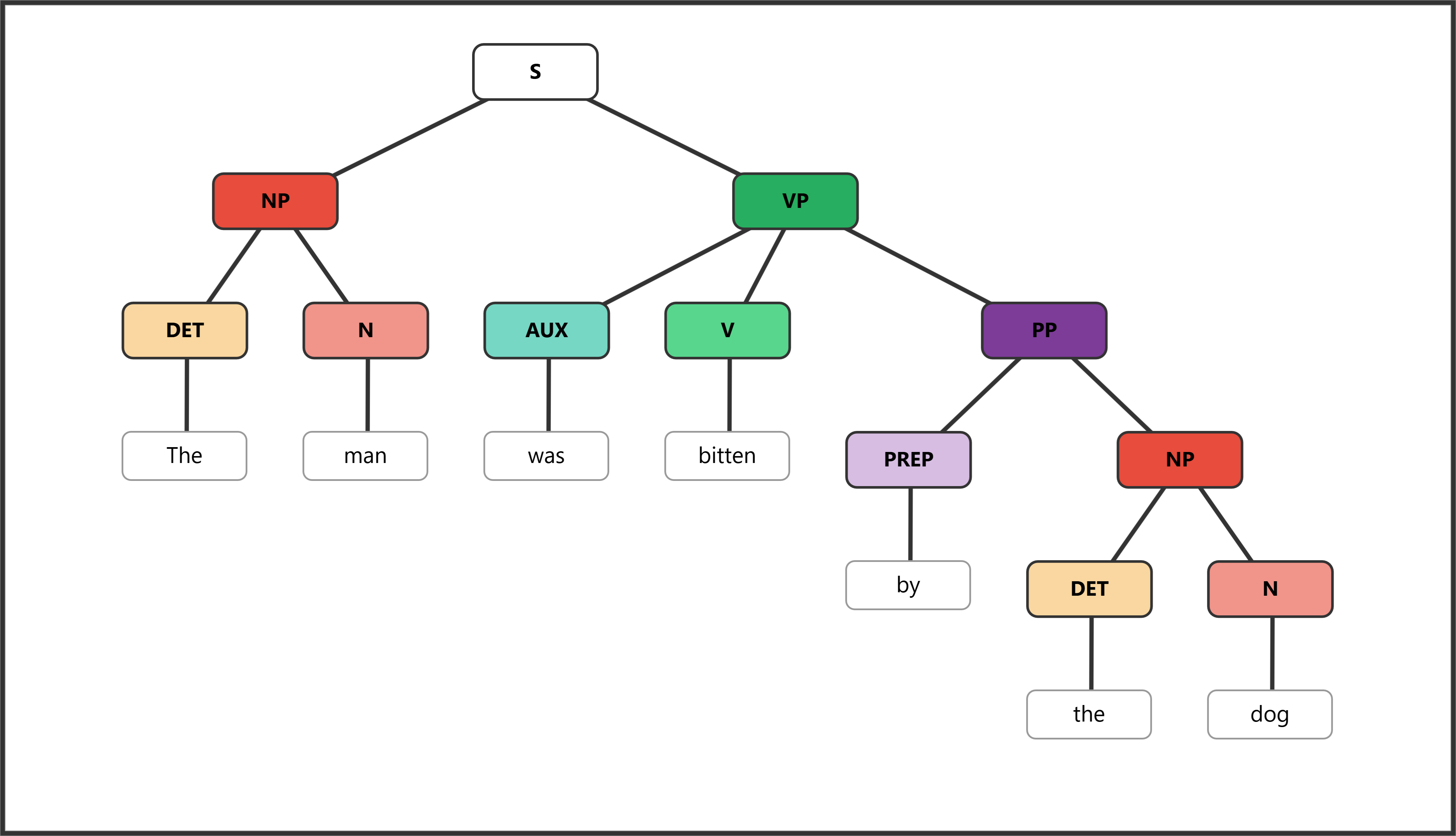
[S [NP [DET The] [N man]] [VP [AUX was] [V bitten] [PP [PREP by] [NP [DET the] [N dog]]]]]
The by-phrase is optional—the writer can include it or leave it out. When the actor is omitted, the passive is called an actorless passive or short passive. This is actually the more common form—most passive sentences in English do not include a by-phrase:
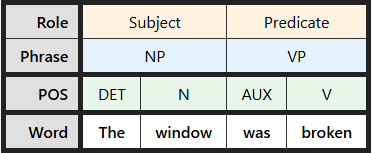
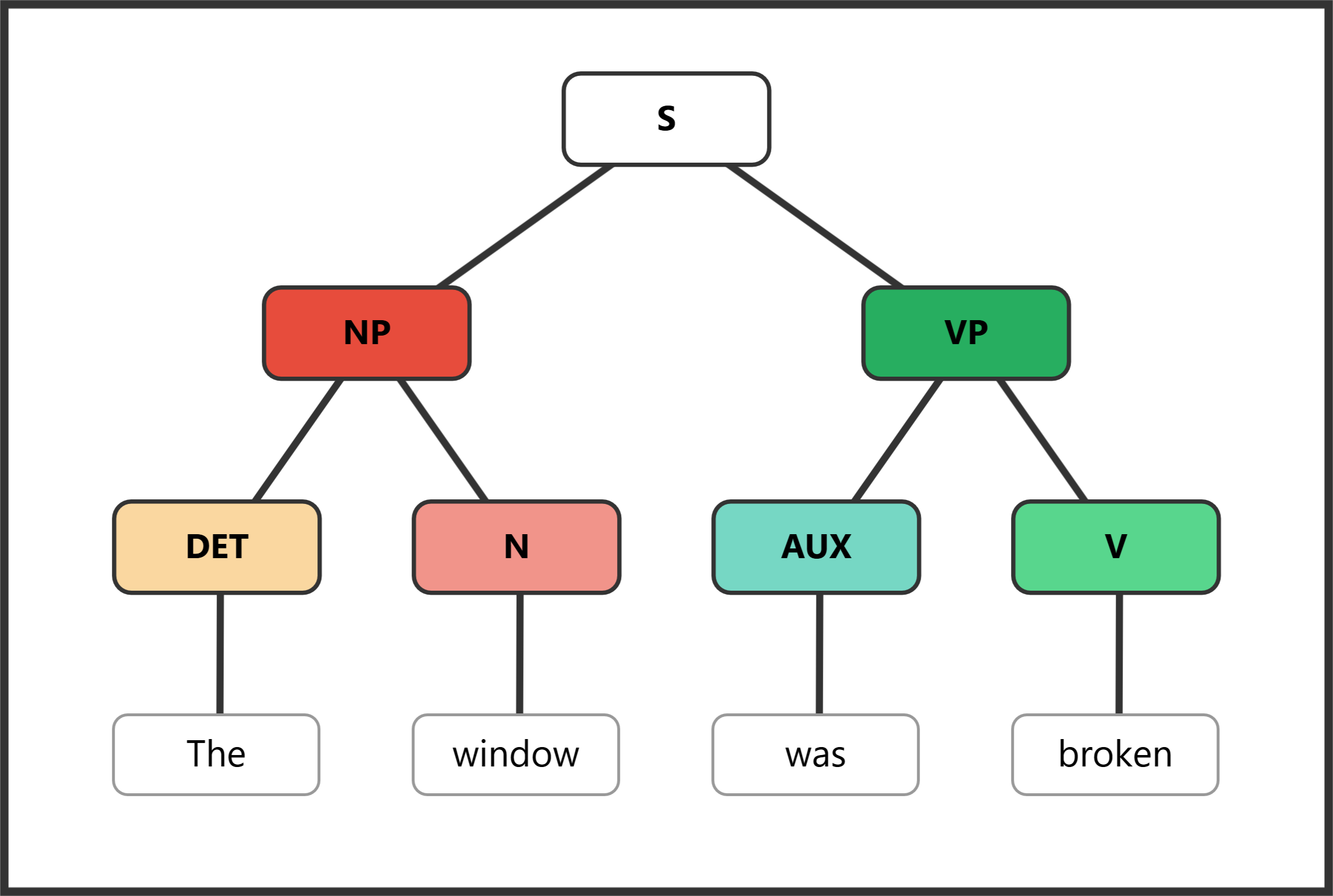
[S [NP [DET The] [N window]] [VP [AUX was] [V broken]]]
Even though the by-phrase is optional, it provides a useful test for identifying passive voice. If you suspect a sentence is passive, try adding by someone or by [actor] after the verb. If the sentence still makes sense, it is likely a true passive:
-
The window was broken. → The window was broken by someone. ✓ (passive)
-
The cake has been eaten. → The cake has been eaten by someone. ✓ (passive)
-
She is interested in music. →
She is interested in music by someone.✗ (not passive—interested is an adjective here) -
He was gone. →
He was gone by someone.✗ (not passive—gone describes a state)
Identifying Passive Voice.
The reliable structural test for passive voice is: look for a form of be (am, is, are, was, were, been, being) followed by a past participle. Both elements must be present:
-
The letter was sent. — was (form of be) + sent (past participle) = passive
-
The results are being analyzed. — are being (form of be) + analyzed (past participle) = passive
-
The cake has been eaten. — been (form of be) + eaten (past participle) = passive
Then confirm with the by someone test described above.
Common Misidentifications.
Not every sentence with be + a word that looks like a past participle is passive. Watch out for these:
-
The door is broken. — This could be passive (“someone broke it”) or a stative description (“it is in a broken state”). The by someone test helps: if The door is broken by the children every week sounds natural, it is passive. If the sentence simply describes the door’s current condition, broken is functioning as a predicative adjective.
-
She is interested in music. — Despite the form, interested here functions as an adjective, not a passive verb. The by someone test fails:
She is interested in music by someone. -
He was gone. — Gone looks like a past participle, but go is intransitive. This is not a passive construction; it describes a state.
What Cannot Be Passivized.
Only transitive verbs—verbs that take a direct object—can form true passives, because the passive promotes the object to subject position. If there is no object, there is nothing to promote:
-
The baby slept. — Sleep is intransitive; no passive is possible. (
The baby was slept.) -
She arrived late. — Arrive is intransitive. (
Late was arrived by her.) -
The vase fell. — Fall is intransitive. (
The vase was fallen.)
Some transitive verbs also resist passivization, particularly stative verbs that describe relationships rather than actions: This shirt fits me but not I am fitted by this shirt (in this sense); She resembles her mother but not Her mother is resembled by her.

