Section 12.3 Adverbial Position
Unlike subjects and objects, which occupy relatively fixed positions in English clauses, adverbials are mobile. You can say Yesterday, she arrived or She arrived yesterday or even She yesterday arrived—and in all three the basic meaning is the same. That mobility is one of the defining features of adverbials. But position is not meaningless: where you place an adverbial signals what is new information, what is the focus, and what serves as background. Understanding the three main positions—initial, medial, and final—gives you a tool for analyzing both how sentences are constructed and why particular arrangements feel more natural than others.
Initial Position.
At the beginning of the sentence, an adverbial sets the scene or signals the topic. Initial adverbials are typically followed by a comma:
-
Yesterday, she arrived. (NP — time)
-
In the morning, we’ll leave. (PP — time)
-
Frankly, I disagree. (AdvP — sentence-level)
-
Because the roads were icy, we drove slowly. (clause — reason)
Initial position often signals scene-setting or topical information. It is the natural home for time and place adverbials that establish context, as well as for sentence-level adverbials that frame the speaker’s stance.
Medial Position.
Between the subject and verb, or within the verb phrase (often after the first auxiliary):
-
She often works late. (AdvP — frequency)
-
He has always been reliable. (AdvP — frequency)
-
They will probably arrive soon. (AdvP — likelihood)
Medial position is the default for frequency adverbs (always, often, never, sometimes) and for epistemic adverbs that express the speaker’s certainty (probably, certainly, definitely). Prepositional phrases and clauses rarely appear in medial position.
Final Position.
At the end of the sentence—the default and most neutral position for most adverbials:
-
She arrived yesterday. (NP — time)
-
He spoke quietly. (AdvP — manner)
-
We’ll leave in the morning. (PP — time)
-
She succeeded because she worked hard. (clause — reason)
Final position is the unmarked default for manner, place, and time adverbials. When multiple adverbials stack in final position, they typically follow the order manner → place → time: She worked diligently in the lab all afternoon.
Within the Predicate.
Adverbials that appear in final position are not all equivalent—their placement within the predicate matters. An adverbial can appear immediately after the verb, after the object, or between auxiliaries, and each position produces a different effect.
Between an auxiliary and the main verb, the adverbial sits inside the verb phrase:
-
She has always enjoyed reading. (between auxiliary and main verb)
-
They had already finished. (between auxiliary and main verb)
-
The report was carefully reviewed. (between auxiliary and past participle)
When a sentence has both an object and an adverbial, the adverbial typically follows the object:
-
She opened the door quietly. (after the object)
-
He finished the assignment on time. (after the object)
Some manner adverbs can appear before the main verb, between the subject and the verb-object unit. This position gives the adverb a more literary feel:
-
She quietly opened the door. (before the verb)
-
He carefully examined the evidence. (before the verb)
Placing the adverbial between the verb and its object (She opened quietly the door.) is generally ungrammatical in English. The verb and its object form a tight unit that most adverbials cannot break apart.
Modifying Adjectives.
Adverbials do not only modify verbs and sentences—they can also modify adjectives. When an adverb modifies an adjective, it appears immediately before the adjective it intensifies or qualifies:
-
The test was extremely difficult. (degree)
-
She seemed quite confident. (degree)
-
That explanation is almost correct. (qualification)
-
The results were surprisingly clear. (speaker evaluation)
These adverbs cannot follow the adjective: The test was difficult extremely. The position is fixed—immediately before the adjective. Degree adverbs like very, quite, extremely, somewhat, rather are the most common type, but evaluative adverbs like surprisingly and disappointingly also modify adjectives from this position.
Modifying Other Adverbs.
Just as adverbs can modify adjectives, they can modify other adverbs. The modifying adverb appears immediately before the adverb it targets:
-
She spoke remarkably quickly. (degree modifying manner)
-
He runs quite often. (degree modifying frequency)
-
They finished very carefully. (degree modifying manner)
-
The train arrived almost immediately. (qualification modifying time)
As with adjectives, the position is fixed: the modifying adverb must come directly before the adverb it modifies. The result is a multi-word adverb phrase (AdvP) that functions as a single adverbial unit in the clause.
Sentence-Level Adverbials.
Some adverbials modify not a verb, adjective, or adverb but the entire sentence. These sentence-level adverbials express the speaker’s attitude or evaluation—words like fortunately, honestly, surprisingly, clearly. They typically appear in initial position, set off by a comma, and they cannot be questioned or negated in the same way as verb-modifying adverbials. Compare:
-
She answered honestly. (modifies the verb—tells how she answered)
-
Honestly, I have no idea. (modifies the sentence—expresses the speaker’s stance)
Notice that the same word can function as a verb-modifier or a sentence-modifier depending on its position and punctuation. The sentence-level use is external to the core proposition—you cannot ask Did honestly you have no idea?
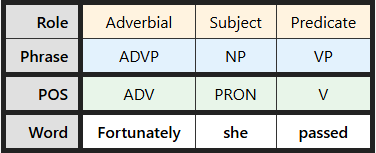
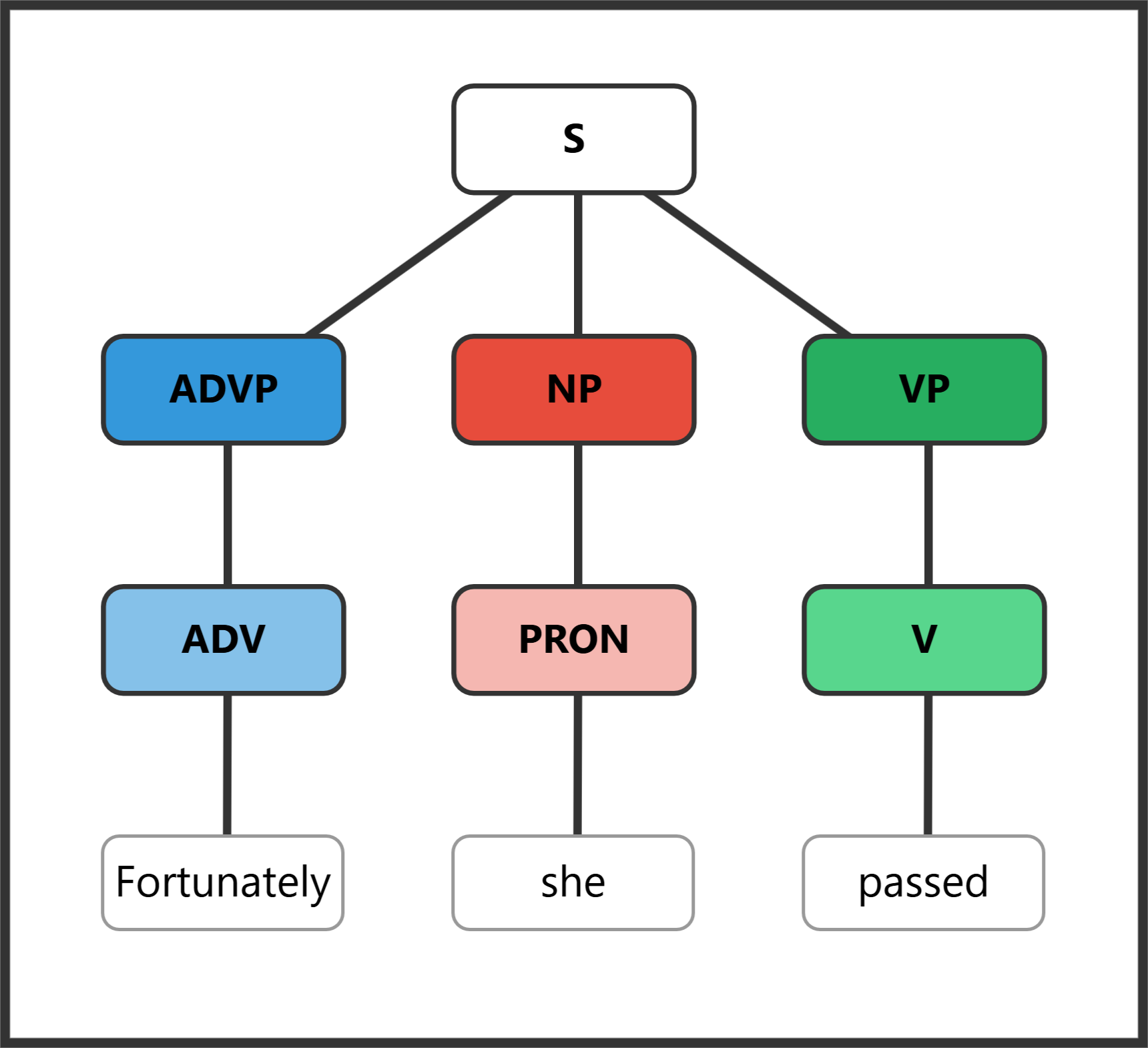
[S [ADVP [ADV Fortunately]] [NP [PRON she]] [VP [V passed]]]
Position and Focus.
Moving an adverbial to a different position changes what receives emphasis. Compare:
-
She spoke quietly in the library. (neutral—library is given information)
-
In the library, she spoke quietly. (library emphasized as scene-setting)
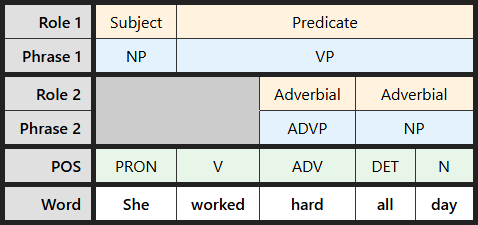
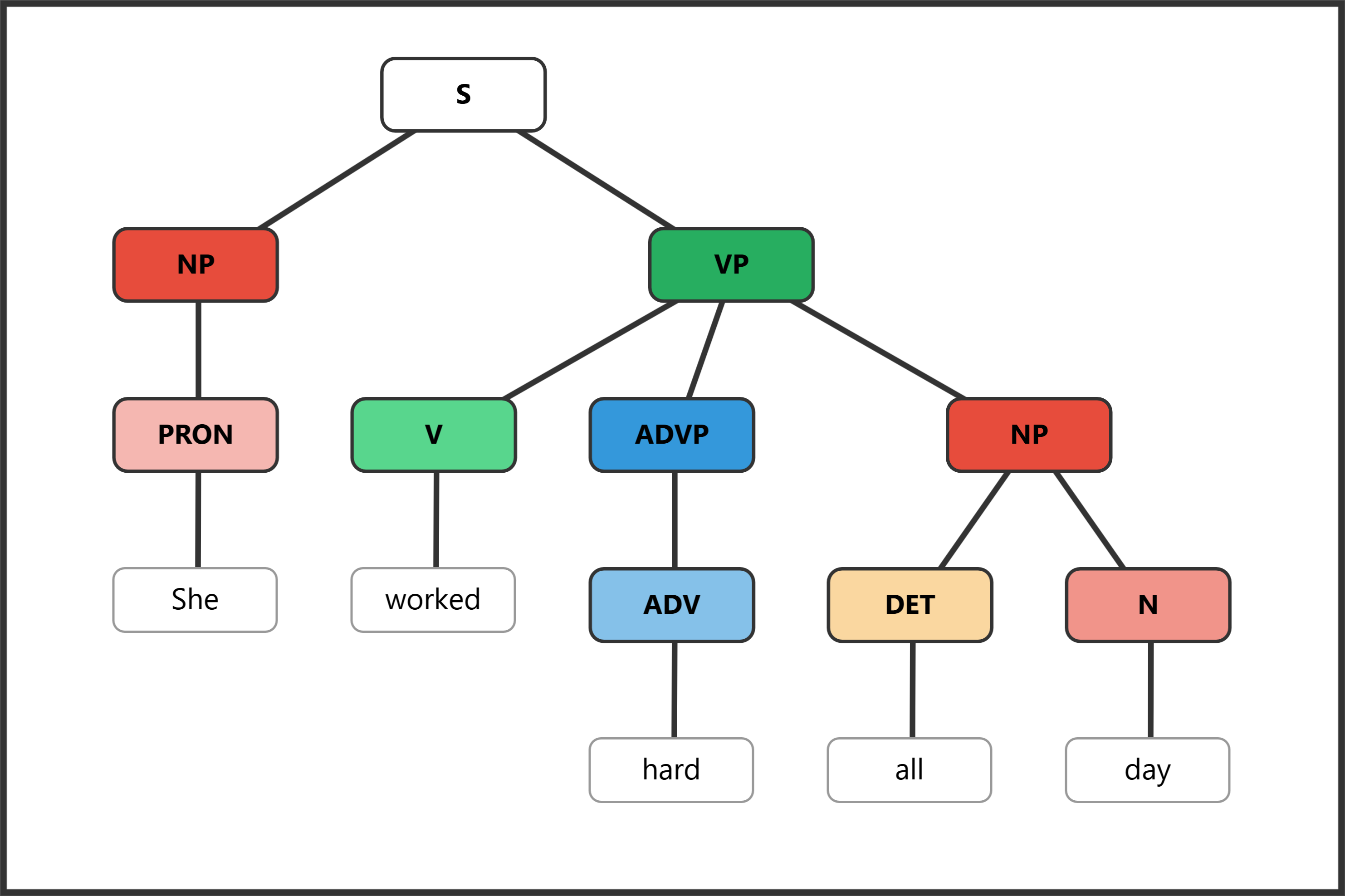
[S [NP [PRON She]] [VP [V worked] [ADVP [ADV hard]] [NP [DET all] [N day]]]]

