Section 10.6 Present Tense
The name "present tense" is somewhat misleading. You might expect it to mean "what is happening right now," but in fact the present tense is used for a surprising range of meanings, most of which have nothing to do with the immediate moment. When someone says Water boils at 100°C, they are using present tense to state a timeless truth. When a storyteller says So then he walks up and says..., they are using present tense to describe past events. The present tense is really the unmarked tense—the default, the one English reaches for when no specific temporal meaning needs to be imposed.
Formation.
Regular verbs:
-
Base form: I/you/we/they walk
-
Third person -s: she/he/it walks
Spelling rules for -s:
-
Most verbs: add -s (walks, runs)
-
Ending in -s, -sh, -ch, -x, -z: add -es (watches, fixes)
-
Consonant + y: change y to -ies (studies, carries)
-
Irregular: has, does, goes
Uses of Present Tense.
Habitual actions:
-
She walks to school every day.
-
I drink coffee in the morning.
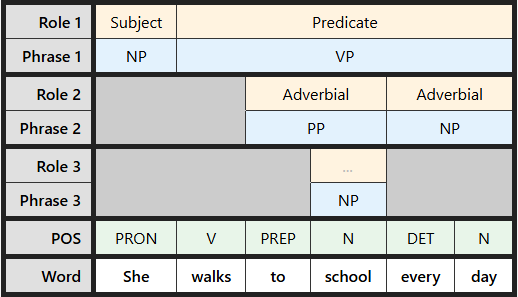
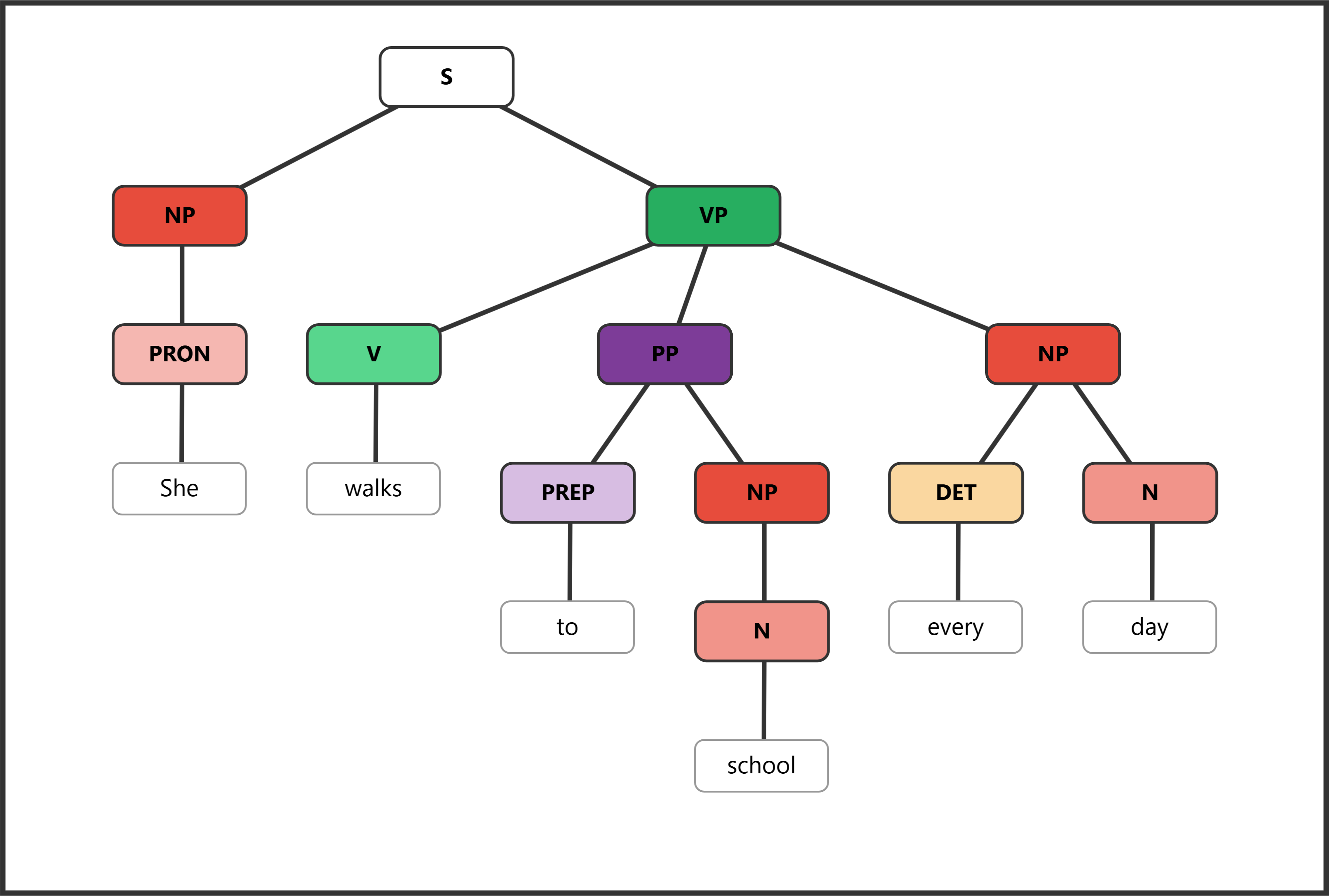
[S [NP [PRON She]] [VP [V walks] [PP [PREP to] [NP [N school]]] [NP [DET every] [N day]]]]
General truths:
-
Water boils at 100°C.
-
The sun rises in the east.
States:
-
She knows the answer.
-
I love this city.
Scheduled future events:
-
The train leaves at noon.
-
The semester starts next week.
Performatives (doing by saying):
-
I apologize for the delay.
-
I promise to help.
Historical present (in narratives):
-
So then he walks up and says...

