Section 13.4 Restrictive vs. Non-Restrictive Modifiers
Consider these two sentences: My sister who lives in Boston visited me and My sister, who lives in Boston, visited me. The difference looks like nothing more than a pair of commas—but the two sentences actually make different claims about the world. The first implies that the speaker has more than one sister, and the clause who lives in Boston identifies which one. The second implies that the speaker has exactly one sister, and the clause simply adds information about her. That difference in meaning—between a modifier that identifies and a modifier that merely supplements—is the restrictive/non-restrictive distinction. It is signaled in writing by commas, but it is a semantic and grammatical distinction, not just a punctuation preference.
Restrictive Modifiers.
Restrictive modifiers (also called defining or identifying modifiers) limit the reference of the noun—they identify which one is meant. Without them, the sentence’s meaning would be different:
-
The students who studied passed. (only those who studied)
-
The book that she recommended changed my life.
-
Cars with manual transmissions are becoming rare.
Characteristics of restrictive modifiers:
-
No commas
-
Essential for identifying the referent
-
Removing them changes meaning significantly
-
Use that for clauses (preferred in American English)
Non-Restrictive Modifiers.
Non-restrictive modifiers (also called non-defining or supplementary modifiers) add extra information about an already-identified referent. They could be removed without changing the basic identification:
-
My sister, who lives in Boston, visited last week. (I have one sister)
-
The book, which she recommended, changed my life. (book already identified)
-
Paris, known for its cuisine, attracts millions of tourists.
Characteristics of non-restrictive modifiers:
-
Set off with commas
-
Add supplementary information
-
Can be removed without losing identification
-
Use which for clauses (not that)
The Meaning Difference.
Compare:
-
The students who studied passed. (restrictive—only studying students)
-
The students, who studied, passed. (non-restrictive—all students studied and passed)
With proper nouns, most modifiers are non-restrictive, since proper nouns are already uniquely identified:
-
Shakespeare, who wrote Hamlet, lived in Stratford.
Labeling Table.
Consider this sentence with both readings:
-
Restrictive: The players who practiced won the game. (only those who practiced won)
-
Non-restrictive: The players, who practiced, won the game. (all the players practiced; all won)
The tree structure is the same in both cases—the difference lies in punctuation and meaning, not in syntax:
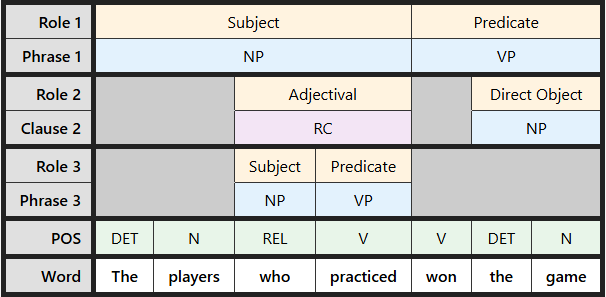
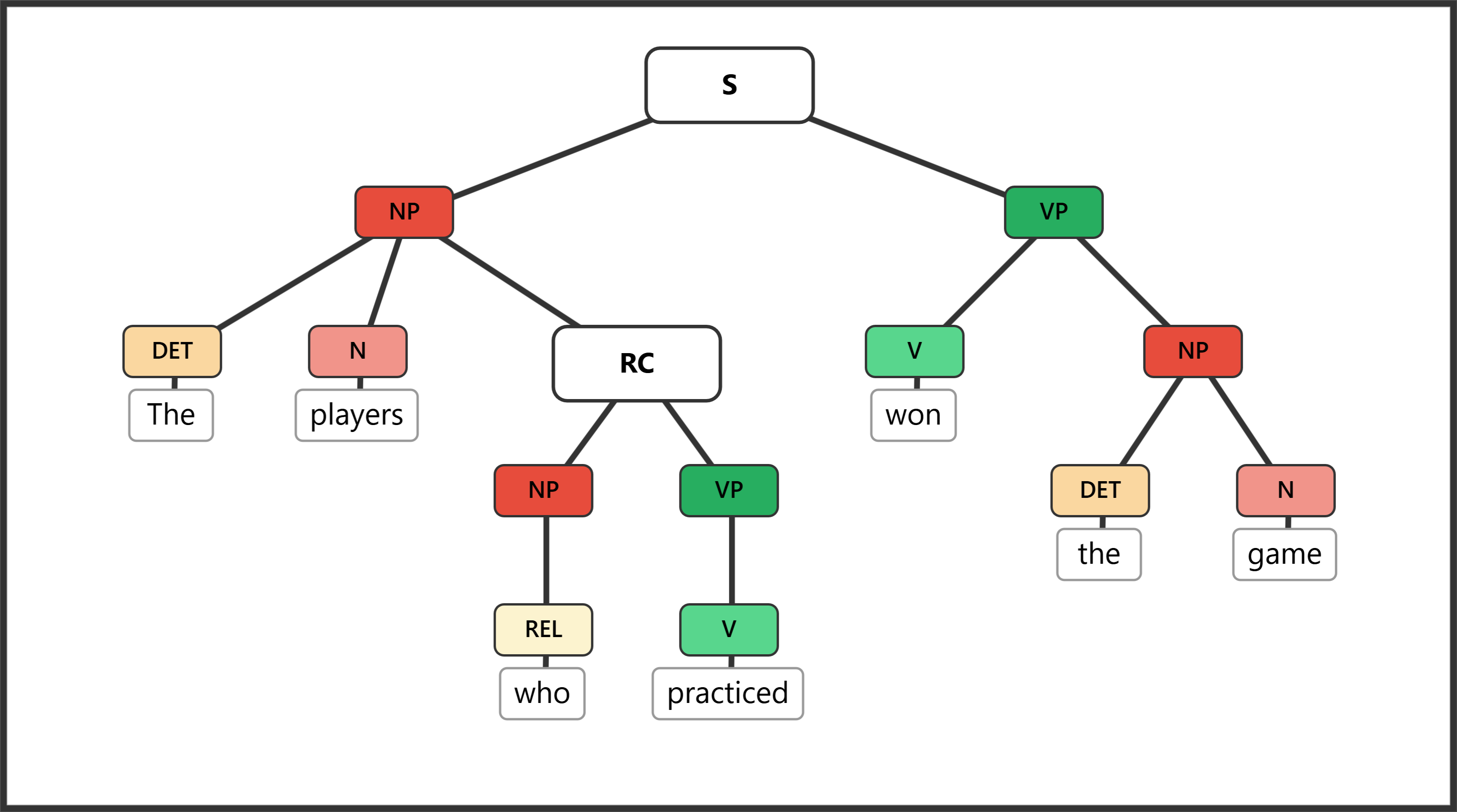
[S [NP [DET The] [N players] [RC [NP [REL who]] [VP [V practiced]]]] [VP [V won] [NP [DET the] [N game]]]]
The commas are the only written signal: with them, the relative clause is supplementary information; without them, it identifies which players.
Beyond Relative Clauses.
The restrictive/non-restrictive distinction applies to all adjectival types, not just relative clauses:
-
PP: The students in the front row answered. (restrictive) vs. The students, in the front row as usual, answered. (non-restrictive)
-
Participial: The man wearing the hat is my uncle. (restrictive) vs. My uncle, wearing his favorite hat, arrived late. (non-restrictive)

