Section 13.6 Noun Adjectivals
When one noun modifies another noun, the modifying noun is called a noun adjectival (also known as an attributive noun). In coffee table, the noun coffee modifies table, specifying what kind of table it is. This is a productive pattern in English—speakers create new noun-noun compounds freely. Noun adjuncts differ from adjectives in important ways: they cannot be graded (a very coffee table), they cannot appear in predicative position (the table is coffee), and they always precede the head noun.
Formation.
A noun adjectival is simply a noun placed before another noun to modify it. The first noun classifies, categorizes, or identifies the type of the second noun:
-
the coffee table (material/purpose)
-
a government report (source)
-
the history professor (field)
-
car insurance (object insured)
-
a chicken sandwich (content)
-
the morning commute (time)
Noun Adjectival vs. Adjective.
How do you know whether a pre-modifier is a noun adjectival or an adjective? Apply the adjective tests from Chapter 5:
-
Can it be graded?
a very government report— No. It is a noun adjectival. -
Can it appear predicatively?
The report is government.— No. It is a noun adjectival. -
Compare: a beautiful report → a very beautiful report → The report is beautiful. — Yes to both. Beautiful is an adjective.
Labeling Table.
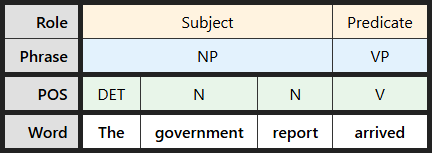
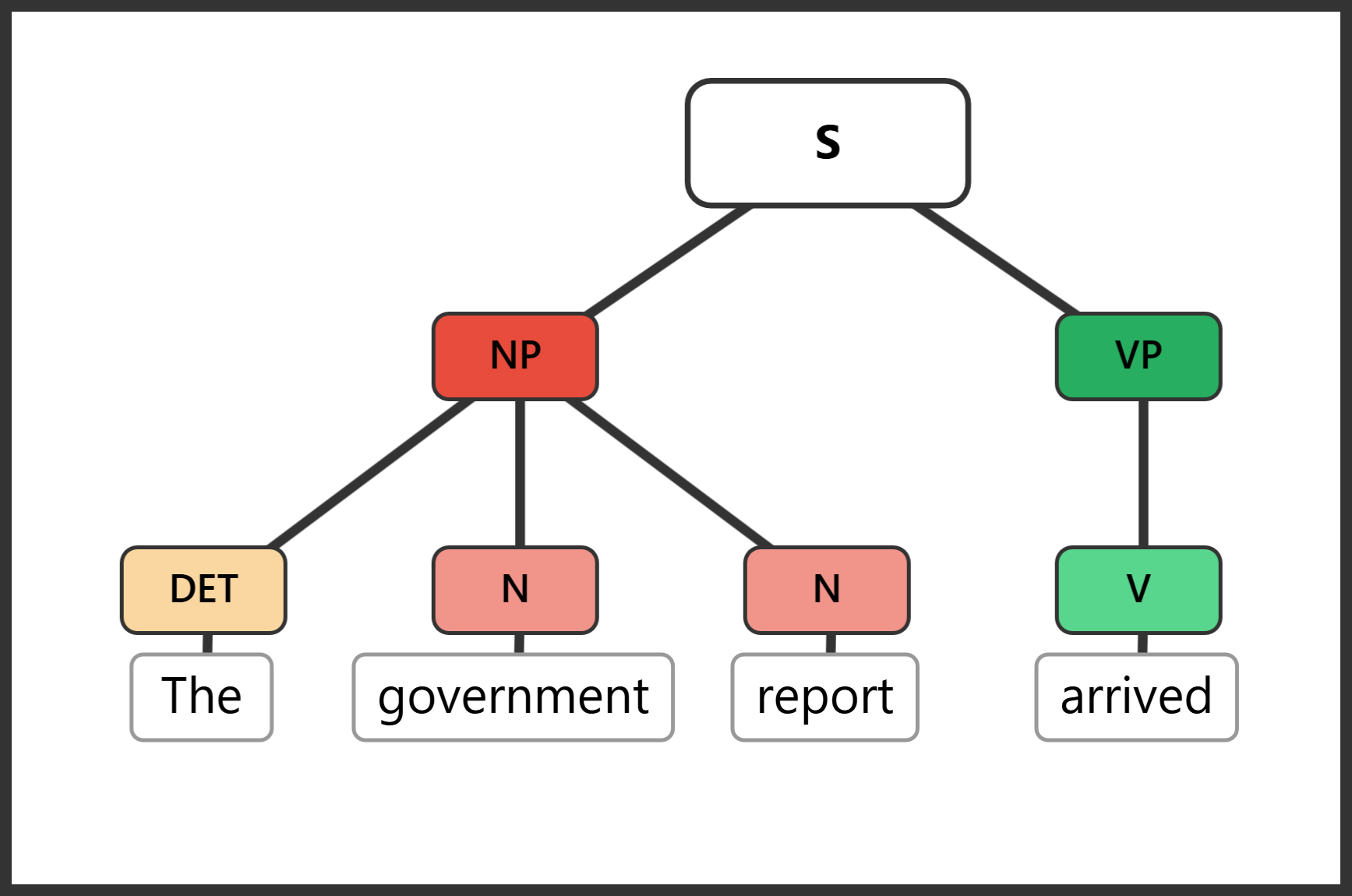
[S [NP [DET The] [N government] [N report]] [VP [V arrived]]]
Note that the POS for the noun adjectival is N (noun), not ADJ—it retains its form as a noun even though it fills the adjectival function.
Key Points.
-
Noun adjuncts always precede the head noun—they never appear in post-position or predicative position.
-
Multiple noun adjectivals can stack: the university research ethics committee.
-
In the pre-modifier order (Section 13.3), noun adjectivals come last, just before the head noun: a beautiful old French cooking pot.
-
In diagrams, label noun adjectivals as N, not ADJ. Their form is noun; their function is adjectival.

