Section 12.4 Prepositional Phrase Adverbials
Prepositional phrases are the workhorse of the adverbial system. They can express nearly every semantic role—time, place, manner, reason, purpose, condition—and they appear in every position. If adverb phrases are the default single-word adverbial, prepositional phrases are the default phrasal adverbial. Their versatility comes from the wide range of prepositions in English and the fact that a PP can embed an NP of any complexity.
Formation.
A prepositional phrase consists of a preposition followed by a noun phrase (its complement): Preposition + NP. The preposition determines the semantic relationship, and the NP provides the content:
-
in + the city = place
-
at + noon = time
-
with + enthusiasm = manner
-
because of + the weather = reason
-
for + the meeting = purpose
Semantic Roles.
PPs fill a wider range of semantic roles than any other adverbial form:
| Role | Common Prepositions | Example |
|---|---|---|
| Place | in, at, on, under, behind, near | She works in the lab. |
| Time | at, on, in, before, after, during | He arrived before noon. |
| Direction | to, toward, into, through, across | She walked toward the exit. |
| Manner | with, without, by, in | He spoke with confidence. |
| Reason | because of, due to, on account of | We left because of the rain. |
| Purpose | for | She came for the interview. |
| Condition | in case of, in the event of | In case of fire, exit immediately. |
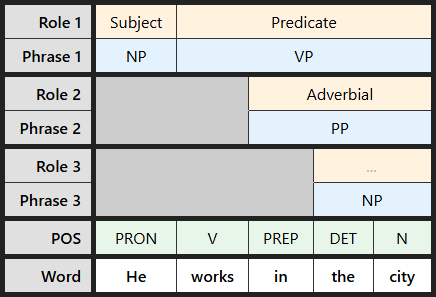
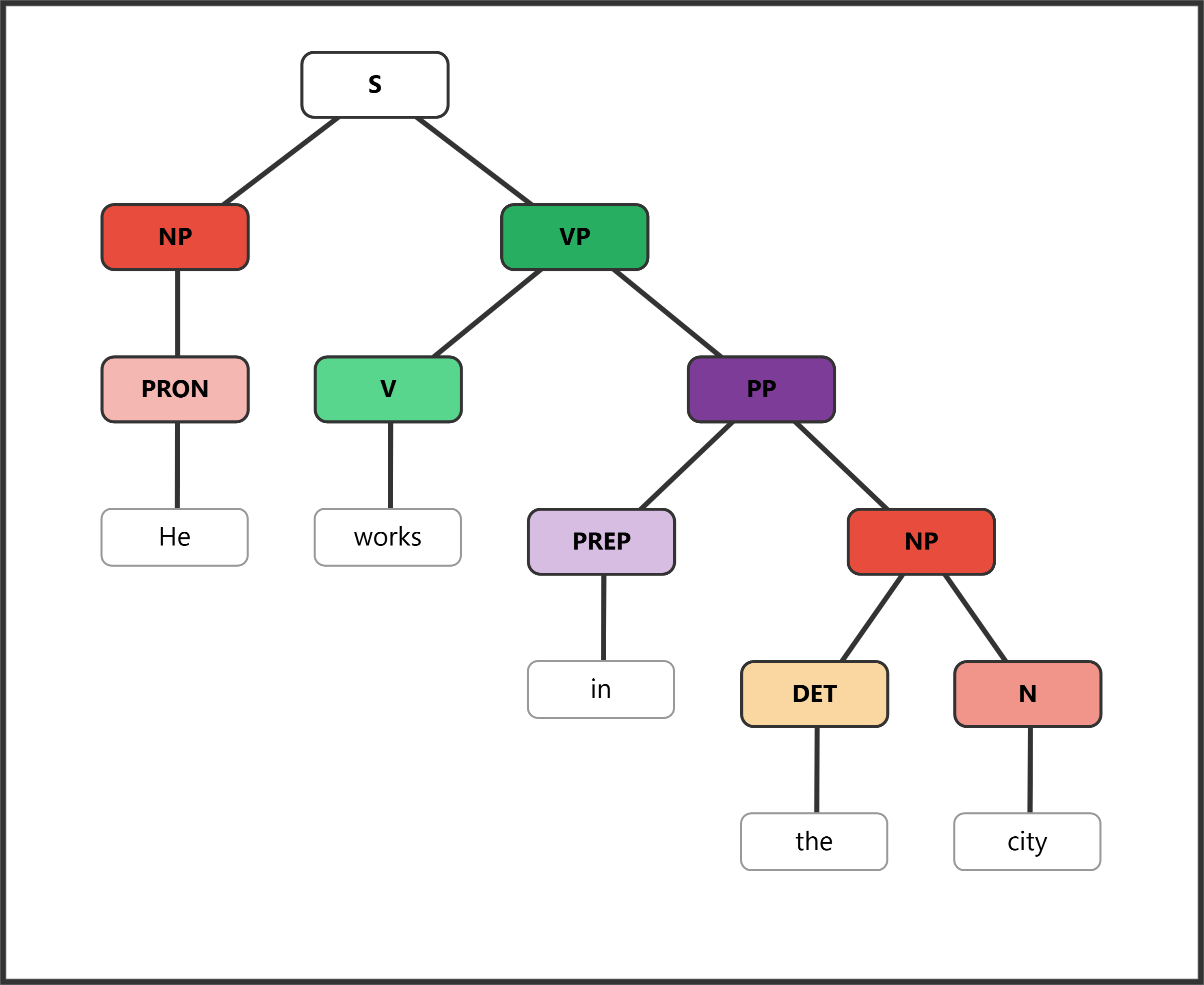
[S [NP [PRON He]] [VP [V works] [PP [PREP in] [NP [DET the] [N city]]]]]
Stacking PPs.
Multiple PP adverbials often stack in final position. When they do, the typical order is manner → place → time:
-
She studied with focus in the library before the exam.
PP Adverbials vs. PP Adjectivals.
Not every PP in a sentence is adverbial. A PP inside a noun phrase modifies the noun (adjectival function), while a PP inside a verb phrase modifies the verb (adverbial function). Compare:
-
The book on the shelf fell. (on the shelf modifies book—adjectival)
-
She put the book on the shelf. (on the shelf modifies put—adverbial)

