Section 8.6 Copular and Linking Verbs: A Closer Look
Patterns 2 and 3 share a common feature: instead of a direct object, the verb is followed by a subject complement—a word or phrase that loops back to describe or identify the subject. The difference between the two patterns lies in which verb connects them.
This section examines Patterns 2 and 3 in more detail, with diagrams that make the structural parallel explicit. The key takeaway is this: in both patterns, the element after the verb is not an object—it is a complement. It does not receive the verb’s action; it characterizes the subject. That single observation separates these patterns from all transitive patterns, where an object is present and refers to an entity distinct from the subject.
Pattern 2: Copular Be.
The verb be (and its forms: am, is, are, was, were, been, being) functions as a pure grammatical connector. It carries almost no independent meaning—its job is simply to link the subject to what is said about it. The element after be is always a subject complement, which can be a noun phrase, an adjective phrase, or a prepositional phrase.
Pattern 2 with NP subject complement:
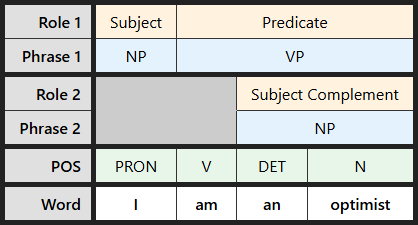
I am an optimist.
Diagram: I am an optimist.
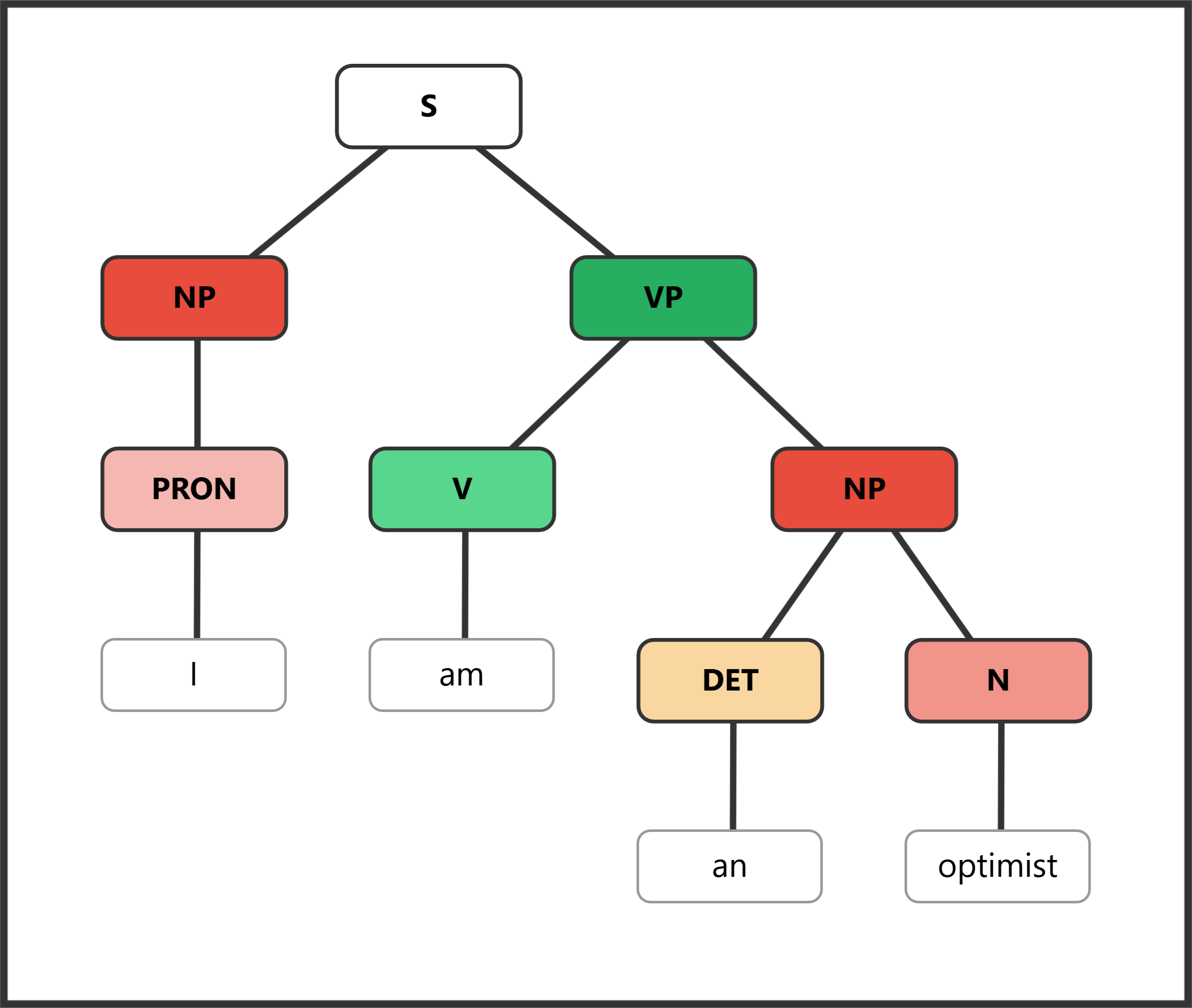
[S [NP [PRON I]] [VP [V am] [NP [DET an] [N optimist]]]]
The NP an optimist follows be and refers to the same entity as the subject. Notice that this NP does not receive any action—it identifies the subject. This is the defining property of a subject complement.
Pattern 2 with AdjP subject complement:
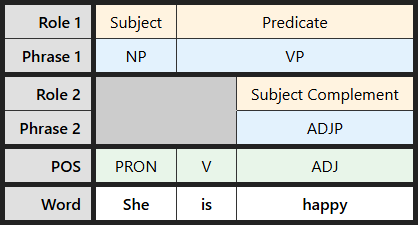
She is happy.
Diagram: She is happy.
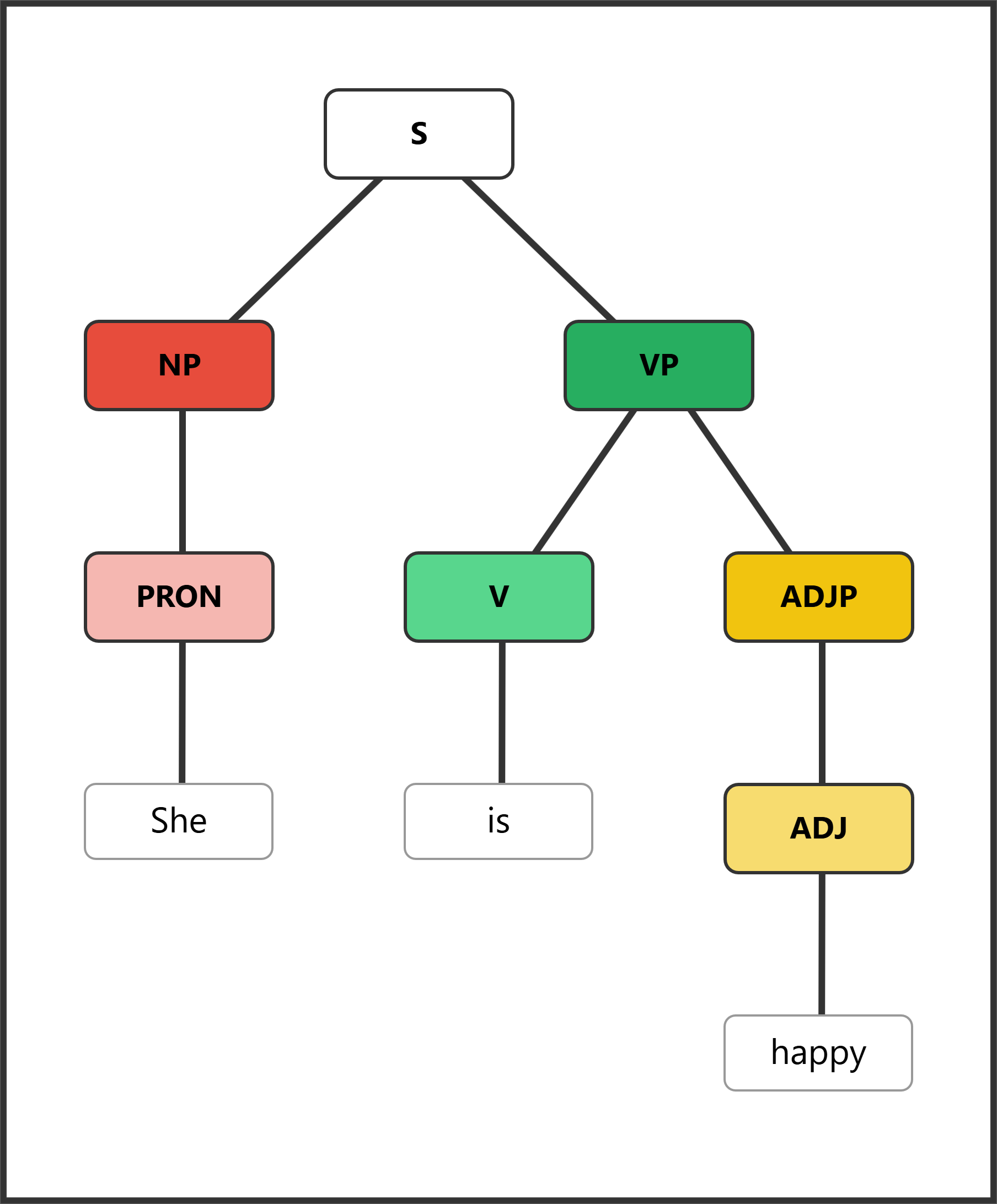
[S [NP [PRON She]] [VP [V is] [ADJP [ADJ happy]]]]
Here the AdjP happy describes the subject. Notice that be cannot be removed: She happy is ungrammatical. The verb must be present even though it contributes no action—it is purely structural.
A subject complement after be can also be a PP, which typically locates or situates the subject:
Diagram: Phillip is over the moon.
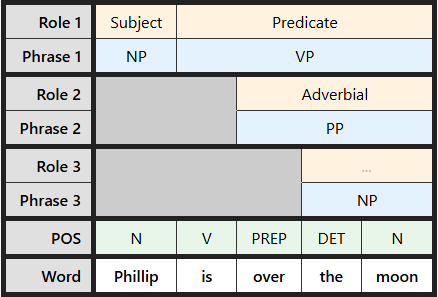
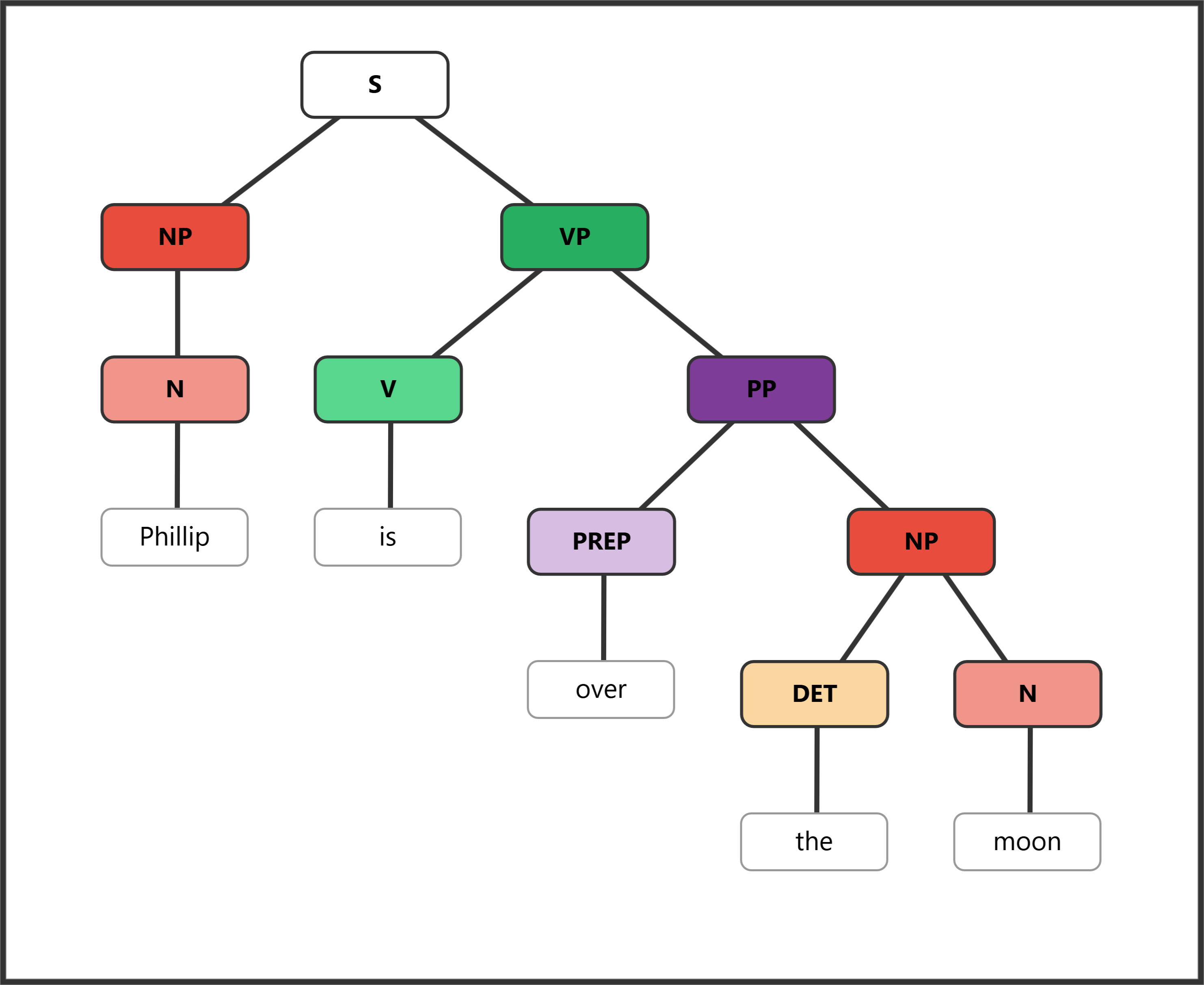
[S [NP [N Phillip]] [VP [V is] [PP [PREP over] [NP [DET the] [N moon]]]]]
Pattern 3: Linking Verbs.
Linking verbs behave structurally like be—they connect the subject to a subject complement—but unlike be, they carry their own semantic content. They typically express sensory perception, appearance, or change of state.
Common linking verbs: appear, become, feel, get, grow, look, prove, remain, seem, smell, sound, stay, taste, turn
The subject complement after a linking verb functions the same way as after be: it describes or identifies the subject, not an object of the verb’s action. Both AdjP and NP subject complements are possible.
Pattern 3 with AdjP subject complement:
Phillip became famous.
Diagram: Phillip became famous.
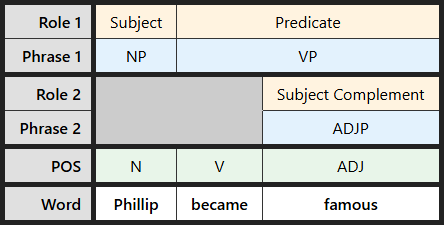
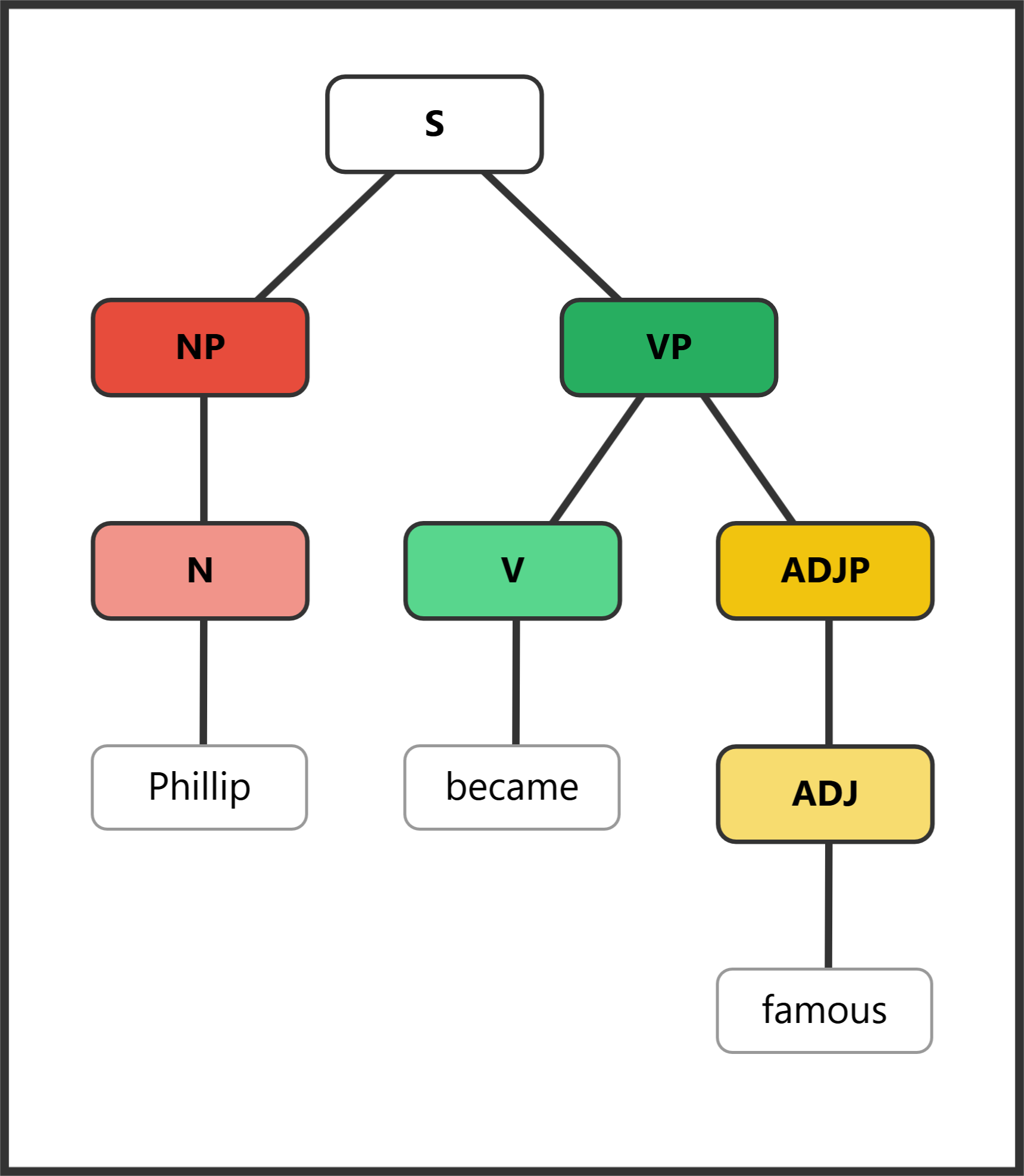
[S [NP [N Phillip]] [VP [V became] [ADJP [ADJ famous]]]]
Pattern 3 with NP subject complement:
Phillip became a doctor.
Diagram: Phillip became a doctor.
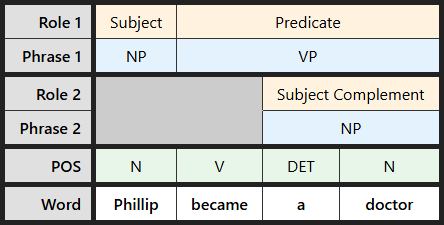
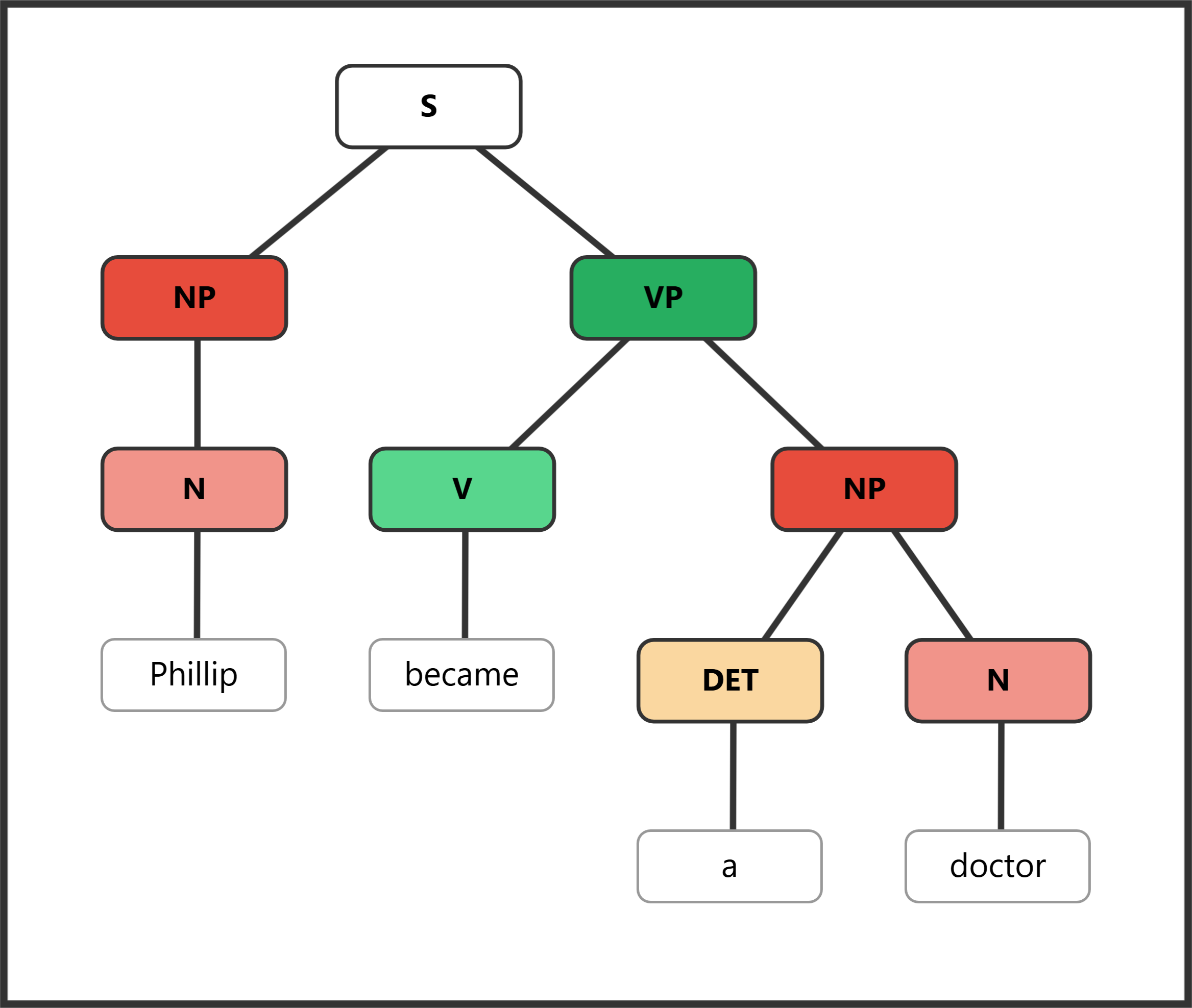
[S [NP [N Phillip]] [VP [V became] [NP [DET a] [N doctor]]]]
In both diagrams the subject complement sits inside the VP alongside the verb. It is part of the predicate, but it points back to the subject rather than forward to an object.
The Be Substitution Test.
To confirm that a verb is linking (Pattern 3 rather than transitive), replace the verb with a form of be. If the sentence still makes sense, the verb is linking:
-
The bread smells wonderful. → The bread is wonderful. ✓ Linking
-
The detective smells trouble. → The detective is trouble. ✗ Not linking—transitive
Many verbs in the list above can function as either linking or transitive depending on context. The substitution test is the most reliable way to distinguish them.

