Section 8.8 Ditransitive Sentences: A Closer Look
Patterns 5 and 6 are both called ditransitive because the verb takes two arguments beyond the subject. In Pattern 5 those are an indirect object and a direct object; in Pattern 6 they are a direct object and an object complement. Both patterns place two elements inside the VP after the verb, which makes them easy to confuse—but the relationship between those two elements is fundamentally different.
The clearest way to approach the distinction is to think about what the two post-verb elements have to do with each other. In Pattern 5, the two NPs are separate entities—a recipient and a thing transferred; they do not refer to the same thing. In Pattern 6, the second element is not a new entity at all; it characterizes the first. Inserting an implied to be between the two post-verb elements is a reliable test: if the result makes sense, you have an object complement (Pattern 6); if it does not, you have an indirect object followed by a direct object (Pattern 5).
Pattern 5: Indirect Object + Direct Object.
In Pattern 5, the verb describes a transfer of something (the direct object) to someone (the indirect object). The indirect object is the recipient or beneficiary; the direct object is the thing transferred. The indirect object always appears immediately after the verb, before the direct object.
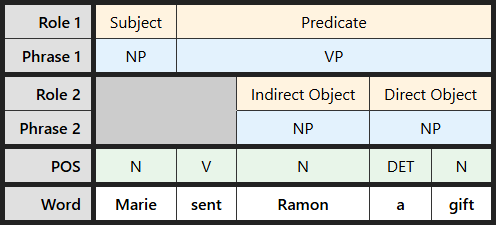
Marie sent Ramon a gift.
Diagram: Marie sent Ramon a gift.
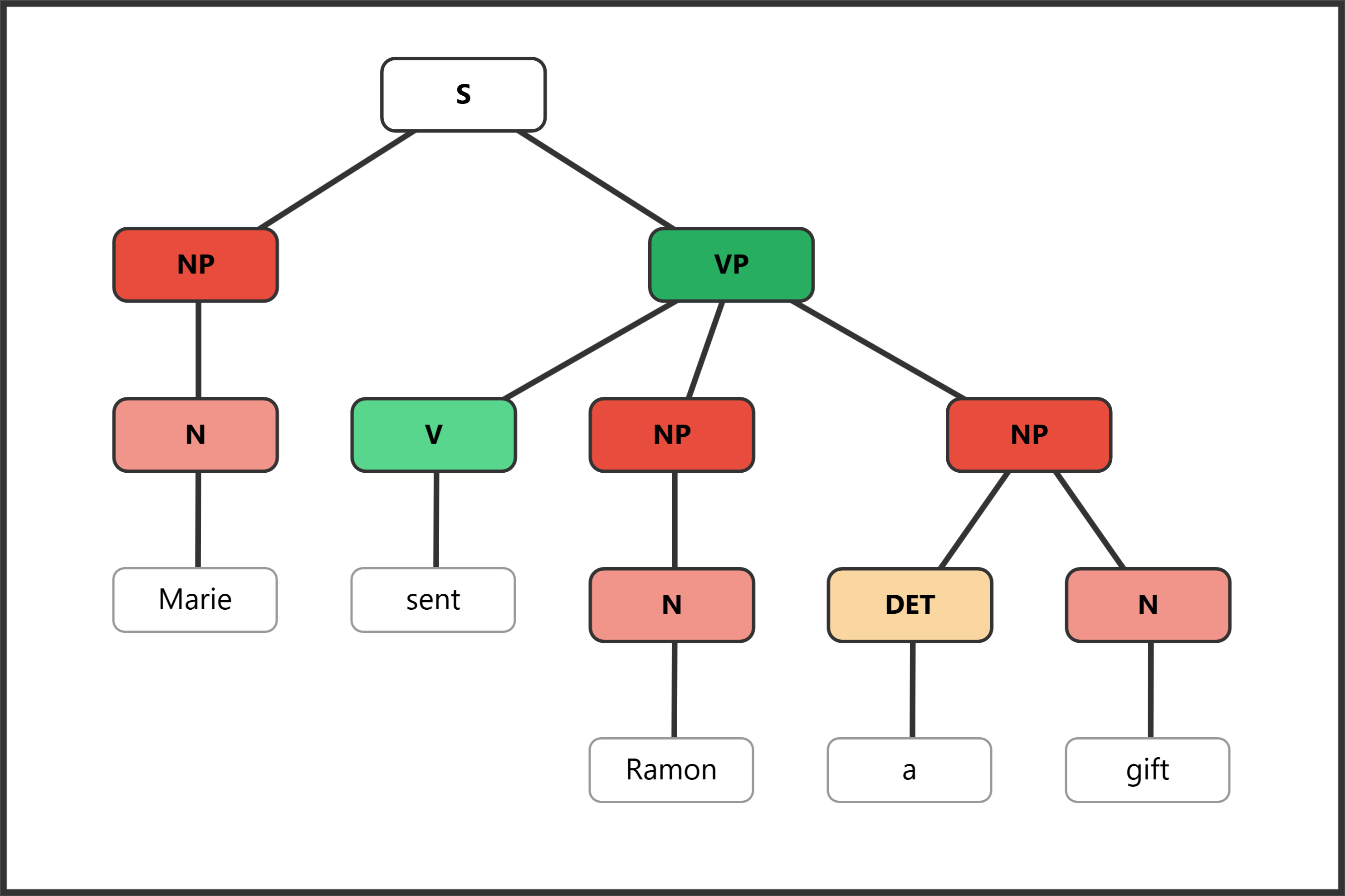
[S [NP [N Marie]] [VP [V sent] [NP [N Ramon]] [NP [DET a] [N gift]]]]
Both objects appear inside the VP. The two NPs refer to different things: Ramon and a gift are distinct entities. Ramon receives the gift; he does not become or equal it.
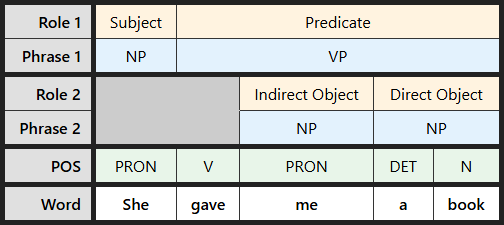
She gave me a book.
Diagram: She gave me a book.
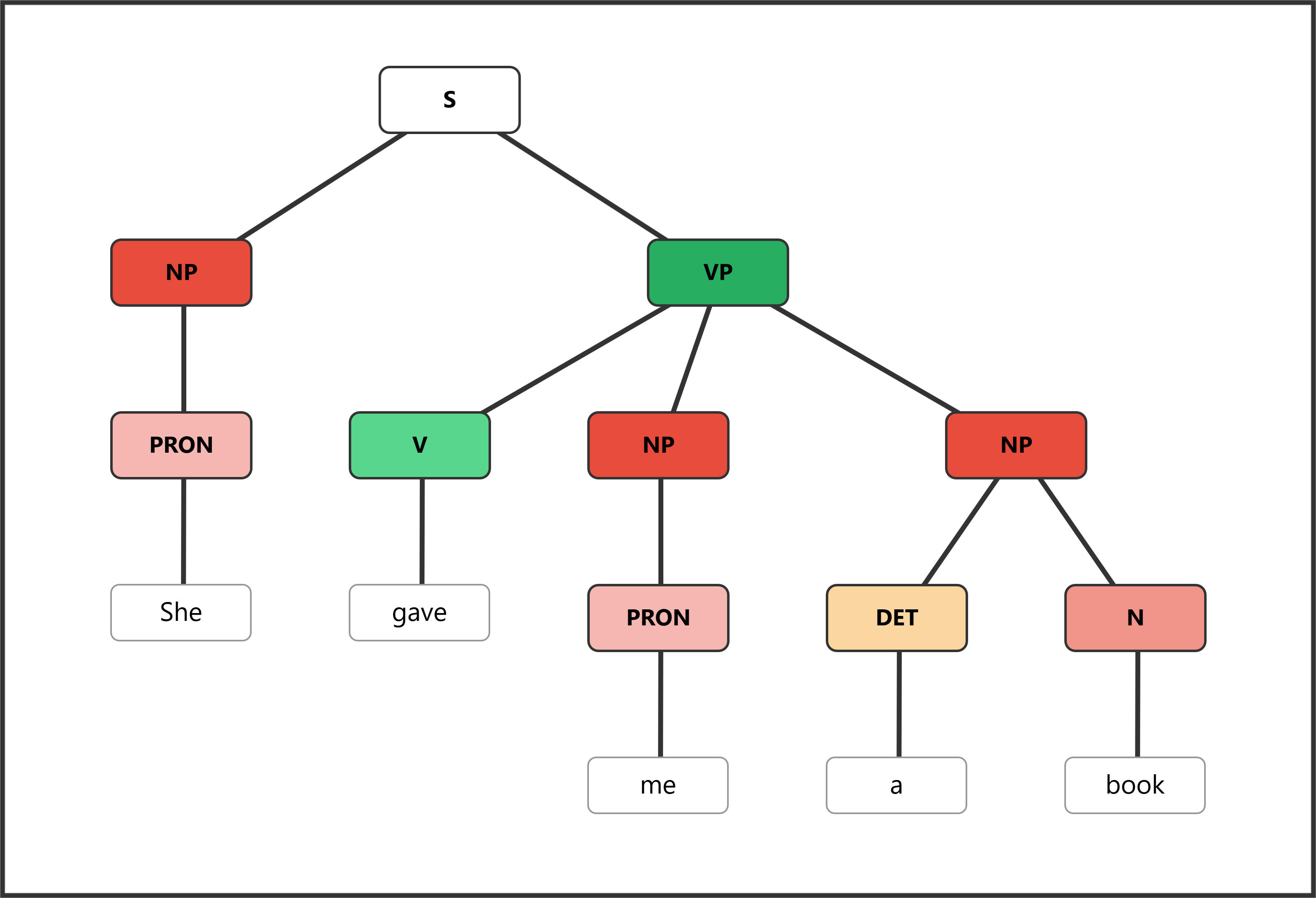
[S [NP [PRON She]] [VP [V gave] [NP [PRON me]] [NP [DET a] [N book]]]]
The indirect object can be a full NP or a pronoun. Confirm it with the to/for paraphrase test: if the sentence can be rephrased using “to” or “for” before the recipient, the first post-verb NP is an indirect object:
-
She gave me a book. → She gave a book to me. ✓
-
The chef made us dinner. → The chef made dinner for us. ✓
Pattern 6: Direct Object + Object Complement.
In Pattern 6, the verb takes a direct object followed by an object complement that describes or identifies the direct object. The relationship is similar to a subject complement after a linking verb—but here it describes the object, not the subject.
The jury found him guilty.
Diagram: The jury found him guilty.
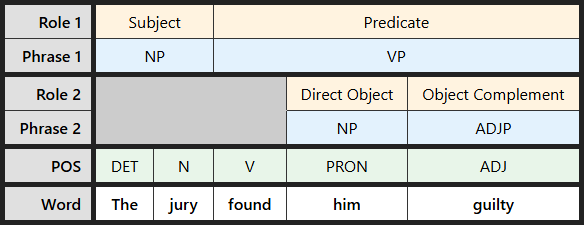
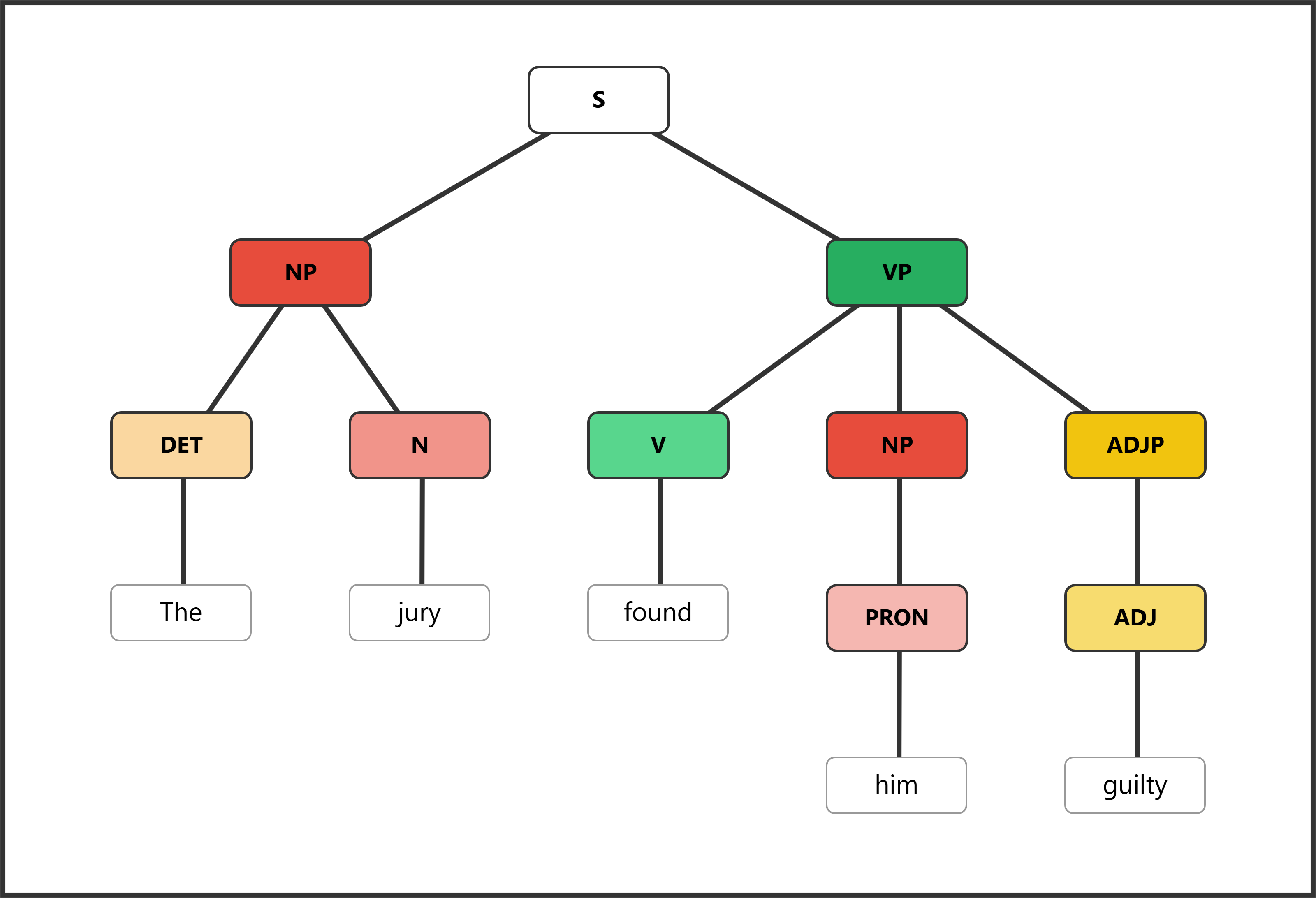
[S [NP [DET The] [N jury]] [VP [V found] [NP [PRON him]] [ADJP [ADJ guilty]]]]
They elected her president.
Diagram: They elected her president.
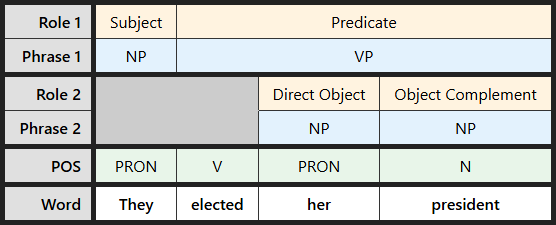
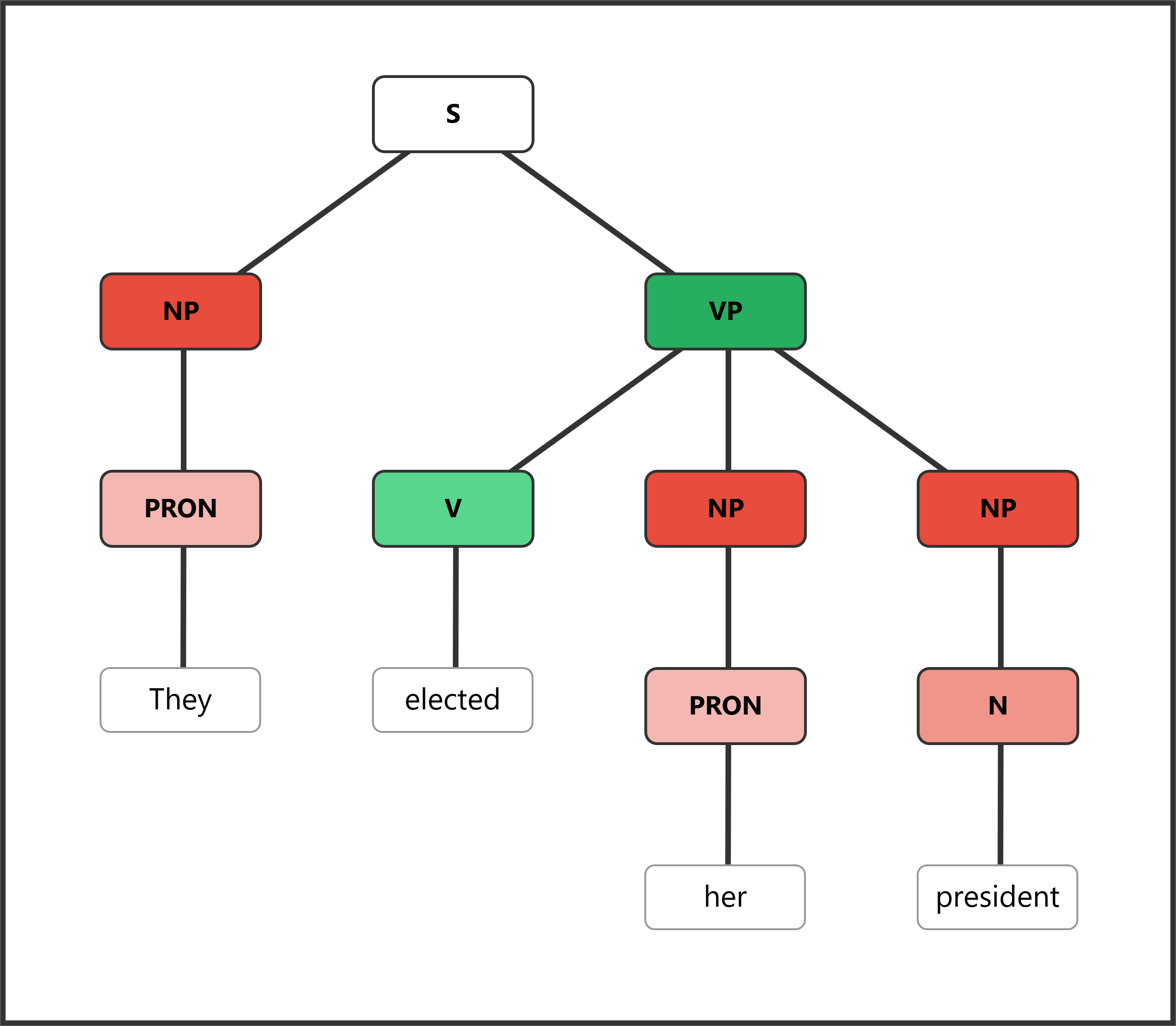
[S [NP [PRON They]] [VP [V elected] [NP [PRON her]] [NP [N president]]]]
The object complement can be an AdjP (describing a quality of the DO, as in guilty) or an NP (identifying what the DO becomes or is called, as in president). In both cases the object complement describes the same entity as the direct object.
Distinguishing Pattern 5 from Pattern 6.
The key is the relationship between the two post-verb elements:
-
Pattern 5 (IO + DO): the two NPs refer to different entities. She gave Marcus a book. — Marcus ≠ book.
-
Pattern 6 (DO + OC): the complement describes or equals the direct object. They elected her president. — she = president.
A reliable test: insert an implied be between the two post-verb elements. If it makes sense, the second element is an object complement (Pattern 6):
-
They elected her [to be] president. ✓ → Pattern 6
-
She gave Marcus [to be] a book. ✗ → Pattern 5

