Section 9.6 Compound Sentences
A compound sentence contains two or more independent clauses joined by a coordinating conjunction. Each clause has its own subject and predicate and could stand alone as a complete sentence. Coordination shows the ideas are related and presents them as grammatically equal—neither is made to depend on the other.
This grammatical equality is the defining feature of a compound sentence. In It rained, and we stayed inside, both It rained and we stayed inside are complete thoughts. The coordinating conjunction and connects them without subordinating either one. Compare this with a complex sentence like Because it rained, we stayed inside, where because makes the first clause dependent—it can no longer stand on its own.
Creating Compound Sentences with Coordinating Conjunctions.
A coordinating conjunction (FANBOYS—see Section 9.3) placed between two independent clauses creates a compound sentence. A comma precedes the conjunction:
“It rained, and we stayed inside.”
The labeling table and tree diagram below show the structure of this compound sentence:
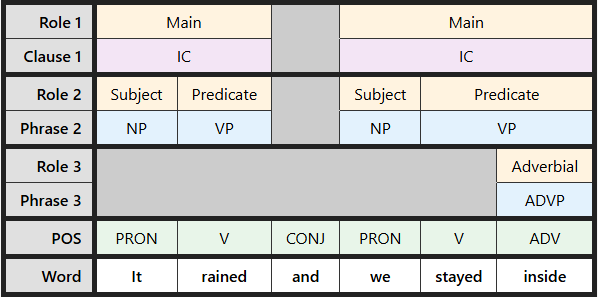
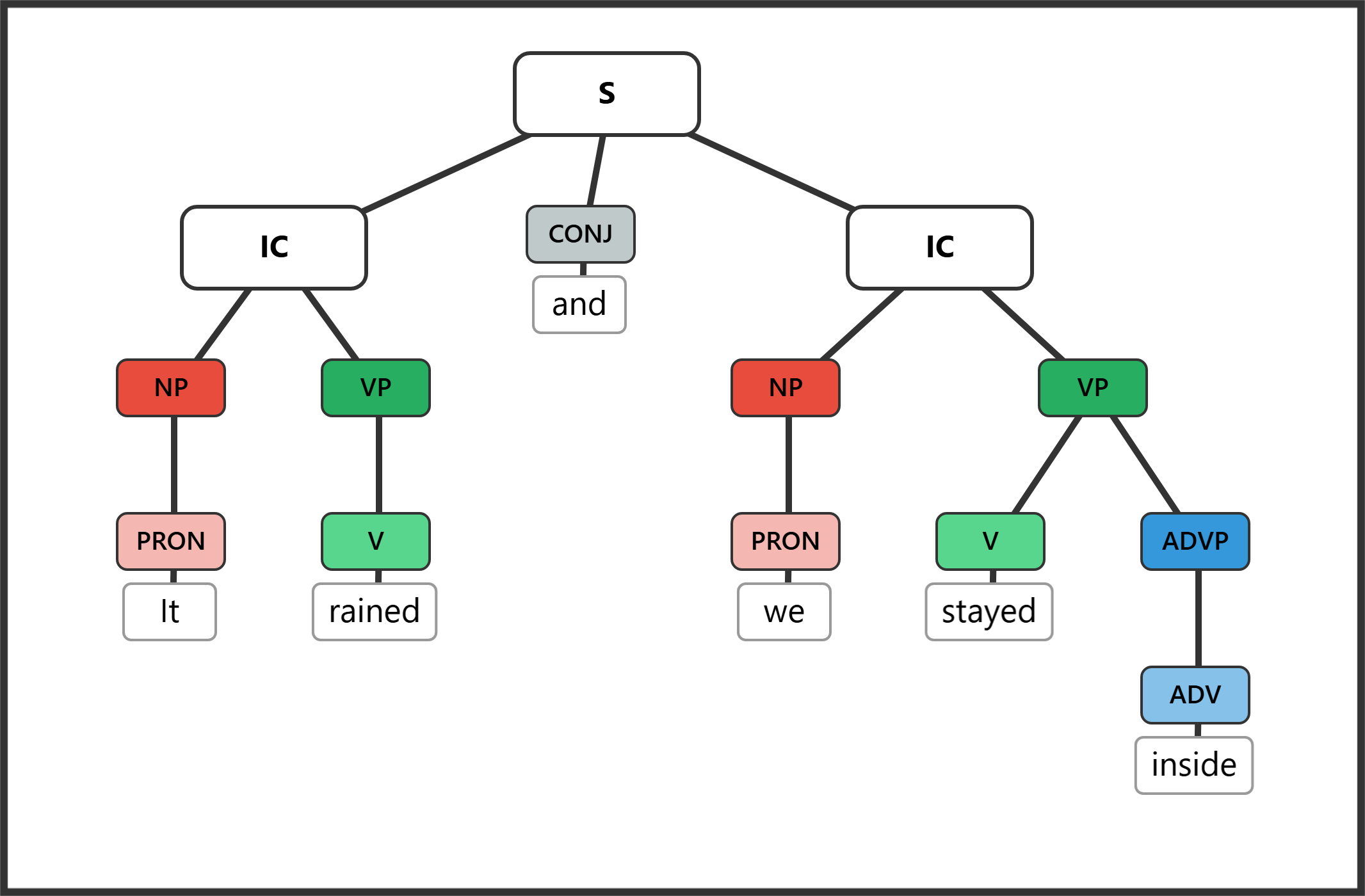
[S [IC [NP [PRON It]] [VP [V rained]]] [CONJ and] [IC [NP [PRON we]] [VP [V stayed] [ADVP [ADV inside]]]]]
Clause Roles in Compound Sentences.
In the labeling table above, each independent clause receives the role Main at the clause level. Why "Main"? Because each independent clause could be the main clause of its own sentence. Coordination preserves that independence—it presents two main clauses side by side as equals. Neither clause is pushed into a supporting role. The tree diagram reflects this structure: both clauses appear as IC (independent clause) nodes directly under the sentence node S, connected by the conjunction.
Compound vs. Compound Elements.
Don’t confuse compound sentences with simple sentences containing compound elements:
| Structure | Example | Type |
|---|---|---|
| Compound subject | Marcus and Elena traveled. | Simple (one VP) |
| Compound predicate | The dog barked and chased the squirrel. | Simple (one subject) |
| Compound sentence | She writes poetry, and he composes music. | Compound (two clauses) |
Test: Does each side of the conjunction have its own subject and predicate? If yes → compound sentence. If they share a subject or a predicate → simple sentence with a compound element.
Compare the simple sentence Marcus and Elena traveled (compound subject, one clause):
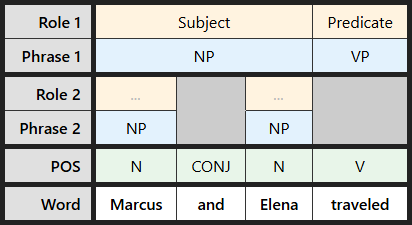
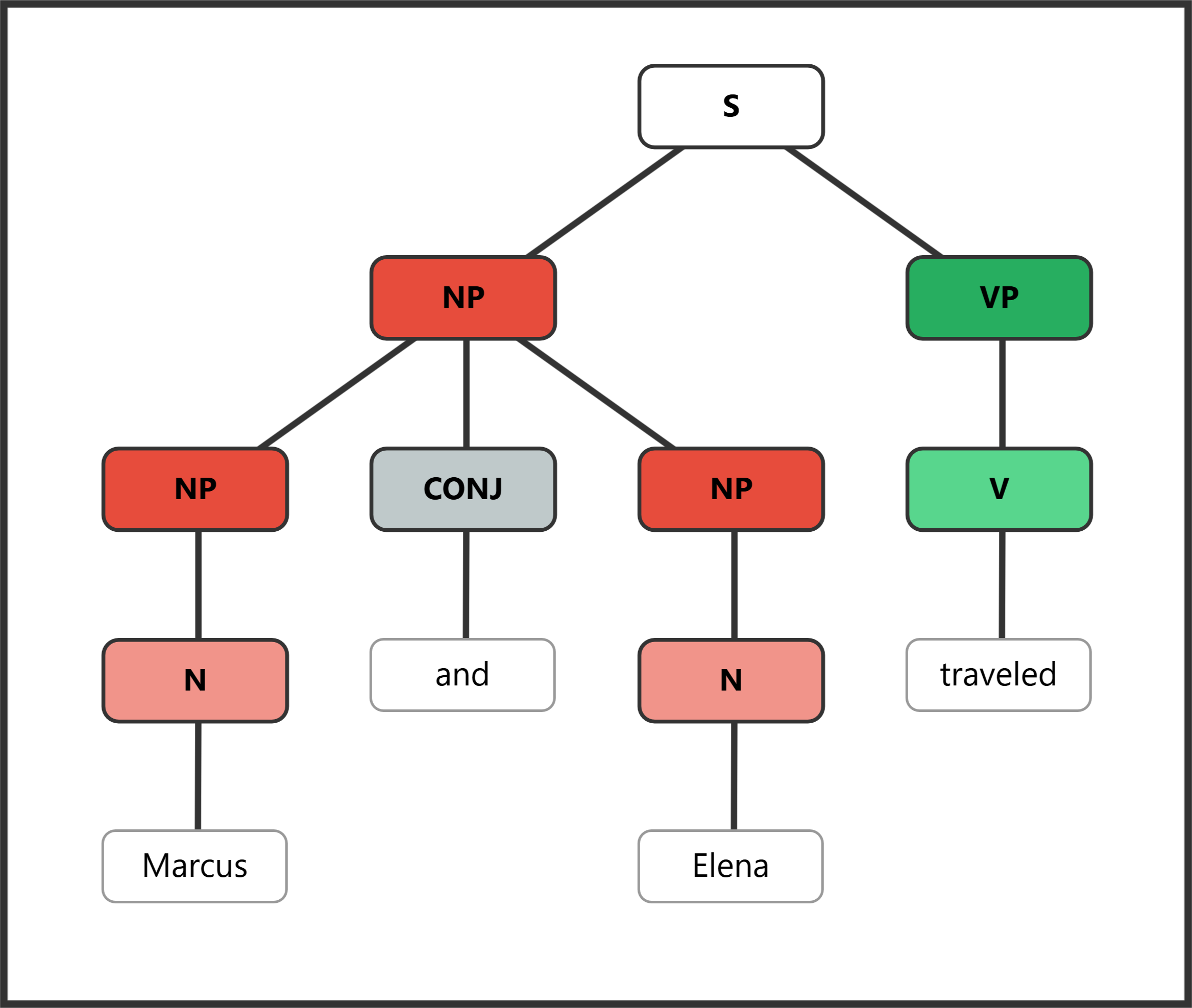
[S [NP [NP [N Marcus]] [CONJ and] [NP [N Elena]]] [VP [V traveled]]]
With the compound sentence She writes poetry, and he composes music (two independent clauses, both labeled Main):
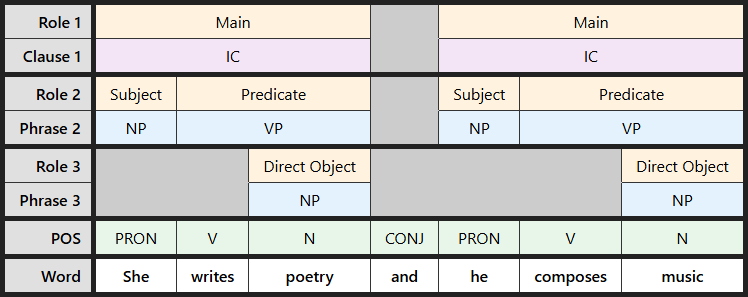
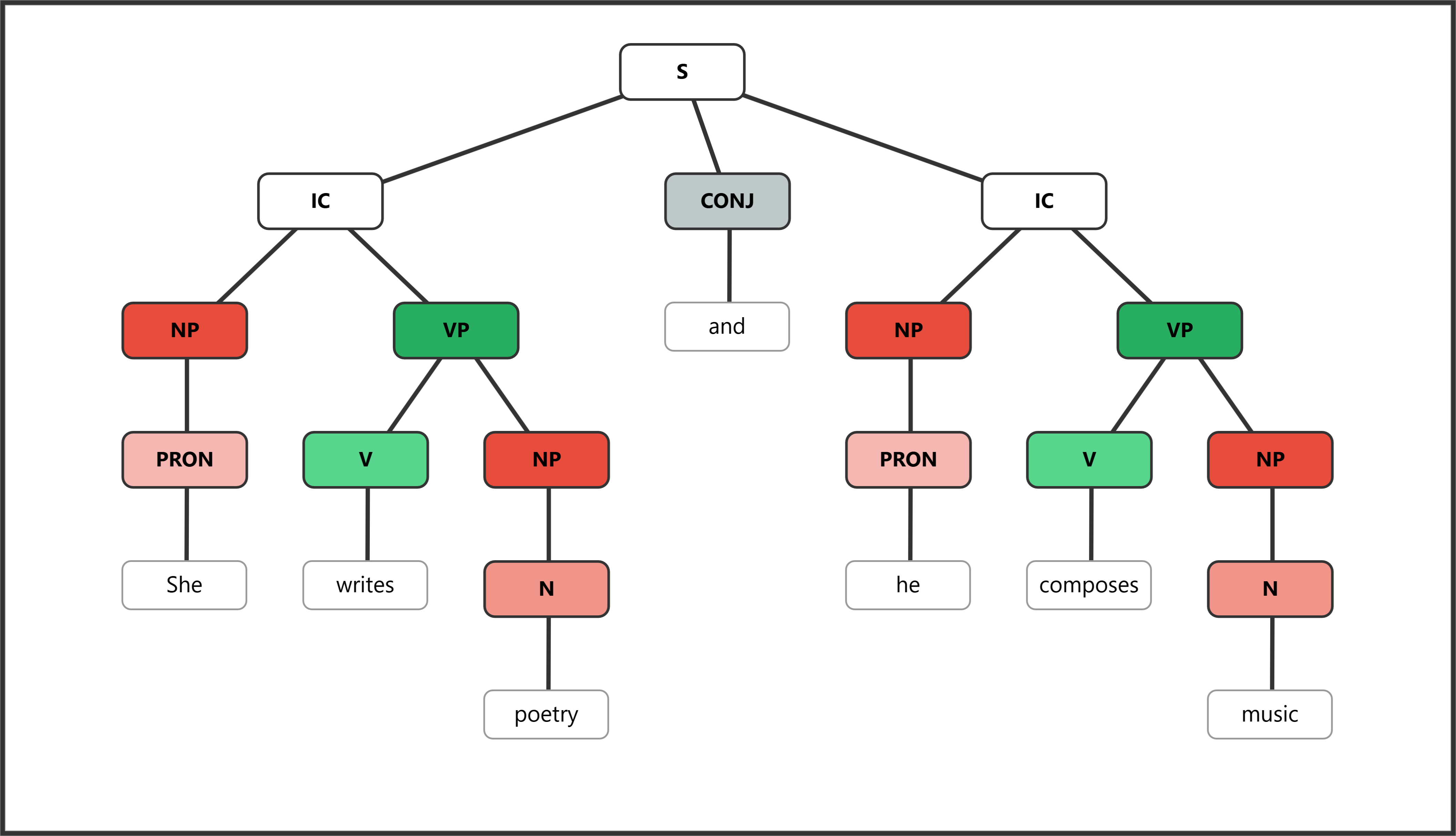
[S [IC [NP [PRON She]] [VP [V writes] [NP [N poetry]]]] [CONJ and] [IC [NP [PRON he]] [VP [V composes] [NP [N music]]]]]

