Section 11.6 Combining Modals with Tense and Aspect
In Chapter 10 you learned how tense and aspect combine within the verb phrase: present or past tense, simple or progressive aspect, perfect or non-perfect. Modals add another layer to this system. Because modals always appear first in the verb phrase—before any auxiliaries and before the main verb—they can combine with every tense-aspect pattern you already know. The result is a rich set of verb phrase structures that let speakers simultaneously express time, aspect, attitude, and voice.
The Base Form Rule.
There is one principle that governs every modal combination: the verb or auxiliary immediately after a modal always appears in its base (present) form. Modals absorb the tense, so nothing after them needs to carry tense marking:
-
He must have left. — base form have, not
must has -
They might have been sleeping. — have in base form, been as past participle of be (required by the perfect)
This rule applies no matter how complex the verb phrase gets. The modal takes the first position and the base form rule handles the rest.
Modal + Simple Verb.
The simplest combination places a modal directly before the base form of the main verb:
-
She can write. (ability)
-
You must leave. (obligation)
-
It might rain. (possibility)
Modal + Progressive.
Adding progressive aspect (modal + be + -ing) presents the action as ongoing at the time the modal applies to:
-
She must be sleeping. (I conclude she is sleeping right now)
-
They could be waiting for us. (it is possible they are waiting)
-
He should be studying. (he has an obligation to be studying)
Modal + Perfect.
Adding perfect aspect (modal + have + past participle) reaches back into the past while carrying the modal’s attitude:
-
She must have left. (I conclude she left)
-
He might have forgotten. (possibly he forgot)
-
You should have called. (but you didn’t—criticism)
-
I would have helped if I could. (hypothetical past)
-
They could have won. (they had the ability but didn’t)
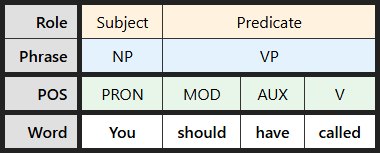
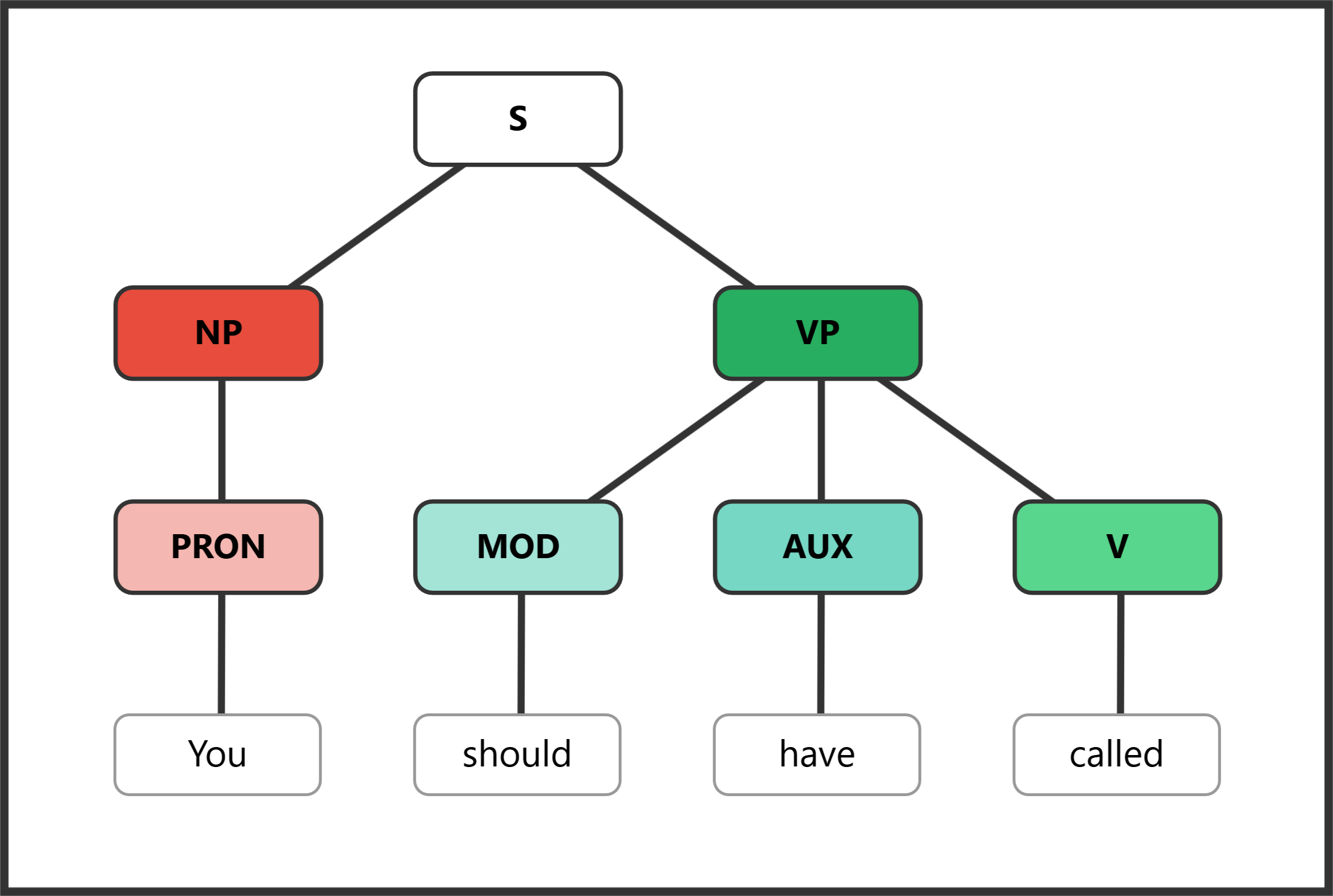
[S [NP [PRON You]] [VP [MOD should] [AUX have] [V called]]]
Modal + Passive.
Modals also combine with passive voice (modal + be + past participle). You will learn more about passive voice in the sections that follow, but notice the pattern here:
-
The report can be written by anyone.
-
Mistakes will be corrected.
-
The decision should be made carefully.
Complex Combinations.
All of these can combine further. Modal + perfect + progressive, modal + perfect + passive—English verb phrases can stack multiple layers:
-
She must have been sleeping. (modal + perfect + progressive)
-
The report should have been written. (modal + perfect + passive)
-
He could have been being interviewed. (modal + perfect + progressive + passive—grammatical but rare)
The following table summarizes the main combinations:
| Combination | Pattern | Example |
|---|---|---|
| Modal + simple | modal + base verb | can write |
| Modal + progressive | modal + be + -ing | must be writing |
| Modal + perfect | modal + have + past participle | should have written |
| Modal + passive | modal + be + past participle | can be written |
| Modal + perfect + progressive | modal + have been + -ing | must have been writing |
| Modal + perfect + passive | modal + have been + past participle | must have been written |
The key principle is that the order is always fixed: modal comes first, then perfect have (if present), then progressive or passive be (if present), then the main verb. You cannot rearrange these elements. This fixed ordering is what makes the English verb phrase systematic rather than chaotic—once you know the slots, you can build any combination.

