Section 13.5 Adjective Phrase Adjectivals
The adjective phrase is the prototypical adjectival—the first structure most people think of when they hear "noun modifier." An adjective phrase can be as simple as a single adjective (tall) or as elaborate as an adjective with degree modifiers and complements (very happy about the news). Because adjective phrases are so central to the adjectival function, this section examines them in detail: how they are formed, how grading and degree modification work, and what positions they occupy.
Formation.
An adjective phrase consists of a head adjective with optional modifiers:
-
Simple: the tall man
-
With degree modifier: a very tall man
-
With complement: someone proud of her work
-
With both: a student extremely eager to learn
Grading and Degree Modification.
Most adjectives can be graded—they express degrees of a quality:
-
Comparative: a taller building, a more interesting book
-
Superlative: the tallest building, the most interesting book
-
Degree adverbs: a very tall building, an extremely interesting book, a somewhat difficult problem
Some adjectives cannot be graded because they name absolute states: unique, dead, pregnant, perfect. You can say a unique opportunity but not a very unique opportunity (in formal usage).
Labeling Table.
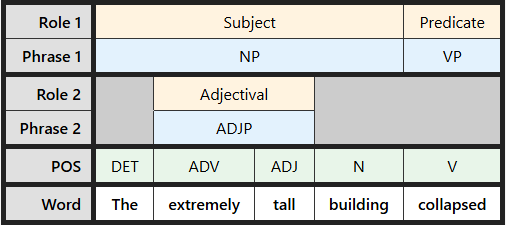
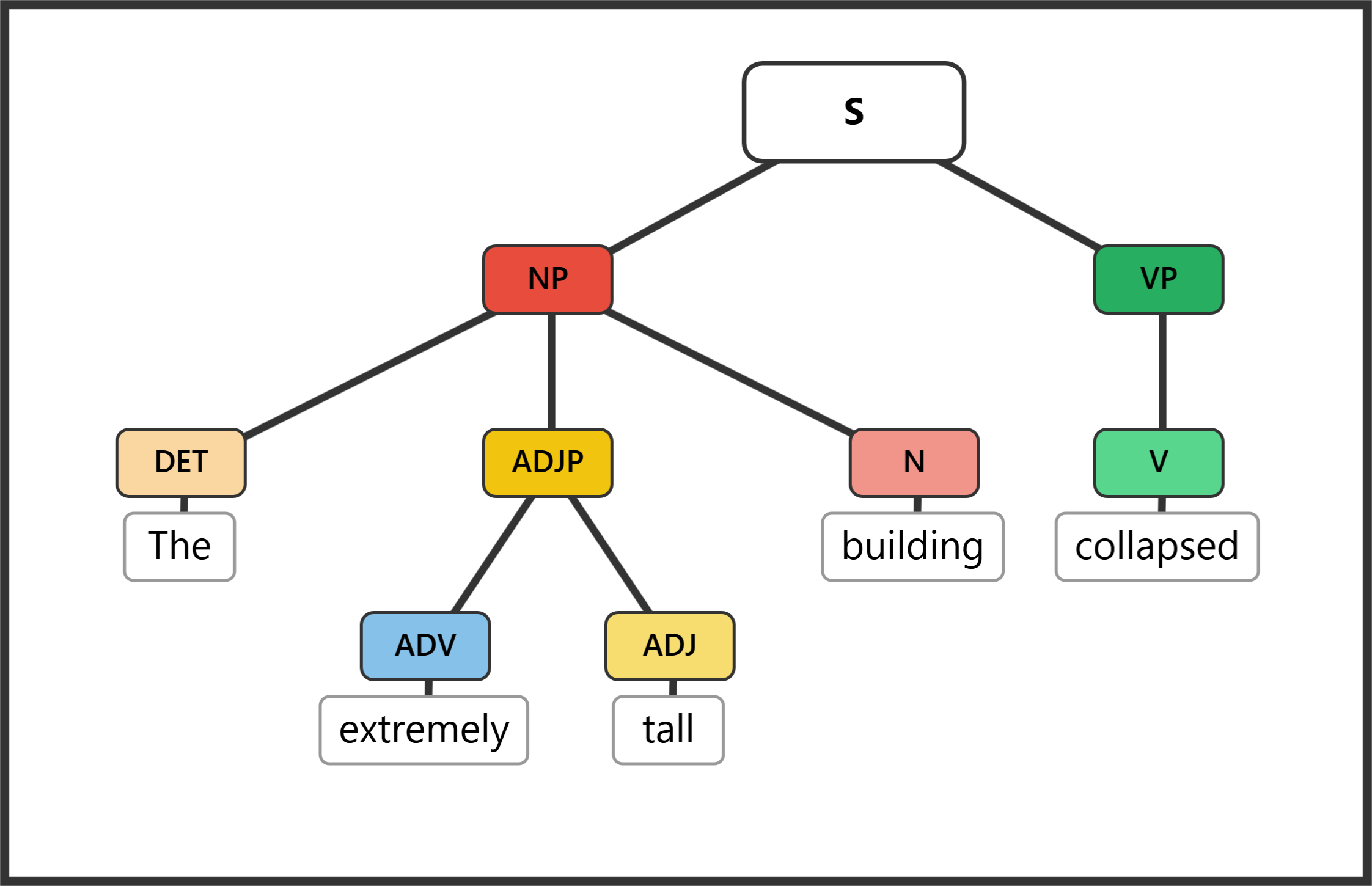
[S [NP [DET The] [ADJP [ADV extremely] [ADJ tall]] [N building]] [VP [V collapsed]]]
The adverb extremely modifies the adjective tall, forming an adjective phrase that functions adjectivally to modify building.
Key Points.
-
Simple adjective phrases appear in attributive position (before the noun) or predicative position (after a linking verb).
-
Adjective phrases with complements move to post-nominal position: someone proud of her work (not
a proud of her work student). -
In diagrams, label the adjective phrase node as ADJP regardless of position.

