Section 14.4 Noun Phrase Nominals
The noun phrase is the prototypical nominal—the structure that fills argument positions by default. Every other nominal type in this chapter can be understood as a non-NP structure stepping into a slot that an NP would normally occupy. Understanding the NP baseline makes the other types easier to grasp, because once you know what an NP can do, you can recognize a present participle phrase or a clause as doing the same job—occupying the same slot, satisfying the same valency, triggering the same verb agreement—simply through a different surface form.
Formation.
A noun phrase consists of a head noun with optional determiners, pre-modifiers, and post-modifiers (Chapter 7). The head determines the agreement features of the whole NP:
-
Bare head: books
-
Determiner + head: the book
-
Determiner + pre-modifier + head: the interesting book
-
Pre-modification and post-modification combined: the interesting old book on the shelf
Section 14.1 showed a basic NP filling the subject slot in The students read books. The labeling table and tree diagram for that example serve as the canonical NP-as-subject illustration; refer back to it for the simplest case. Below we illustrate a more developed NP—one with both pre-modification and post-modification—to show that internal complexity does not change the nominal function.
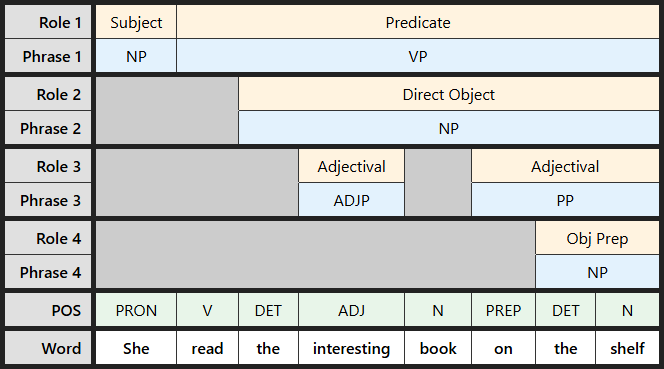
Consider the sentence She read the interesting book on the shelf. The subject She is a pronoun NP; the direct object the interesting book on the shelf is a much heavier NP that combines a determiner, an adjective phrase, a head noun, and a postmodifying prepositional phrase. Despite the difference in length, both NPs do exactly what NPs do: they fill an argument slot of the verb read.
Labeling Table: She read the interesting book on the shelf.
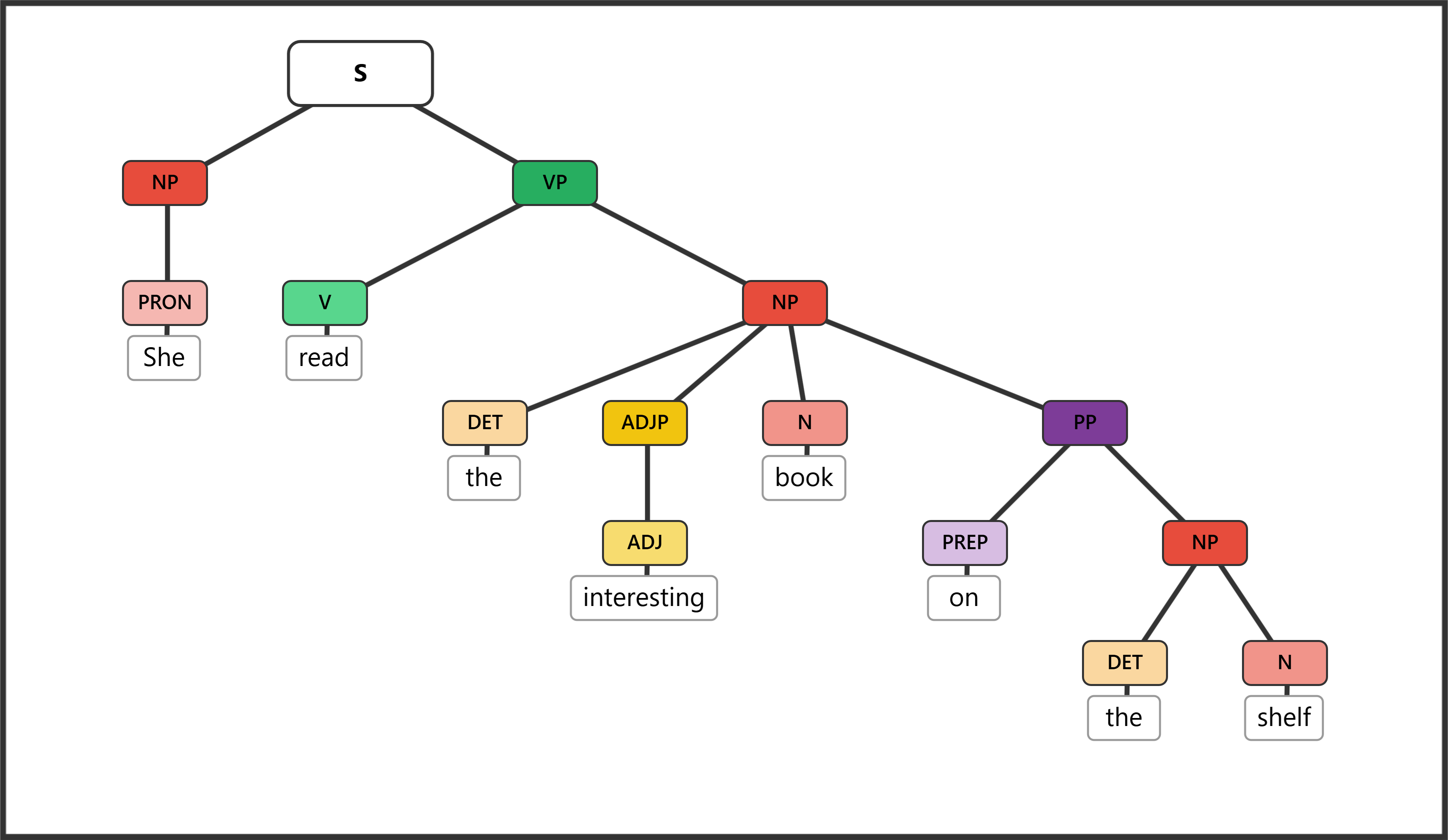
[S [NP [PRON She]] [VP [V read] [NP [DET the] [ADJP [ADJ interesting]] [N book] [PP [PREP on] [NP [DET the] [N shelf]]]]]]
The internal structure of the direct-object NP shows three layers of modification—an adjective before the head, a prepositional phrase after the head, and a smaller NP inside that PP—but the topmost label of the whole structure is still NP, and its role is still Direct Object. That is the point: NPs scale up without changing what they are functionally.
Key Points.
-
NPs can fill all six nominal positions (subject, direct object, indirect object, object of preposition, subject complement, object complement).
-
The head noun determines the number (singular/plural) and triggers verb agreement, regardless of how many modifiers attach to it.
-
Chapters 12 and 13 showed NPs functioning as adverbials and adjectivals—form is noun phrase, but function varies. Position in the sentence is what tells you whether an NP is acting as a nominal, an adverbial, or an adjectival.

