Section 14.1 Nouns vs. Nominals: Form vs. Function
You have already encountered the form-vs.-function distinction twice: in Chapter 12, where you saw that adverbs, prepositional phrases, noun phrases, and clauses can all serve the adverbial function; and in Chapter 13, where you saw that adjectives, nouns, participial phrases, and relative clauses can all serve the adjectival function. Here the same logic applies to the nominal function. The form of a word tells you its part of speech; the function tells you the role it plays in a sentence. A word or phrase that fills a noun-phrase slot—regardless of its internal structure—is functioning nominally.
Noun as Form.
A noun is a part of speech—a word class with particular morphological and syntactic characteristics (Chapter 5). Nouns can be pluralized, possess, follow determiners, and serve as subjects and objects. Examples: book, happiness, Maria, government.
Nominal as Function (Role in a Sentence).
A nominal is any word, phrase, or clause that functions in a position typically occupied by a noun phrase—as subject, object, or complement. The key insight: all nouns functioning as subjects or objects are nominals, but not all nominals are nouns.
Consider a noun phrase filling the subject role:
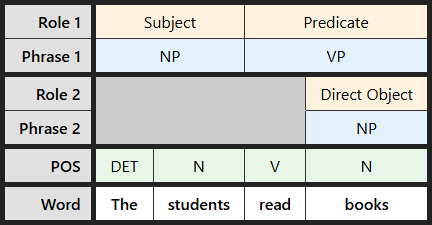
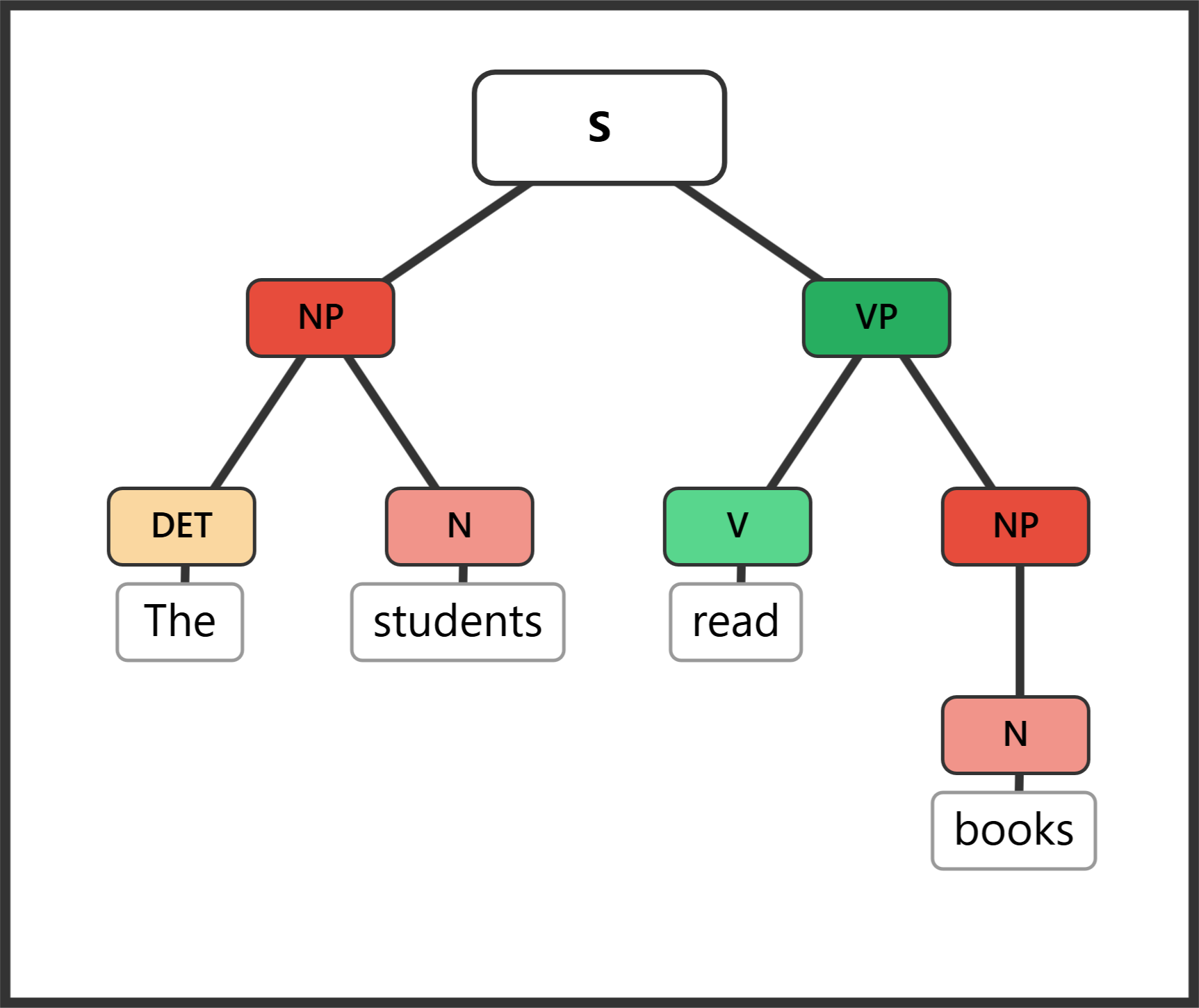
[S [NP [DET The] [N students]] [VP [V read] [NP [N books]]]]
Now compare a present participle phrase filling the same subject role:
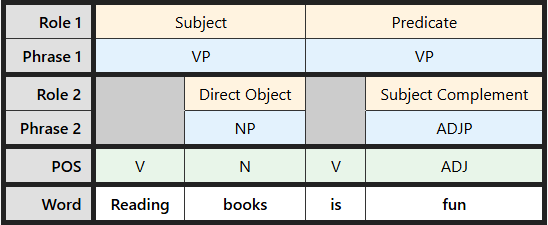
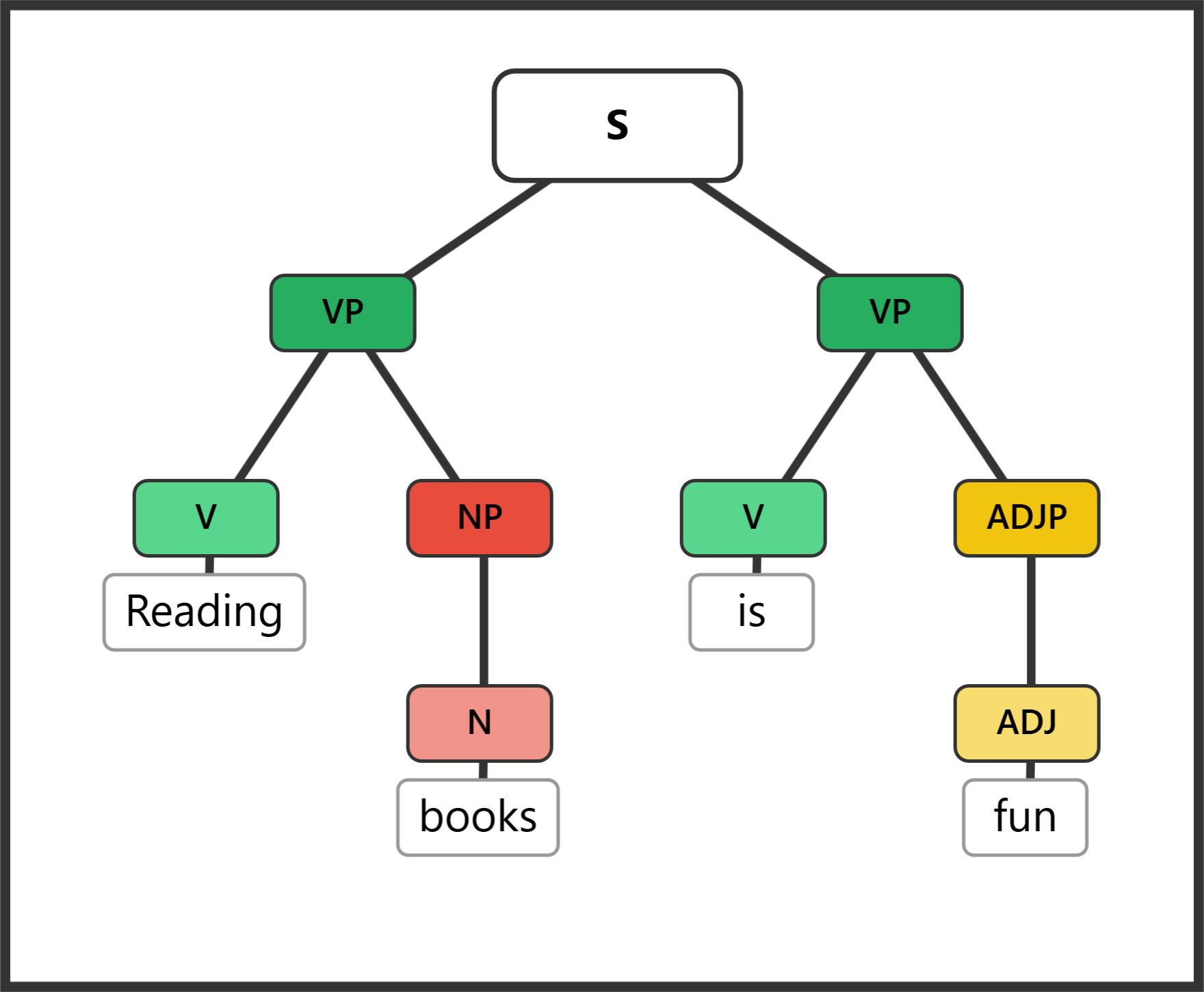
[S [VP [V Reading] [NP [N books]]] [VP [V is] [ADJP [ADJ fun]]]]
Both The students and Reading books fill the subject slot. Their forms are completely different—a noun phrase and a present participle phrase (also called a gerund phrase when used nominally)—but their function is the same.
The Six Nominal Positions.
Unlike adverbials (which are optional) and adjectivals (which modify nouns), nominals fill the argument positions of a clause—the slots that the verb requires or that the sentence structure provides. Chapter 8 introduced these positions; here is a quick reference:
| Position | Location | Example |
|---|---|---|
| Subject | Before the verb | The dog barked. |
| Direct Object | After a transitive verb | She read the book. |
| Indirect Object | Before the direct object | She gave me a book. |
| Object of Preposition | After a preposition | We talked about the problem. |
| Subject Complement | After a linking verb | She is a doctor. |
| Object Complement | After the direct object | They elected her president. |
See Section 14.3 for a fuller treatment of these positions with examples from all nominal types.

