Section 6.4 Prepositions and Prepositional Phrases
Prepositions are the relationship words of English. They create connections between elements in a sentence, expressing how entities relate to each other in space, time, and abstract logic. Without prepositions, we could name things and describe actions, but we could not express where something is, when it happened, how it was done, or what it was about.
Consider the range of relationships that prepositions express. They mark spatial relationships—where things are in relation to each other: “in” the box, “on” the table, “under” the bridge, “above” the clouds, “beside” the river, “between” the buildings. They mark temporal relationships—when events occur relative to other events: “before” lunch, “after” the meeting, “during” the lecture, “since” Tuesday, “until” midnight, “throughout” the semester. And they mark logical and abstract relationships—connections of cause, purpose, association, and topic: “of” the people, “for” a reason, “with” great care, “about” the election, “despite” the obstacles, “because of” the weather.
A single preposition shift can change meaning dramatically. Think about how differently these phrases describe the relationship between the book and the table: “the book on the table”, “the book about the table”, “the book under the table”, “the book beside the table”. The noun phrase stays the same, but the preposition reconfigures the relationship entirely—from physical location (on, under, beside) to subject matter “about”.
Prepositions combine with noun phrases to form prepositional phrases (PPs), which function as modifiers throughout the sentence. They are among the most common structures in English—virtually every sentence of any complexity contains at least one prepositional phrase.
Identifying Prepositions.
A traditional mnemonic says prepositions describe "anywhere a cat can be": “in” the box, “on” the table, “under” the chair, “beside” the sofa, “near” the window, “through” the door...
But prepositions express much more than spatial relationships:
| Category | Examples |
|---|---|
| Spatial | in, on, at, above, below, under, over, between, among, through, across, behind, beside, near, toward |
| Temporal | before, after, during, since, until, throughout |
| Logical/Abstract | of, for, with, by, about, without, despite, concerning, regarding |
Complex prepositions are multi-word units that function as single prepositions:
-
because of, instead of, in spite of
-
according to, due to, prior to
-
in front of, on top of, in addition to
Prepositional Phrase Structure.
A prepositional phrase consists of a preposition plus its object (typically a noun phrase). The formula is simple: PP → Prep + NP
Here are several prepositional phrases shown as tree diagrams. Notice how each one follows the same pattern—a preposition followed by a noun phrase of varying complexity:
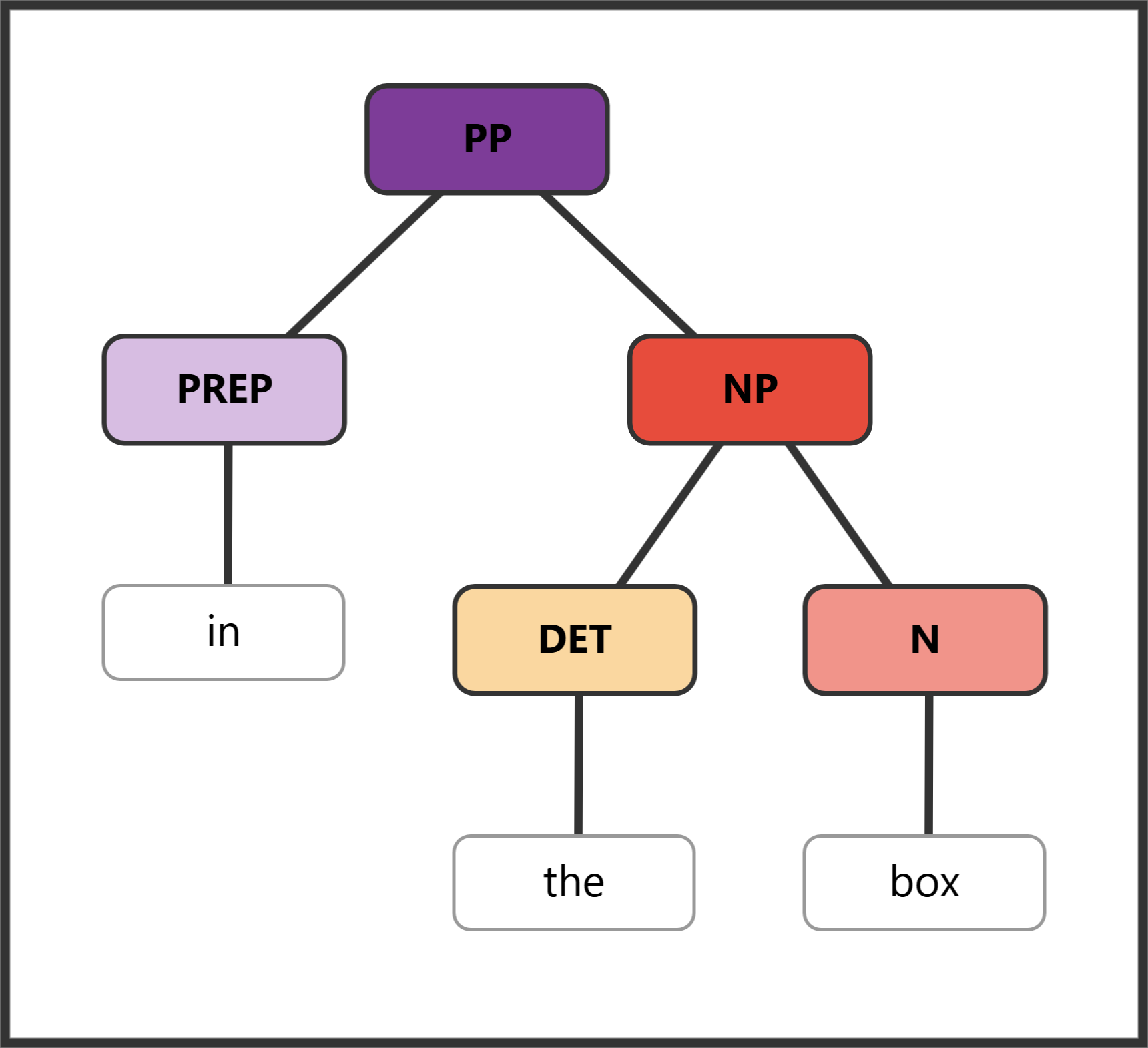
[PP [PREP in] [NP [DET the] [N box]]]
A simple prepositional phrase: in the box.
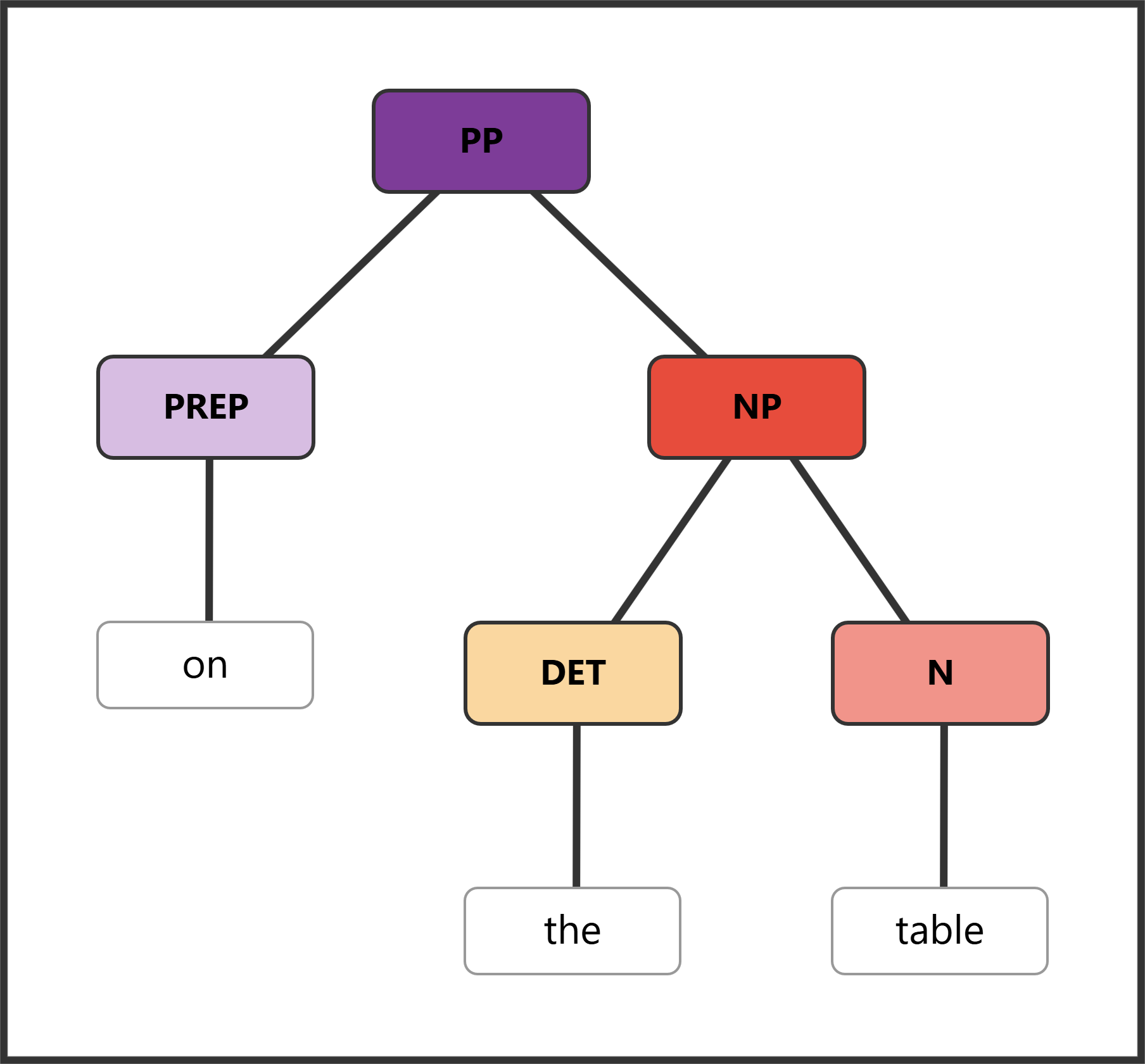
[PP [PREP on] [NP [DET the] [N table]]]
Prepositional phrase: on the table.
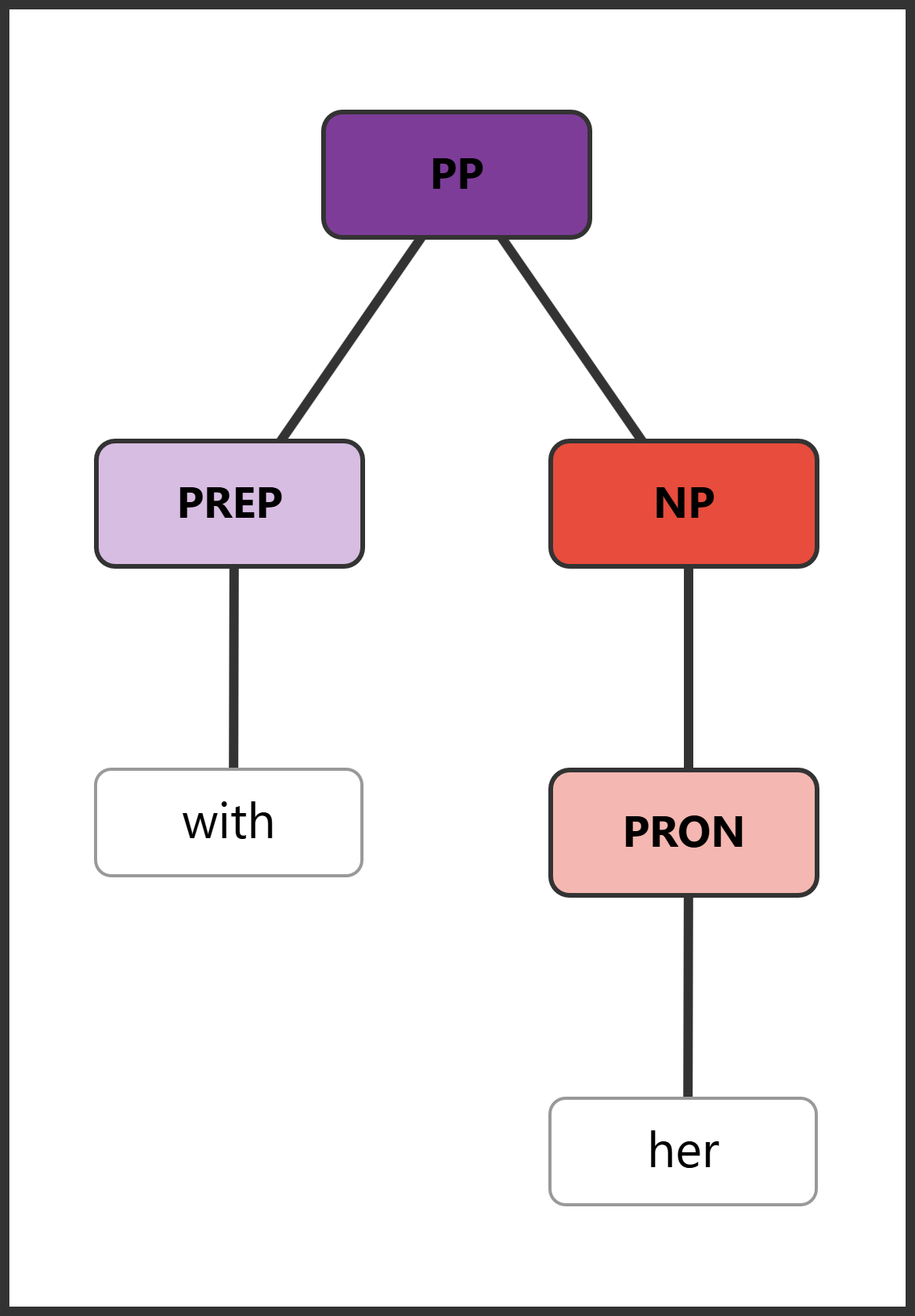
[PP [PREP with] [NP [PRON her]]]
Prepositional phrase with pronoun object: with her.
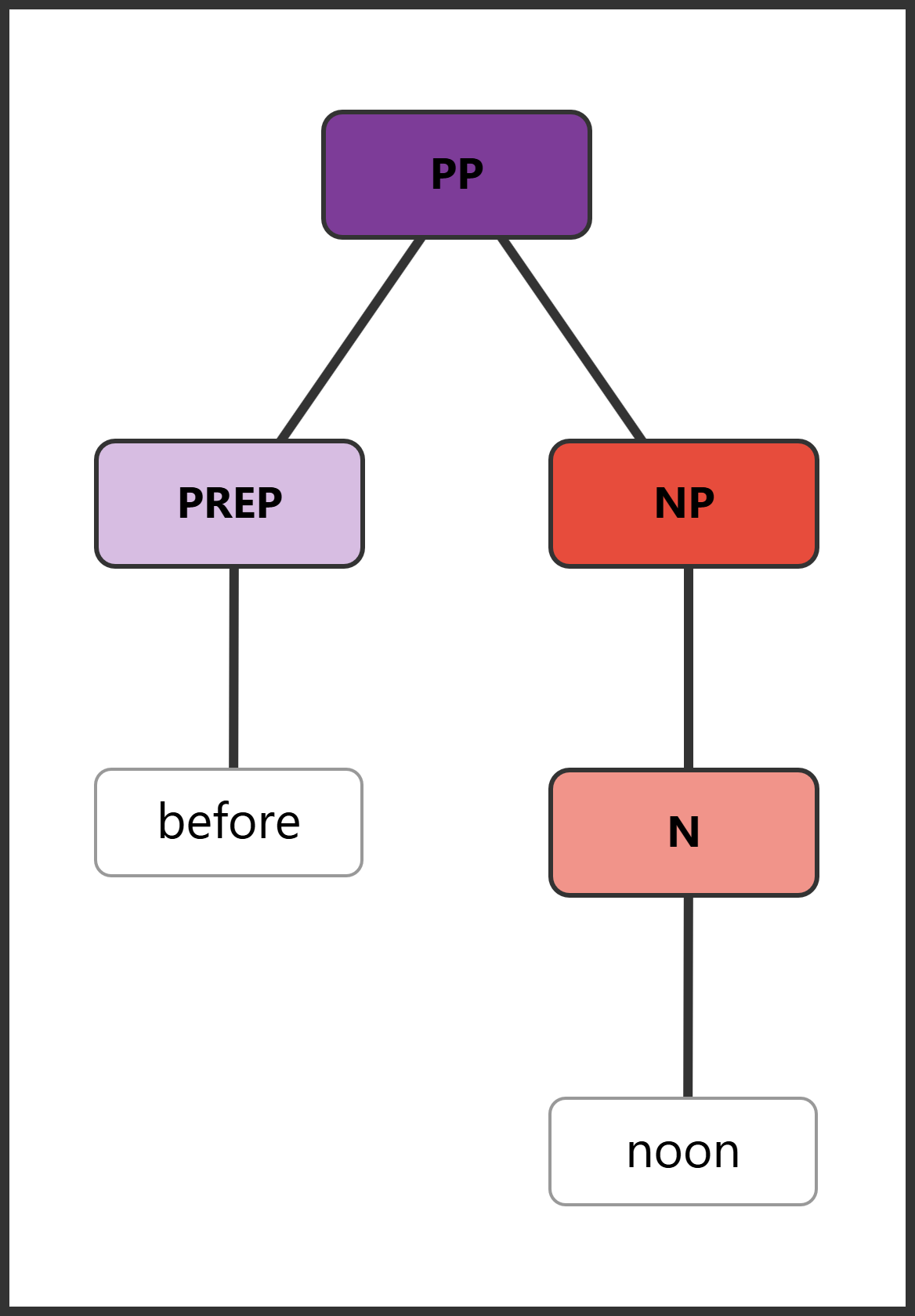
[PP [PREP before] [NP [N noon]]]
Prepositional phrase: before noon.
Examples of prepositional phrases:
-
in the morning
-
on the tall wooden table
-
to my best friend
-
from the old house on the corner
-
about the recent controversy
The object of the preposition can be:
-
A simple noun: in town
-
A complex NP: in the busy downtown area
-
A pronoun: with her (object form required)
What Prepositional Phrases Can Modify.
Prepositional phrases function as modifiers—they provide additional information about other elements in the sentence. Understanding what a PP modifies is essential for accurate sentence analysis. PPs can modify several different kinds of elements:
PPs modifying noun phrases: A PP can modify a noun, answering "which one?" or "what kind?"
-
the man in the hat (which man?)
-
a book about grammar (what kind of book?)
-
the house on the corner (which house?)
-
a sense of accomplishment (what kind of sense?)
In a tree diagram, notice how the PP “in the hat” is embedded inside the NP—it is part of the noun phrase, not separate from it:
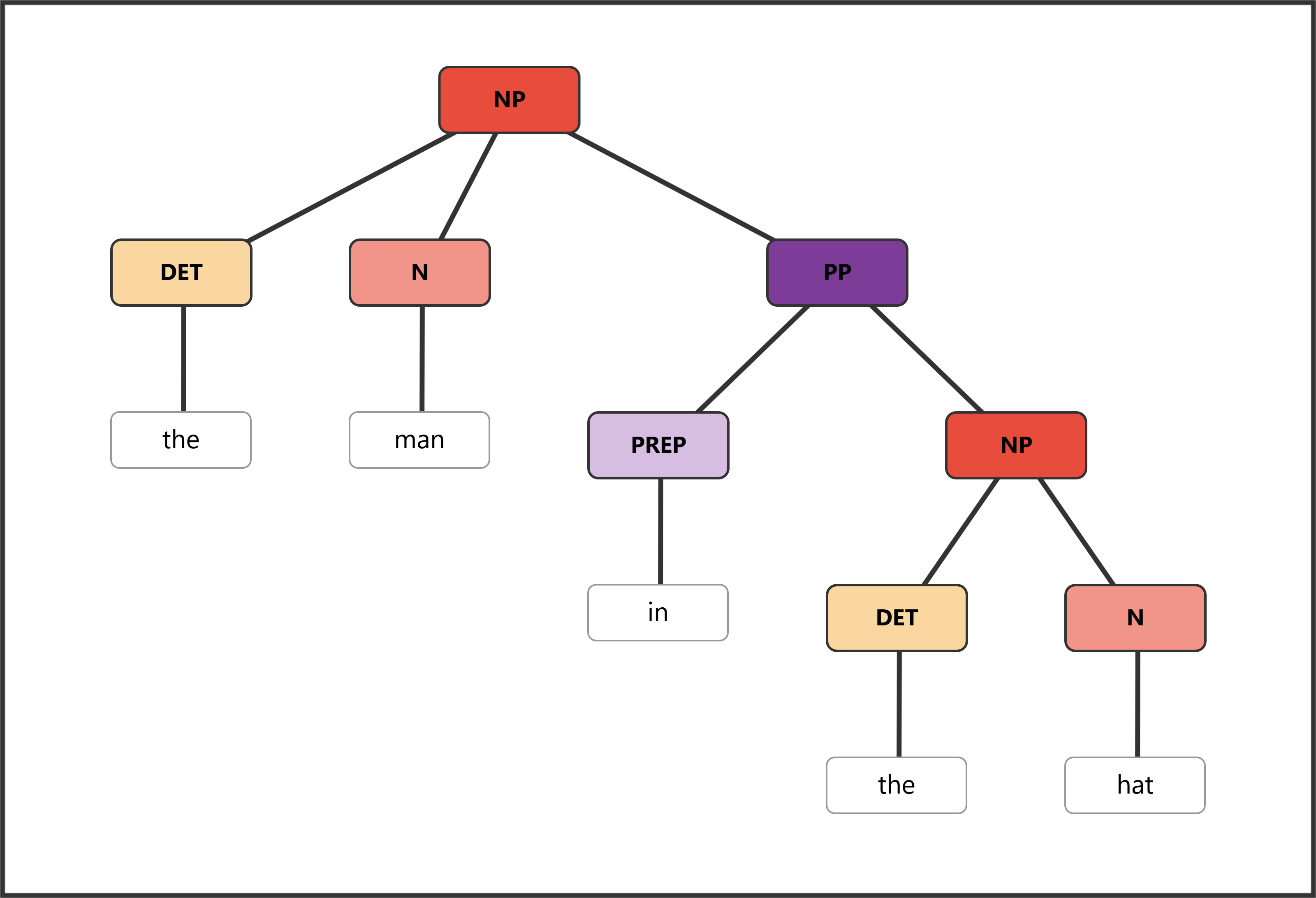
[NP [DET the] [N man] [PP [PREP in] [NP [DET the] [N hat]]]]
PP modifying a noun phrase: the man in the hat.
PPs modifying verb phrases: A PP can modify a verb or the action it describes, providing information about time, place, manner, reason, and other circumstances:
-
She waited in the lobby. (where?)
-
He arrived at noon. (when?)
-
They spoke with enthusiasm. (how?)
-
We left because of the weather. (why?)
When a PP modifies the verb, it attaches inside the VP rather than inside any noun phrase:
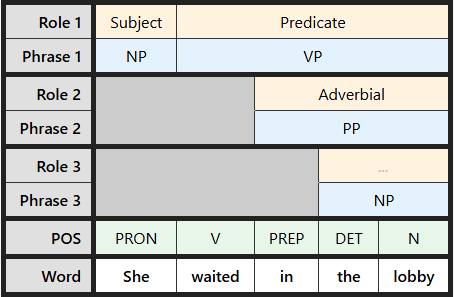
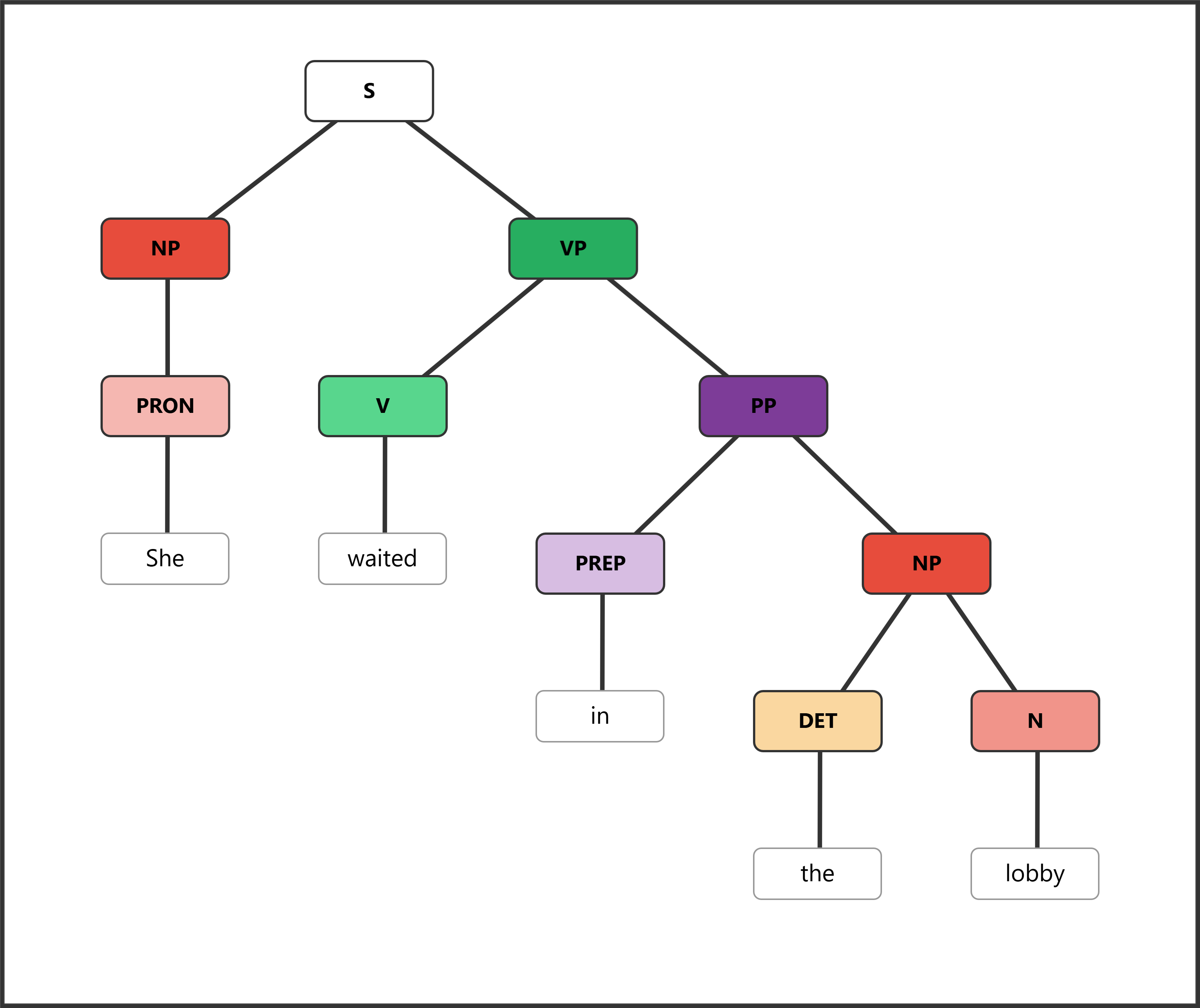
[S [NP [PRON She]] [VP [V waited] [PP [PREP in] [NP [DET the] [N lobby]]]]]
PP modifying a verb phrase: She waited in the lobby.
PPs modifying adjective phrases: Some adjectives require or commonly take PP complements:
-
She is proud of her work. (proud of what?)
-
I’m afraid of the dark. (afraid of what?)
-
He was angry about the decision. (angry about what?)
Here, the PP “of her work” is embedded inside the adjective phrase, completing the meaning of “proud”:
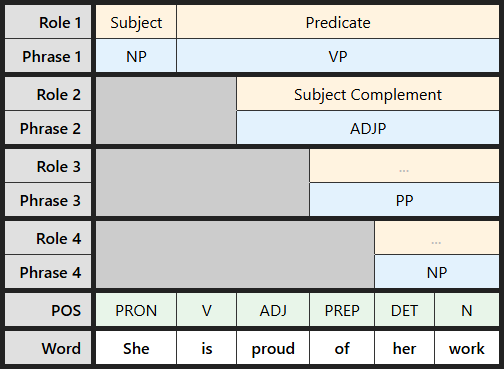
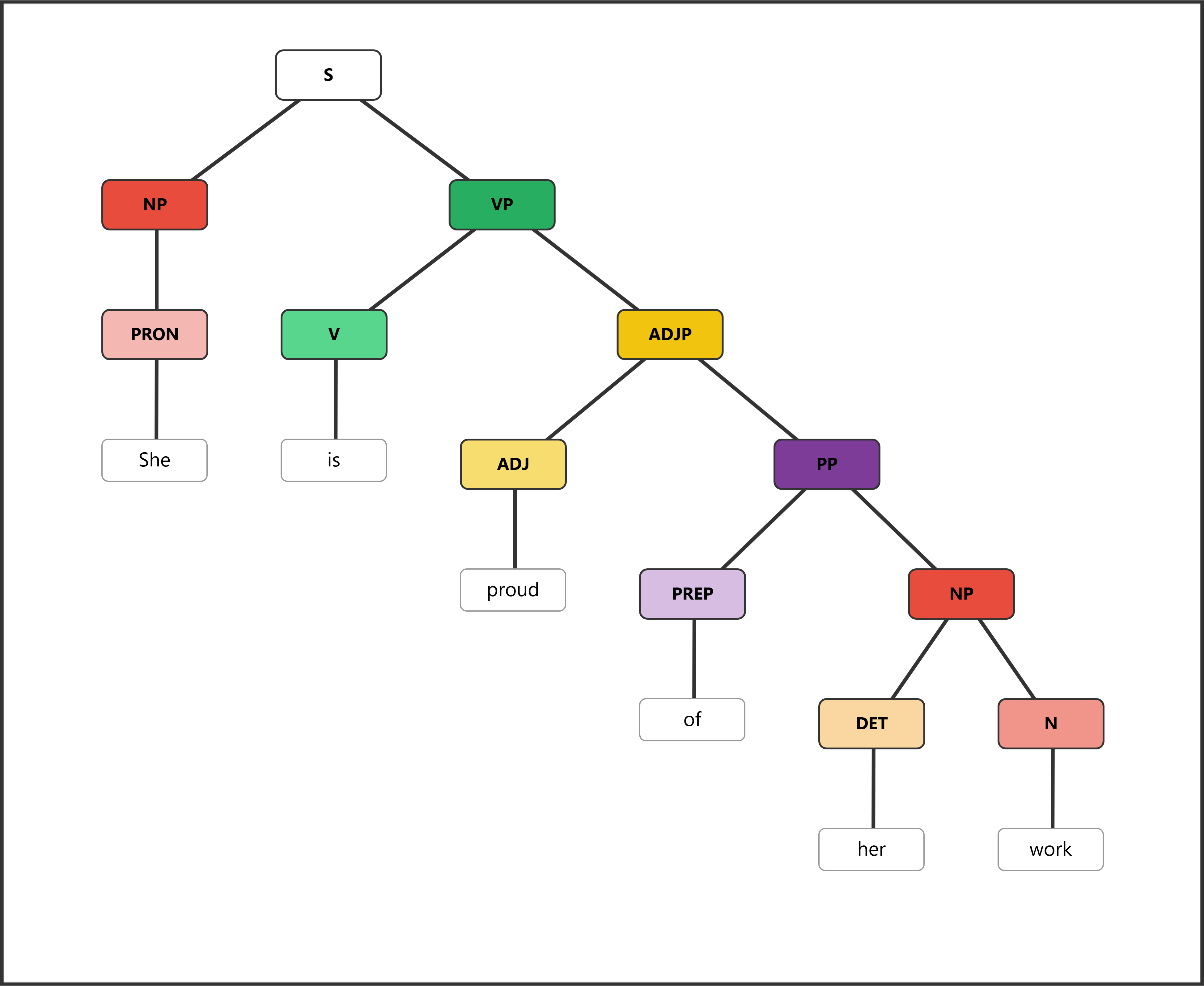
[S [NP [PRON She]] [VP [V is] [ADJP [ADJ proud] [PP [PREP of] [NP [DET her] [N work]]]]]]
PP modifying an adjective phrase: She is proud of her work.
PPs modifying sentences: A PP can modify an entire sentence, often appearing at the beginning:
-
In the morning, we will leave. (when?)
-
Despite the rain, the game continued. (under what circumstances?)
-
According to the report, sales have increased. (on what authority?)
When a PP modifies the whole sentence, it attaches at the sentence level rather than inside any particular phrase:
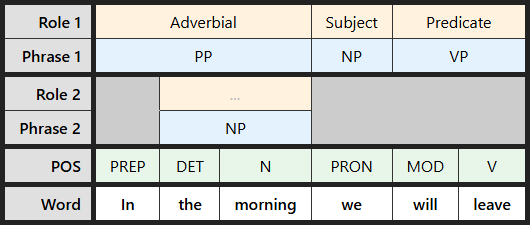
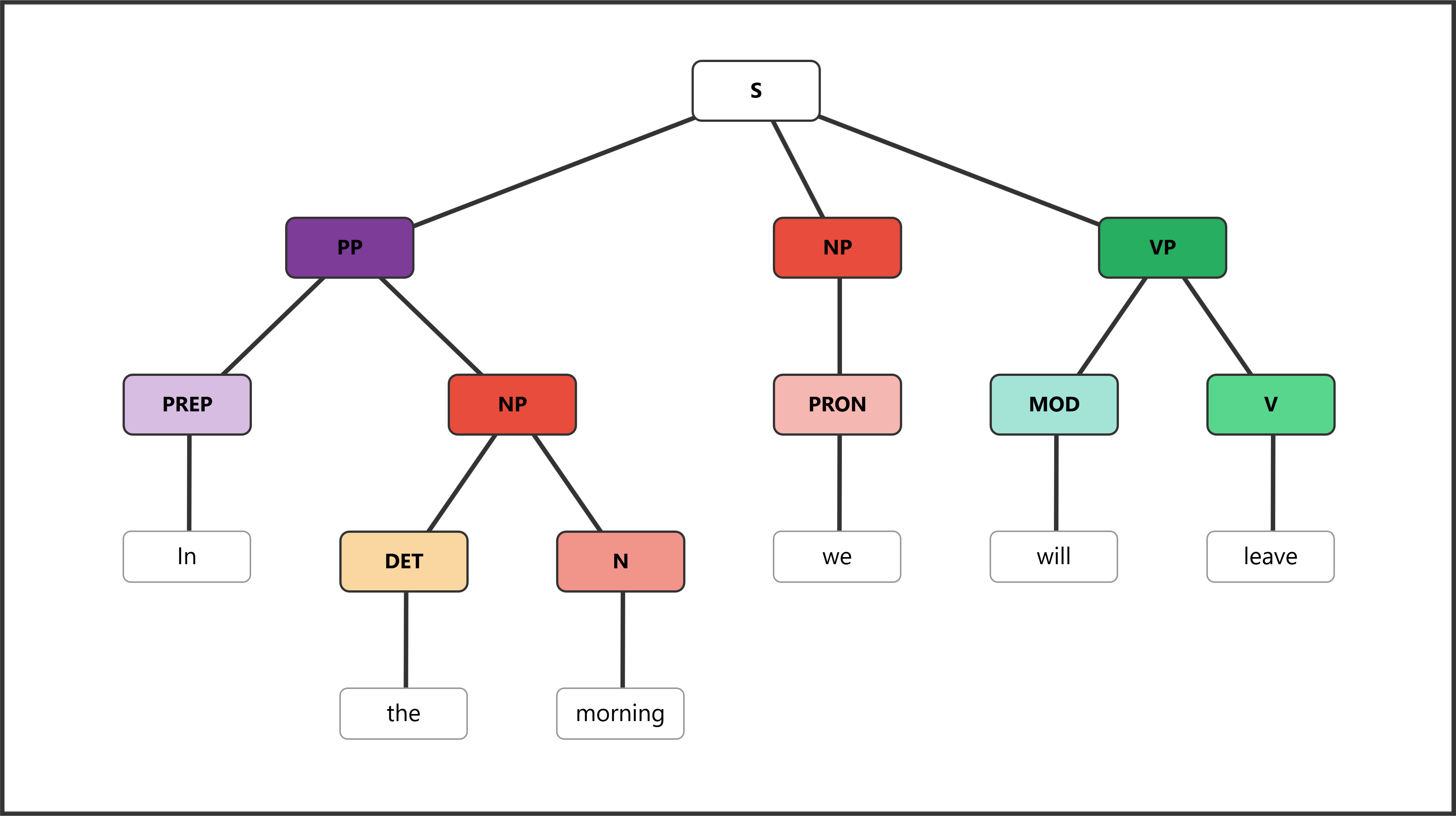
[S [PP [PREP In] [NP [DET the] [N morning]]] [NP [PRON we]] [VP [MOD will] [V leave]]]
PP modifying a sentence: In the morning, we will leave.
Determining What a PP Modifies.
The key question: What does the PP modify?
Test 1: What question does it answer?
-
"Which one?" or "What kind?" → PP modifies a noun the man in the hat
-
"Where?" "When?" "How?" → PP modifies a verb waited in the lobby
Test 2: Can it move to sentence-initial position?
-
PPs that modify verbs often can: In the morning, we left.
-
PPs that modify nouns typically cannot:
In the hat, the man waved.
Test 3: Does the noun phrase make sense without it?
-
If replacing the NP with a pronoun eliminates the PP, it modifies the noun: The man in the hat waved. → He waved. (PP gone—it was part of the NP)
-
If the PP survives pronoun replacement, it modifies the verb: She saw the man with binoculars. → She saw him with binoculars. (PP remains—it modifies saw)
Structural Ambiguity in PP Attachment.
Sometimes a prepositional phrase can plausibly attach to either the noun phrase or the verb phrase, creating structural ambiguity—a single sentence with two different possible structures and two different meanings. This is not a matter of vague wording; the words themselves are perfectly clear. The ambiguity arises because the grammar allows two different attachment points for the PP.
Consider the classic example:
I saw the man with binoculars.
-
Reading 1: The PP with binoculars modifies the noun man—"the man who had binoculars"
-
Reading 2: The PP with binoculars modifies the verb saw—"I used binoculars to see him"
The two readings correspond to two different tree structures. In Reading 1, the PP is embedded inside the NP:
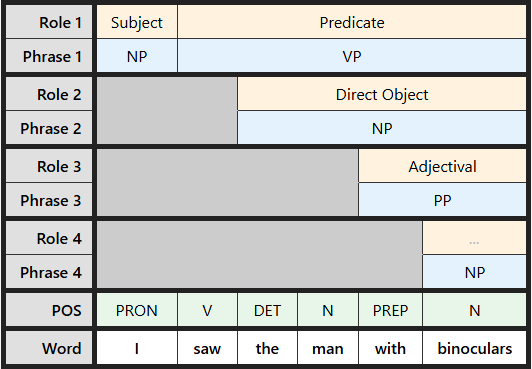
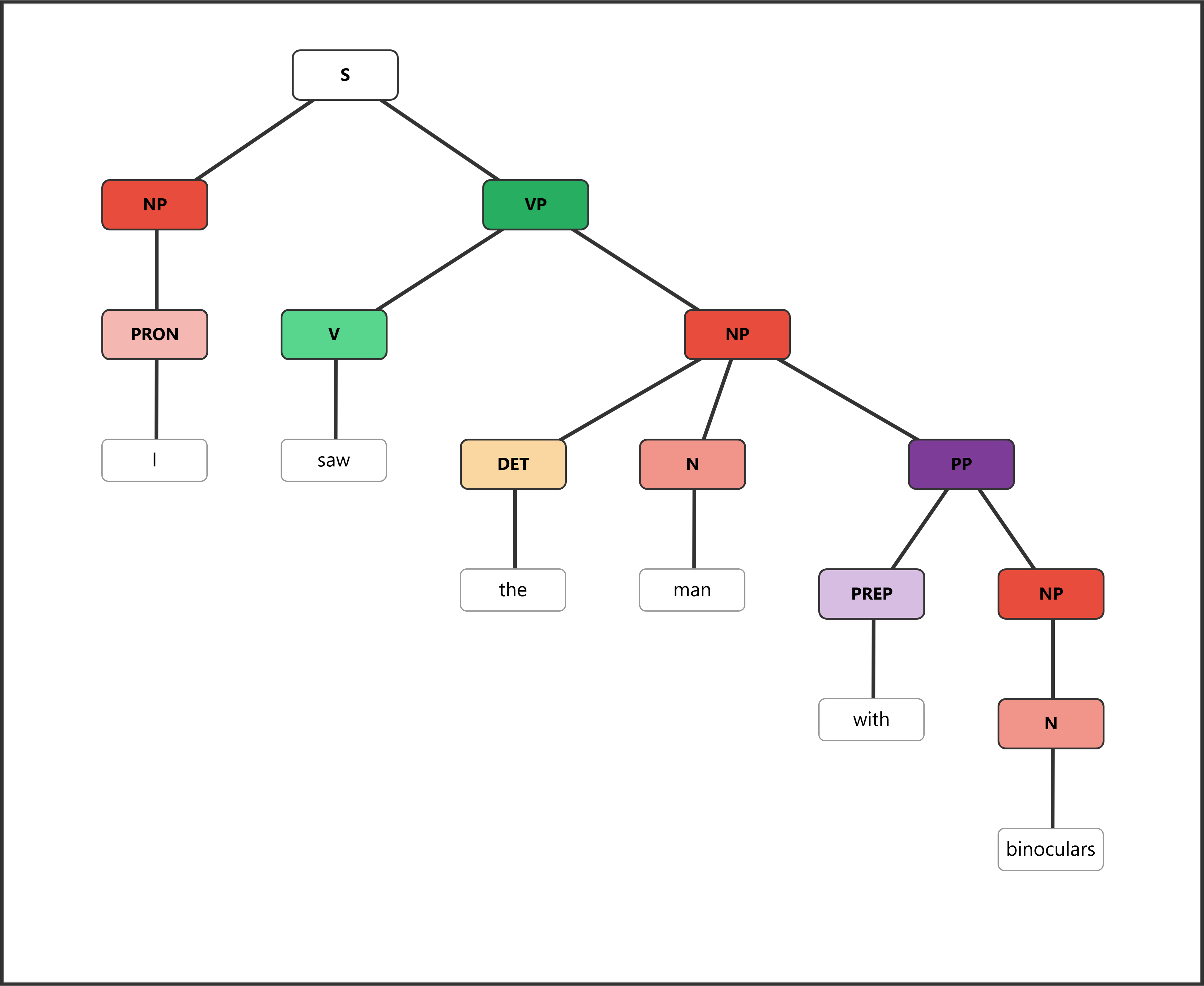
[S [NP [PRON I]] [VP [V saw] [NP [DET the] [N man] [PP [PREP with] [NP [N binoculars]]]]]]
PP modifying the NP: "the man with binoculars".
In Reading 2, the PP attaches to the VP instead:
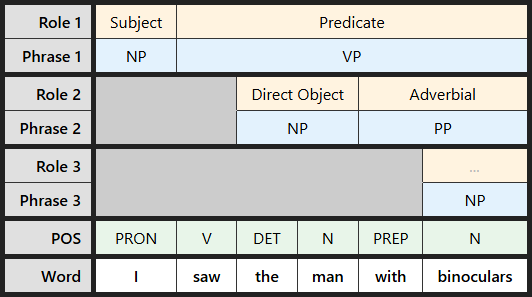
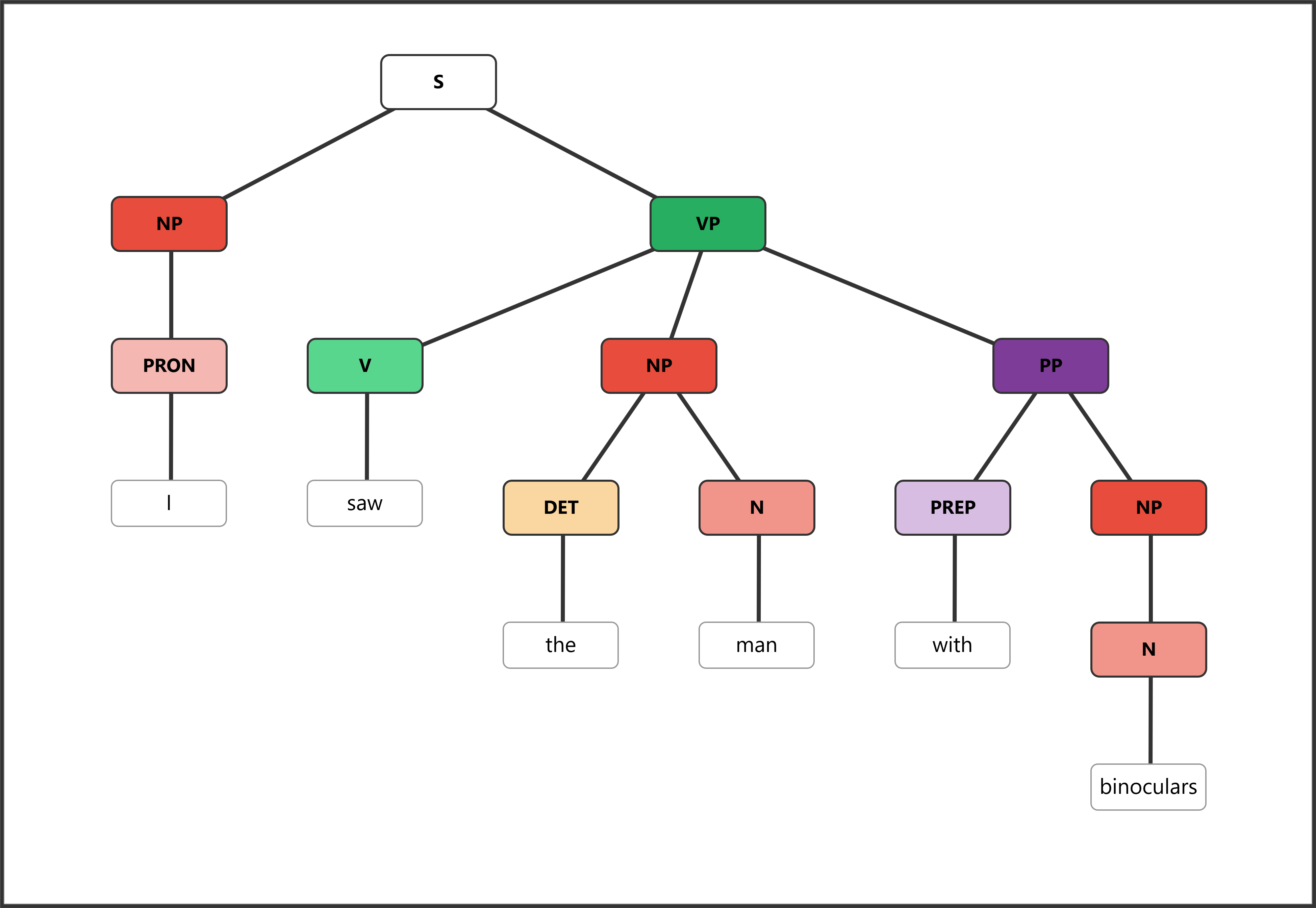
[S [NP [PRON I]] [VP [V saw] [NP [DET the] [N man]] [PP [PREP with] [NP [N binoculars]]]]]
PP modifying the VP: "saw with binoculars".
You can use the tests from the previous section to tease apart the two readings. The pronoun replacement test is especially helpful: if you replace “the man with binoculars” with “him” and the sentence still makes sense “I saw him with binoculars”, then “with binoculars” can modify the verb. If the PP disappears when you pronominalize “I saw him”, it was part of the NP.
Here is another example of the same kind of ambiguity:
He discussed the problem with the professor.
-
PP modifying the noun: "the problem that involves the professor"
-
PP modifying the verb: "he discussed it alongside the professor"
In speech, context usually resolves such ambiguity. In writing, you may need to restructure for clarity:
-
I saw the man who had binoculars. (PP modifies noun—unambiguous)
-
Using binoculars, I saw the man. (PP modifies verb—unambiguous)
Multiple PPs in a Sentence.
Sentences often contain multiple prepositional phrases with different functions:
The student from Colorado studied in the library for three hours.
-
from Colorado: modifies the noun student (which student?)
-
in the library: modifies the verb studied (where?)
-
for three hours: modifies the verb studied (how long?)

