Section 12.5 Noun Phrase Adverbials
Most noun phrases function as subjects, objects, or complements—nominal roles. But a restricted class of noun phrases can function adverbially, filling the same slot as a prepositional phrase or adverb. These are almost always expressions of time, direction, or extent. You cannot use just any noun phrase as an adverbial (She spoke the table.), but temporal and spatial expressions have a long history of adverbial use in English.
Formation.
Noun phrase adverbials take the same form as any NP—a noun with optional determiners and modifiers—but they appear in positions where you would expect a prepositional phrase or adverb. Compare:
-
She arrived on Monday. (PP adverbial)
-
She arrived Monday. (NP adverbial—same meaning, no preposition)
Common Types.
Temporal NP adverbials are the most common. They answer when?, how long?, or how often? Notice that they appear freely in initial, medial, and final positions:
-
Last week, the students met with their advisor. (initial — scene-setting)
-
The meeting lasted three hours. (final — duration)
-
He calls every morning. (final — frequency)
-
She that afternoon submitted her application. (medial — less common, literary)
Directional and extent NP adverbials answer which way? or how far?
-
The bird flew north. (direction)
-
We walked two miles. (extent)
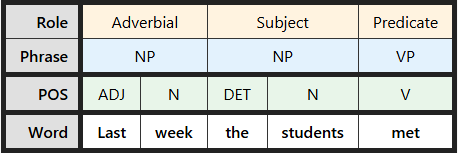
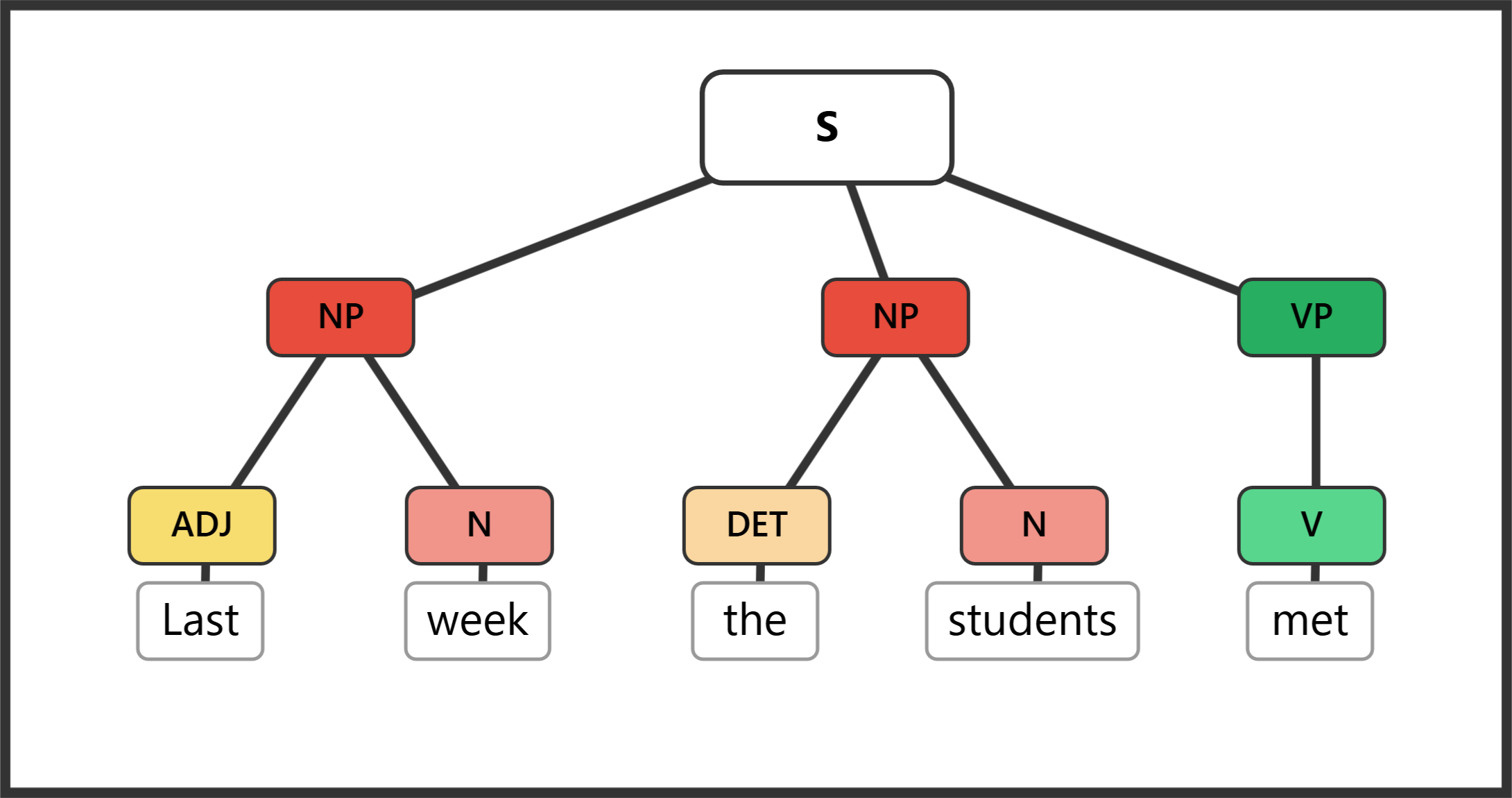
[S [NP [ADJP [ADJ Last]] [N week]] [NP [DET the] [N students]] [VP [V met]]]
Key Points.
-
NP adverbials are restricted to time, direction, and extent meanings.
-
They are often interchangeable with prepositional phrases: Monday ≈ on Monday; two miles ≈ for two miles.
-
In diagrams, label these as NP even though they fill the adverbial role—form and function are separate.

