Section 12.6 Infinitive Phrase Adverbials
Infinitive phrases—to followed by the base form of a verb—can fill several grammatical roles. In Chapter 14 you will see them as nominals (subjects, objects). Here the focus is on their adverbial use, both as modifiers of verbs (expressing purpose) and as modifiers of adjectives.
The Infinitive Form.
In many languages, the infinitive is a single word—a specific verb form with its own ending. Spanish has correr ("to run"), French has courir, German has laufen. In those languages, the infinitive is one inflected form. English works differently: the infinitive is a two-word construction—the marker to plus the base form of the verb. There is no special verb ending; to run and run use the same base form. In our labeling system, we treat the infinitive as a single unit—one V node containing both the marker and the verb—inside a VP:
-
to run → VP containing V(to run)
-
to pass the exam → VP containing V(to pass) + NP(the exam)
Formation.
Adverbial infinitive phrase = to + base verb + (complements/modifiers). The expanded form in order to makes the purpose meaning explicit:
-
She came to help.
-
He studied hard to pass the exam.
-
To succeed, you must practice daily.
-
She saved money in order to buy a car.
Purpose vs. Other Infinitive Functions.
Not every infinitive is adverbial. The purpose test is straightforward: can you paraphrase with in order to? If yes, it is an adverbial of purpose. If not, it is likely nominal (Chapter 14) or adjectival (Chapter 13).
-
He ran to catch the bus. → He ran in order to catch the bus. ✓ (adverbial—purpose)
-
She wants to leave. →
She wants in order to leave.✗ (nominal—direct object) -
She has a book to read. →
She has a book in order to read.✗ (adjectival—modifies book)
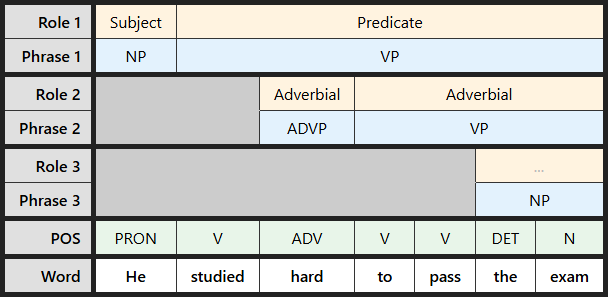
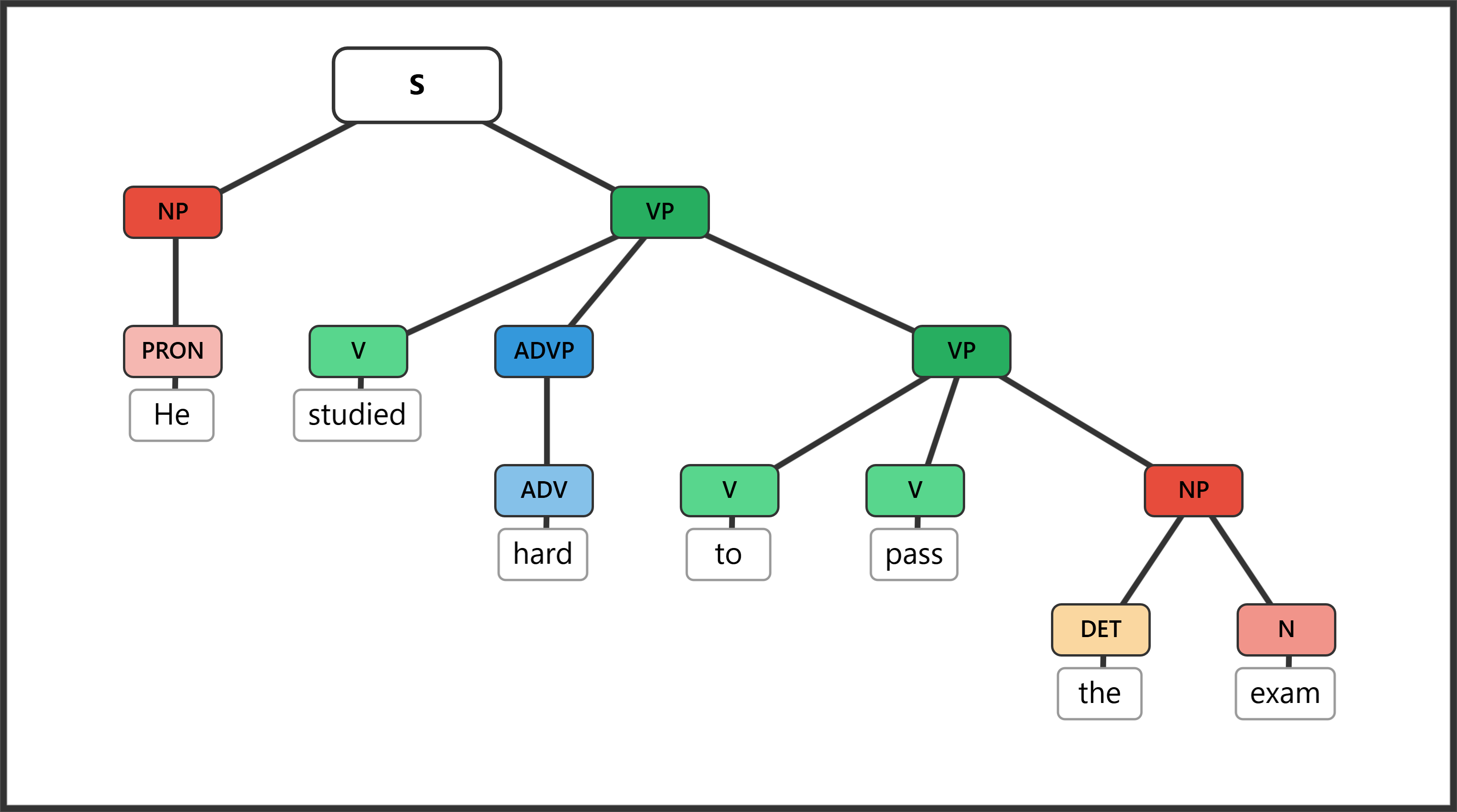
[S [NP [PRON He]] [VP [V studied] [ADVP [ADV hard]] [VP [V to pass] [NP [DET the] [N exam]]]]]
Position.
Purpose infinitives appear most naturally in final position but can be fronted for emphasis: To succeed in this program, you must commit to daily practice. When fronted, a comma follows the infinitive phrase.
Infinitives Modifying Adjectives.
Infinitive phrases do not only modify verbs. They can also appear after adjectives, where they function as adverbials telling in what way or under what conditions the adjective applies. In these cases, the infinitive VP sits inside the adjective phrase:
-
She was happy to help. (happy in what way?)
-
The problem is easy to solve. (easy in what respect?)
-
He seemed reluctant to answer. (reluctant to do what?)
-
They were ready to leave. (ready for what?)
This pattern is very common in English. The adjective provides the evaluation, and the infinitive specifies the action that the evaluation applies to. Many adjectives that describe emotional states (happy, eager, reluctant, afraid) or qualities of difficulty (easy, hard, difficult, impossible) take infinitive complements in this way.
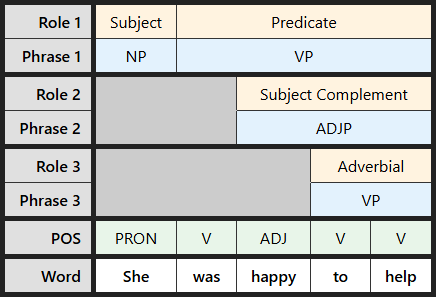
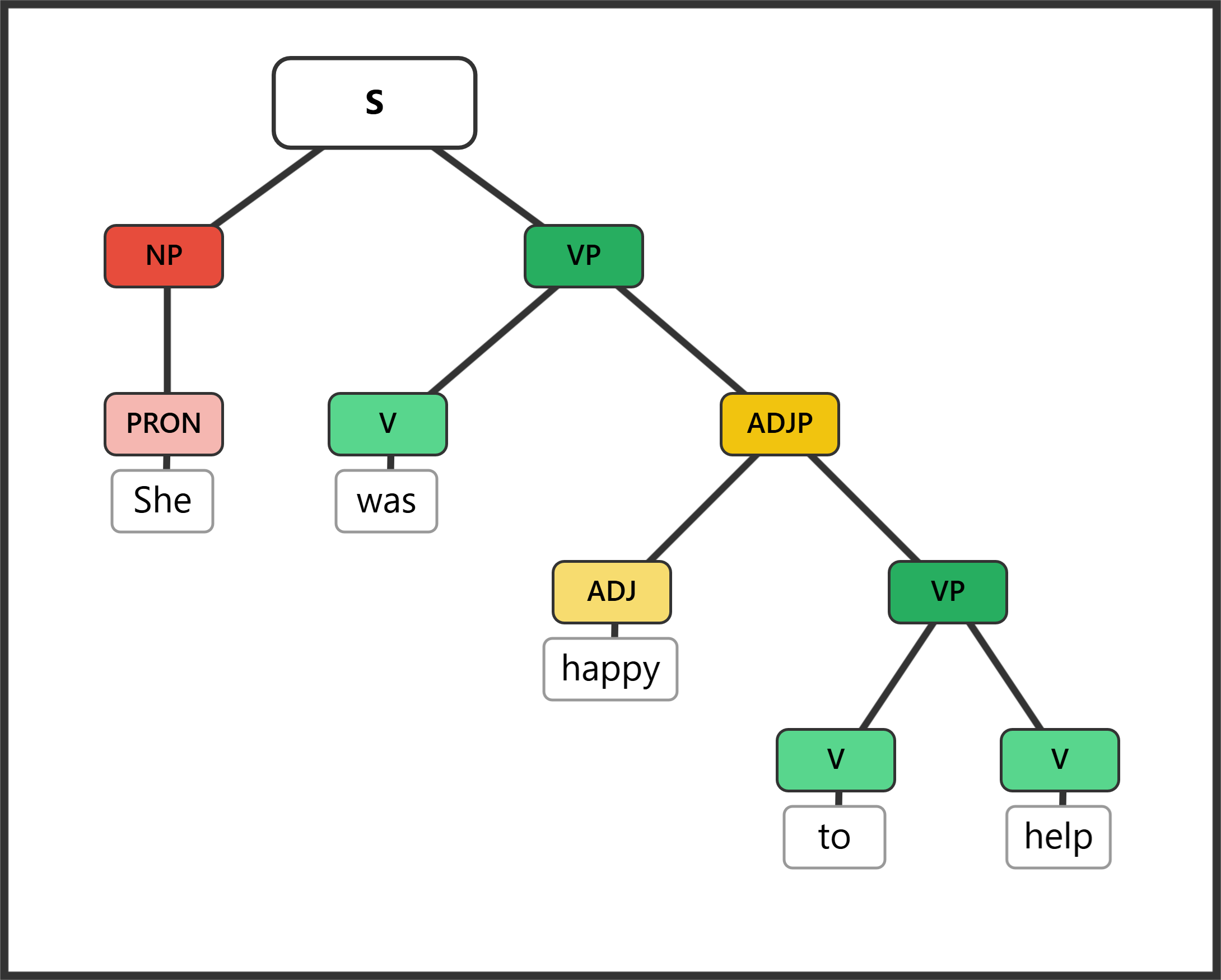
[S [NP [PRON She]] [VP [V was] [ADJP [ADJ happy] [VP [V to help]]]]]

