Section 14.7 Infinitive Phrase Nominals
Like present participle phrases, infinitive phrases are built on a verbal base, and they can take their own objects and modifiers. In Chapter 12 you saw infinitive phrases as adverbials of purpose (She came to help). In Chapter 13 you saw them as adjectivals modifying nouns (a book to read). Here the focus is on their nominal use—when an infinitive phrase fills a subject, object, or complement position. Unlike present participle phrases, infinitives have a narrower distribution as nominals: they appear frequently as subjects and complements, but only certain verbs allow an infinitive direct object.
Formation.
Infinitive Phrase = to + Verb + (Complements/Modifiers)
-
To swim is fun. (simple infinitive)
-
To finish on time seemed impossible. (infinitive + modifier)
-
To convince the board of our plan took hours. (infinitive + complex complement)
Infinitive Functions.
As subject (often with extraposition):
-
To err is human.
-
It is difficult to learn a new language. (extraposed)
As direct object:
-
She wants to succeed.
-
They decided to leave early.
-
He hopes to be promoted.
As subject complement:
-
The goal is to finish on time.
-
Her dream is to travel the world.
Extraposition.
When infinitive subjects are long or complex, English often moves them to the end of the sentence and places the pronoun it at the front as a placeholder. This pattern is called extraposition:
-
To explain all the details would take too long. (full subject)
-
It would take too long to explain all the details. (extraposed)
-
To learn a new language at fifty is challenging. (full subject)
-
It is challenging to learn a new language at fifty. (extraposed)
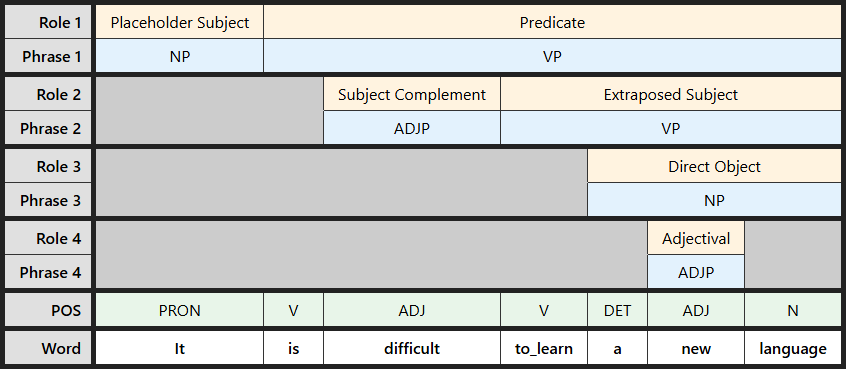
Extraposition is extremely common in both speech and writing. The extraposed version is often preferred because it places the main verb closer to the beginning of the sentence, making it easier to process. The labeling table below shows what extraposition looks like under analysis: the surface subject is the placeholder pronoun it, while the infinitive phrase—the real subject in semantic terms—appears at the end of the clause.
Labeling Table: It is difficult to learn a new language (extraposition).
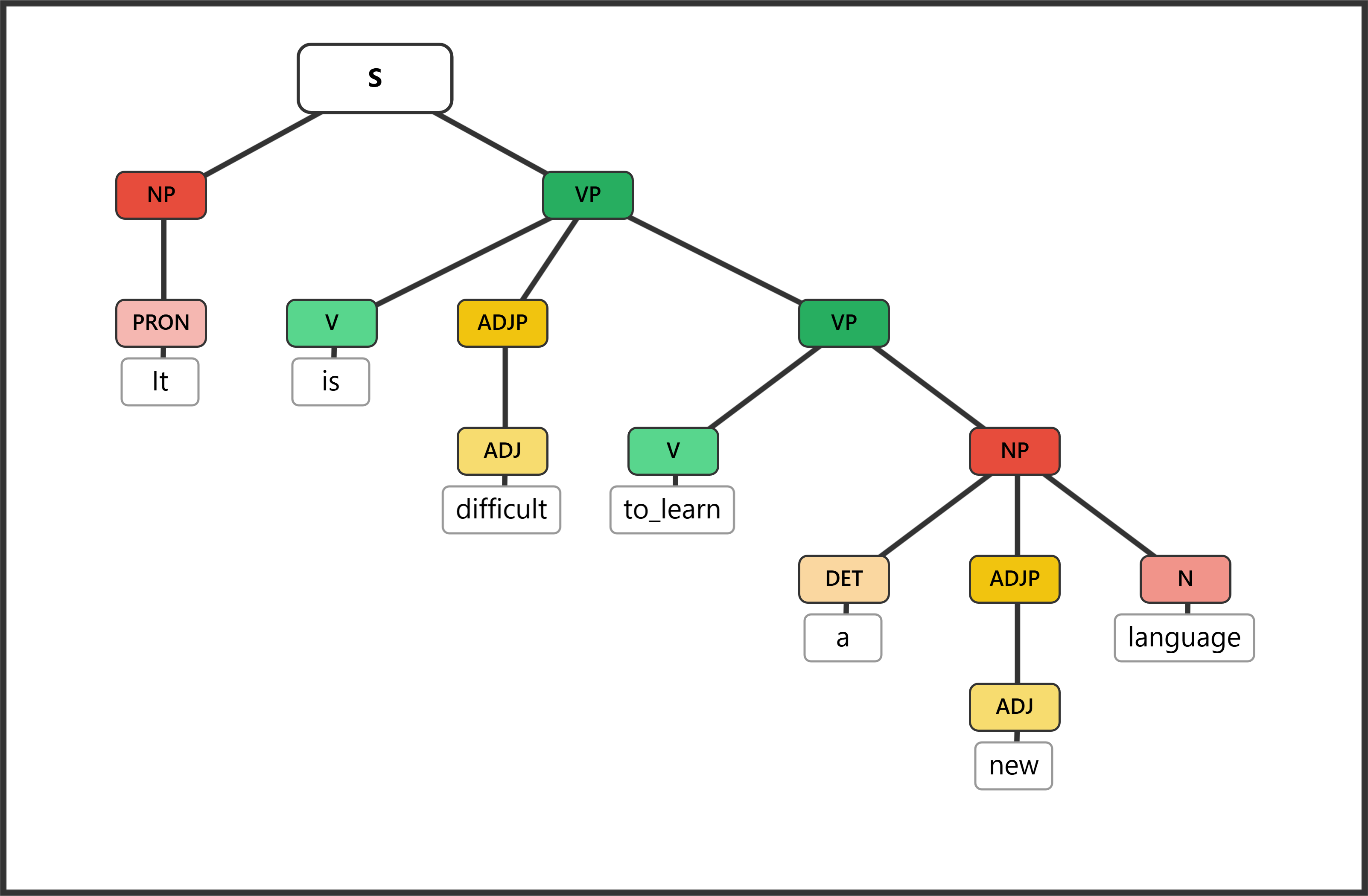
[S [NP [PRON It]] [VP [V is] [ADJP [ADJ difficult]] [VP [V to learn] [NP [DET a] [ADJP [ADJ new]] [N language]]]]]
Two things stand out. First, English fills the surface subject slot with it even though that pronoun has no real referent—a pure placeholder. Second, the infinitive phrase is labeled Extraposed Subject to mark the unusual relationship: it is the underlying subject, but it has been displaced to the end of the clause to satisfy the end-weight preference. Notice also that the infinitive to learn sits in a single column under a single V—the marker to and the verb learn form one verbal unit.
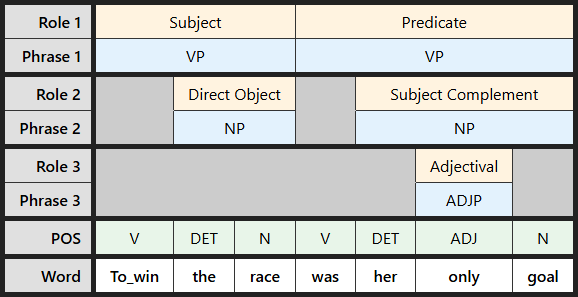
Labeling Table: To win the race was her only goal.
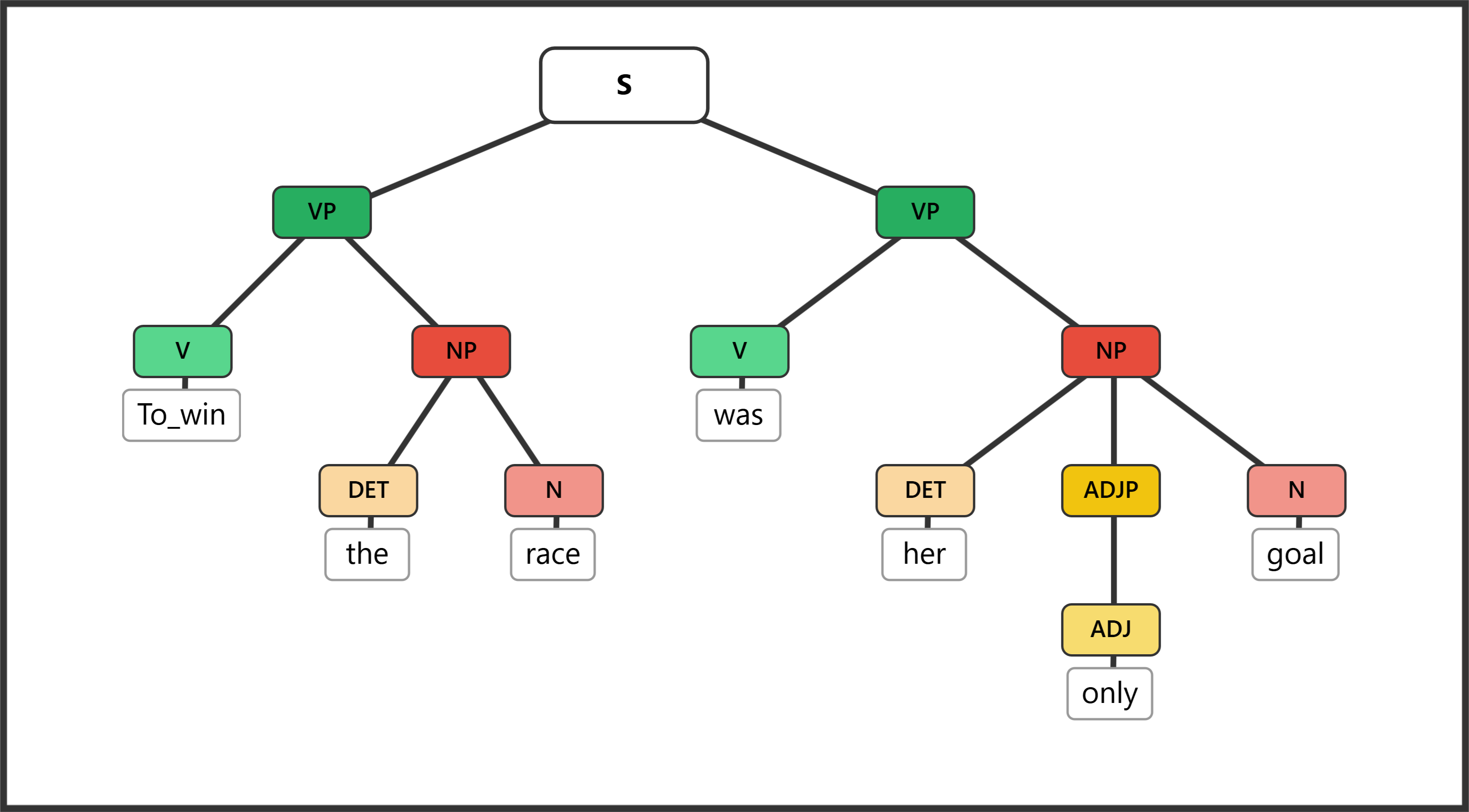
[S [VP [V To win] [NP [DET the] [N race]]] [VP [V was] [NP [DET her] [ADJP [ADJ only]] [N goal]]]]
The infinitive phrase To win the race fills the subject position. Note that the marker to and the verb win are treated as a single verb unit—they live in one cell of the labeling table and one V node in the tree. The phrase as a whole is a VP serving the nominal function (Subject); the form is verbal but the function is nominal.
Key Points.
-
Nominal infinitives fill subject, direct object, and complement positions—but not object of preposition (use a present participle phrase instead: interested in learning, not
interested in to learn). -
Extraposition with it is the most common way to handle long infinitive subjects.
-
The same infinitive form can be nominal (filling an argument slot), adverbial (expressing purpose), or adjectival (modifying a noun)—always check the position.

