Section 10.12 Homework: Tense and Aspect
Subsection 10.12.1 Part 1: Identification
Instructions.
For each sentence below, identify the auxiliary verb(s), main verb, tense, and aspect. Use the following labels for aspect: simple, progressive, perfect, or perfect progressive.
Example (completed).
She has been waiting for an hour.
-
Auxiliary verb(s): has, been
-
Main verb: waiting
-
Tense: present
-
Aspect: perfect progressive
Exercises.
Exercise 1. The researchers have analyzed the experimental data.
-
Auxiliary verb(s):
-
Main verb:
-
Tense:
-
Aspect:
Exercise 2. Yesterday, she was working in the library when I called.
-
Auxiliary verb(s):
-
Main verb:
-
Tense:
-
Aspect:
Exercise 3. By next month, they will have completed the entire project.
-
Auxiliary verb(s):
-
Main verb:
-
Tense:
-
Aspect:
Exercise 4. The professor teaches linguistics every semester.
-
Auxiliary verb(s):
-
Main verb:
-
Tense:
-
Aspect:
Exercise 5. The students had been studying for three hours before the test began.
-
Auxiliary verb(s):
-
Main verb:
-
Tense:
-
Aspect:
Subsection 10.12.2 Part 2: Sentence Completion
Instructions.
Complete each sentence with the correct form of the verb in parentheses to match the tense-aspect indicated.
Example (completed).
Present perfect: She ________ (study) at this university since 2022.
Answer: has studied
Exercises.
Exercise 6. Present progressive: Right now, the children ________ (play) in the park.
Exercise 7. Past perfect: By the time I arrived, they ________ (already / leave).
Exercise 8. Present perfect progressive: She ________ (work) on this project for six months.
Exercise 9. Future progressive: At noon tomorrow, I ________ (meet) with the committee.
Exercise 10. Past simple: The team ________ (finish) the assignment last night.
Subsection 10.12.3 Part 3: Sentence Writing
Instructions.
Write original sentences using the indicated tense-aspect combination. Make sure your sentence clearly demonstrates the meaning of that combination.
Example (completed).
Present perfect (past action with present relevance):
I have already eaten breakfast, so I’m not hungry now.
Exercises.
Exercise 11. Write a sentence in present perfect that shows an experience up to now:
Exercise 12. Write a sentence in past progressive that describes a background action interrupted by another event:
Exercise 13. Write a sentence in future perfect that describes an action completed before a future point:
Exercise 14. Write a sentence in present simple that expresses a general truth:
Exercise 15. Write a sentence in past perfect that positions one past event before another:
Subsection 10.12.4 Part 4: Diagramming Verb Phrases
Instructions.
For each sentence below, (a) draw a tree diagram showing the full sentence structure and (b) identify the tense and aspect of the verb phrase. Label all nodes using ALL CAPS labels: S, NP, VP, DET, N, V, PRON, PREP, PP, etc. Label auxiliary verbs as AUX and main verbs as V. You may draw tree diagrams by hand and photograph them, use a digital tool, or describe the structure in bracket notation.
Example (completed).
Sentence: She has been reading the book.
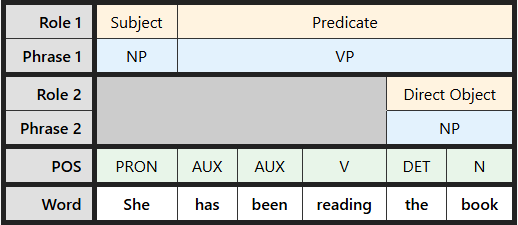
Bracket notation:
[S [NP [PRON She]] [VP [AUX has] [AUX been] [V reading] [NP [DET the] [N book]]]]
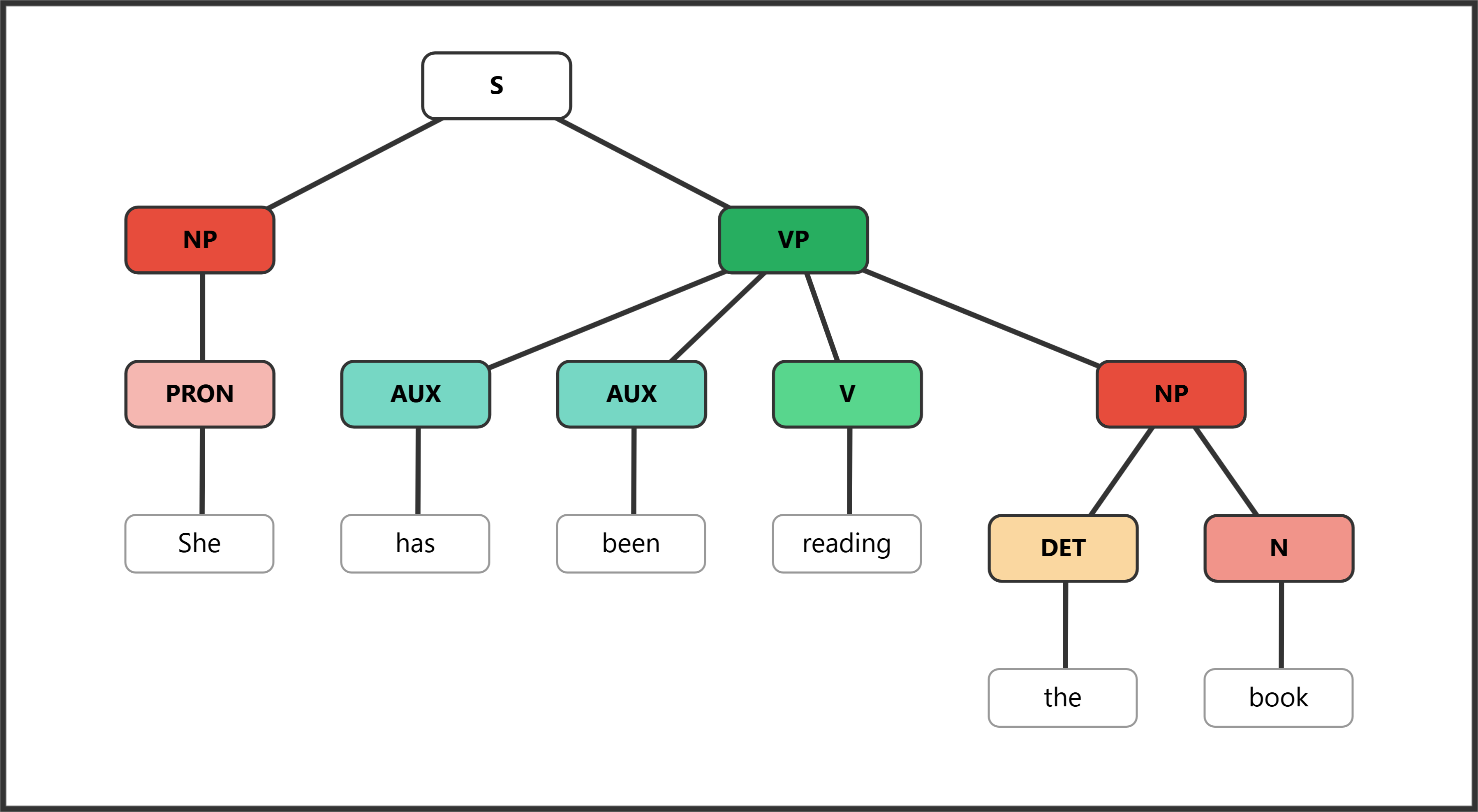
Tense: present. Aspect: perfect progressive.
Exercises.
Exercise 16. The students are studying for the exam.
| Role | |||||||
| Phrase | |||||||
| Word | The | students | are | studying | for | the | exam |
| POS |
-
Bracket notation: _____
-
Diagram:
Tense: Aspect:
Exercise 17. He had finished the assignment before class.
| Role | |||||||
| Phrase | |||||||
| Word | He | had | finished | the | assignment | before | class |
| POS |
-
Bracket notation: _____
-
Diagram:
Tense: Aspect:
Exercise 18. Does the professor teach on Fridays?
| Role | ||||||
| Phrase | ||||||
| Word | Does | the | professor | teach | on | Fridays |
| POS |
-
Bracket notation: _____
-
Diagram:
Tense: Aspect:
Exercise 19. The report was written by the committee.
| Role | |||||||
| Phrase | |||||||
| Word | The | report | was | written | by | the | committee |
| POS |
-
Bracket notation: _____
-
Diagram:
Tense: Aspect/Voice:
Exercise 20. They have been waiting at the station for an hour.
| Role | ||||||||||
| Phrase | ||||||||||
| Word | They | have | been | waiting | at | the | station | for | an | hour |
| POS |
-
Bracket notation: _____
-
Diagram:
Tense: Aspect:
Subsection 10.12.5 Part 5: Contextual Analysis
Instructions.
Read the passage below and answer the questions.
Passage.
Maria moved to Boston in 2018. She has lived there ever since. When I visited her last summer, she was working on her dissertation. She has been writing it for two years now. By next June, she will have finished the entire project. After that, she will be looking for a teaching position.
Exercises.
Exercise 21. Identify the tense-aspect of each verb phrase in the passage:
-
moved:
-
has lived:
-
visited:
-
was working:
-
has been writing:
-
will have finished:
-
will be looking:
Exercise 22. The passage uses both moved (past simple) and has lived (present perfect). Both refer to events that began in 2018. Explain why the writer chose different tense-aspects for these two verbs.
Exercise 23. Rewrite the following sentence in three different tense-aspect combinations and explain how the meaning changes with each:
Original: She studies linguistics.
a) Past progressive:
Meaning change:
b) Present perfect:
Meaning change:
c) Future perfect:
Meaning change:

