Section 8.7 Transitive Sentences: A Closer Look
Pattern 4 — the transitive sentence — is the most common sentence type in English. A transitive verb extends its action outward to a direct object: some entity that receives, undergoes, or results from the action.
Because transitive verbs are so prevalent, understanding them precisely matters for both analysis and writing. The subject acts; the direct object is acted upon. But that direction of action is not always as straightforward as it sounds. In She received a letter, the subject is on the receiving end rather than doing something to the object. In She resembles her mother, there is no physical action at all. Yet both are transitive: both have a direct object, both pass the what/whom question test, and both can be made passive. The label transitive describes grammatical structure—the presence of a direct object inside the VP—not necessarily physical causation.
The Direct Object.
The direct object is always a noun phrase (or a clause functioning as an NP). It answers the question “verb what?” or “verb whom?” and sits inside the VP, immediately after the verb.
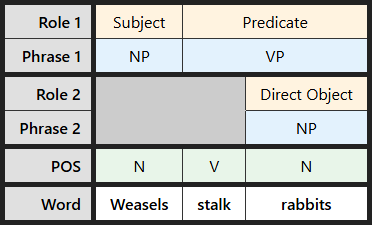
Weasels stalk rabbits.
Diagram: Weasels stalk rabbits.
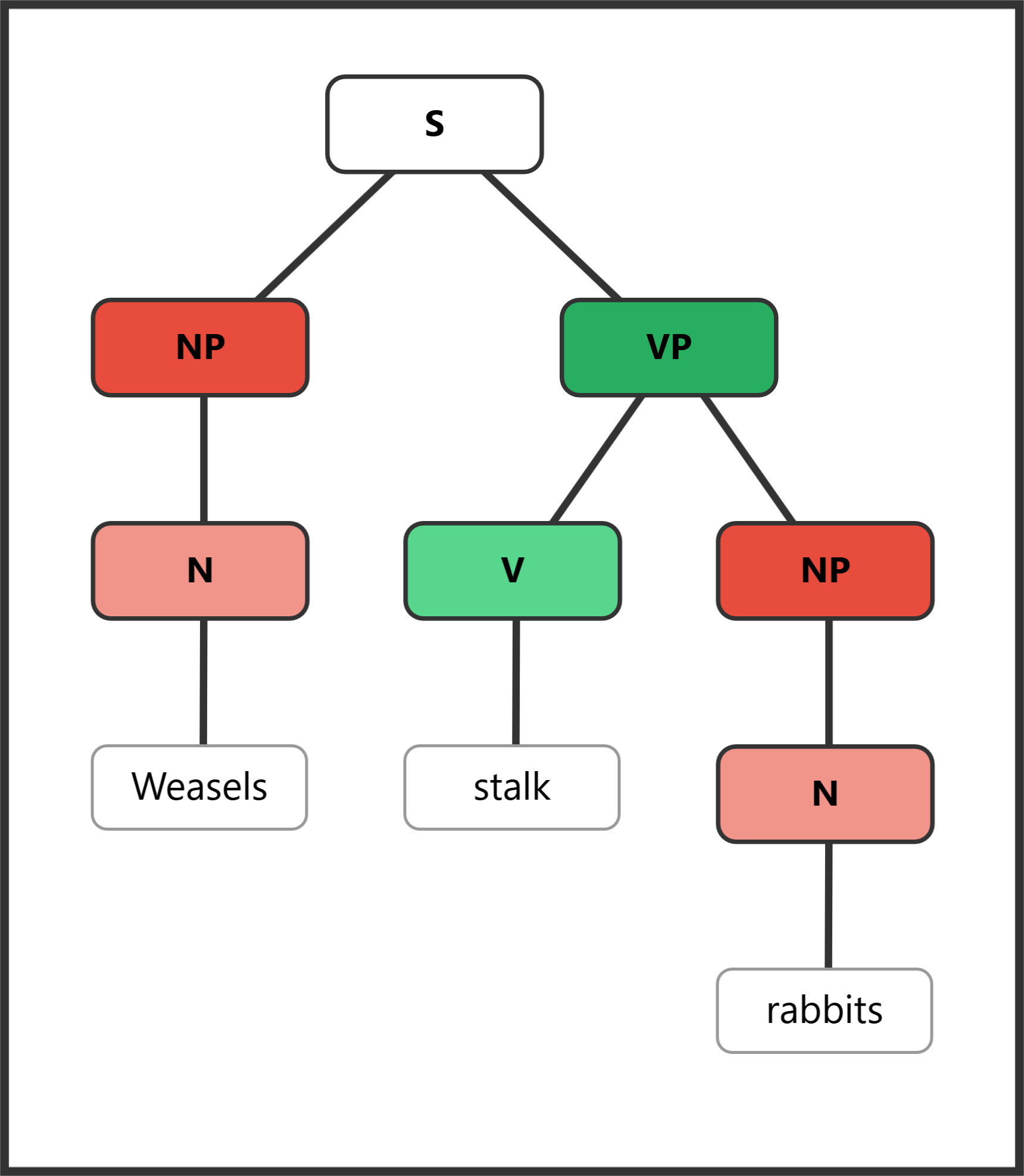
[S [NP [N Weasels]] [VP [V stalk] [NP [N rabbits]]]]
The direct object NP sits inside the VP. This is consistent with all transitive structures: the object is part of the predicate. The subject NP sits outside the VP, before it.
In more complex sentences the NPs involved may carry determiners and other modifiers, but the underlying structure is identical:
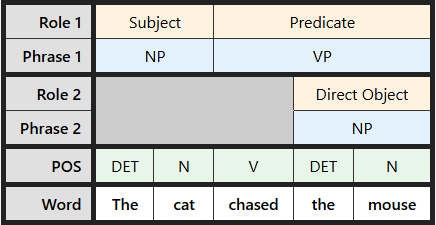
The cat chased the mouse.
Diagram: The cat chased the mouse.
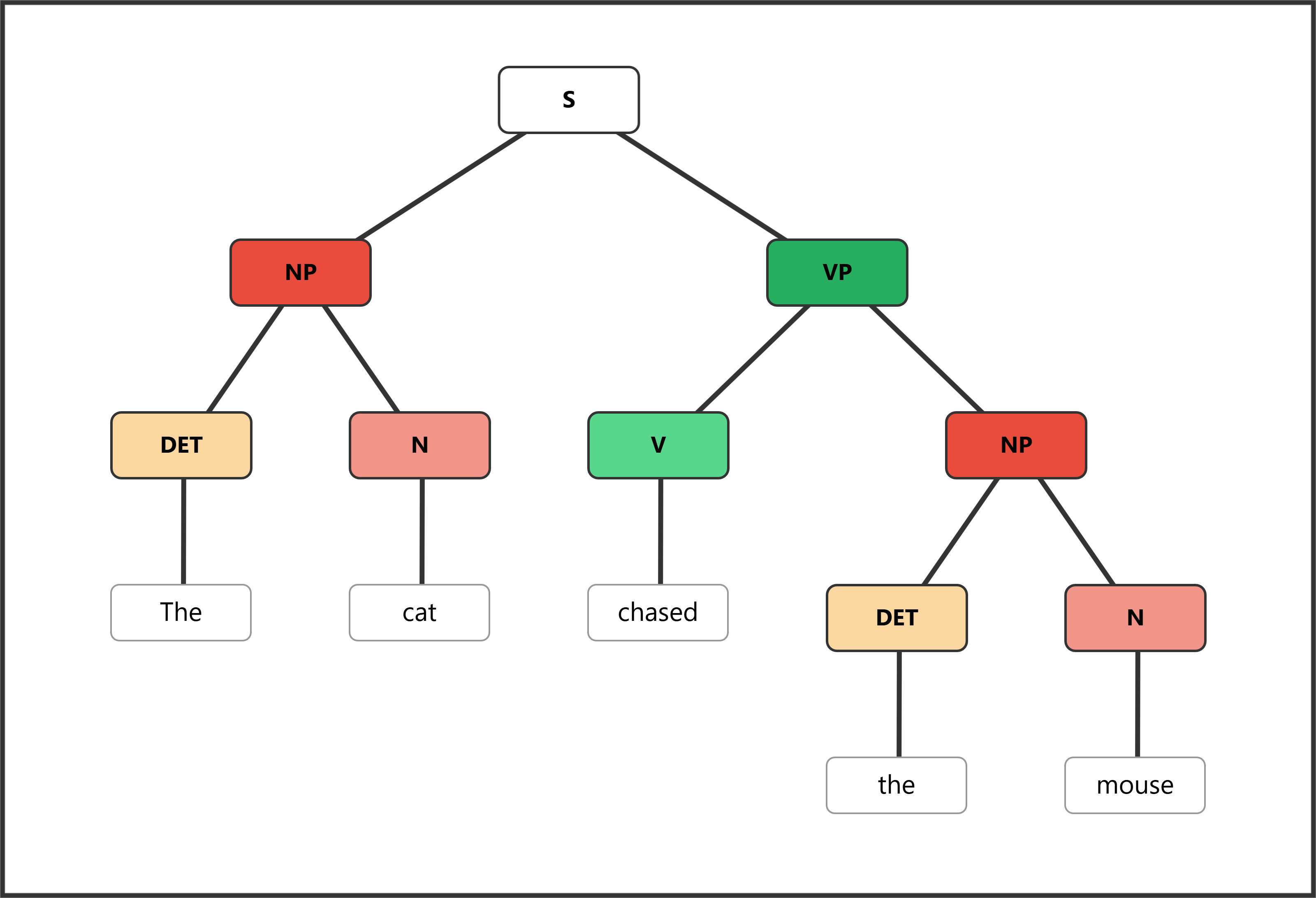
[S [NP [DET The] [N cat]] [VP [V chased] [NP [DET the] [N mouse]]]]
Both the subject and the direct object are full NPs with determiners. Their positions reveal their roles: the subject NP is outside the VP; the object NP is inside it, governed by the verb.
Three Tests for Direct Objects.
When you are unsure whether an element is a direct object or something else (such as an adverbial), apply these tests:
-
The what/whom question. Ask the verb plus “what?” or “whom?”: Weasels stalk what? → rabbits. If an answer exists and it names the element in question, it is the direct object.
-
Pronoun replacement. A direct object can be replaced with a pronoun: She finished her dissertation. → She finished it.
-
Passive transformation. The direct object can become the subject of a passive sentence: Lightning struck the old oak. → The old oak was struck.
Adverbials vs. Direct Objects.
A common error is to mistake a prepositional phrase for a direct object. Direct objects are always NPs (or NP-clauses), not PPs. Compare:
-
She read the book. — the book is a direct object: NP, passes all three tests
-
She read in the library. — in the library is an adverbial: PP, cannot be pronoun-replaced as a DO, cannot passivize

