Section 13.3 Adjectival Position
You may have noticed in the previous section that single adjectives tend to appear before the noun (the tall man), while longer phrases and clauses tend to appear after it (the man in the hat, the man who arrived late). This is not arbitrary: English has a strong preference for keeping modifiers close to the nouns they modify without disrupting the noun’s core structure. A single word can slip in before the noun easily, but a relative clause or a long prepositional phrase would be awkward and confusing in that position. Understanding the three positional slots available to adjectivals—pre-modification, post-modification, and predicative—helps explain both why modifiers appear where they do and what options a writer has when constructing complex noun phrases.
Pre-modification (Before the Noun).
Single adjectives, single-word participles, and attributive nouns appear before the head noun in the attributive position:
-
the tall man (adjective)
-
a very interesting book (adjective phrase)
-
running water (present participle)
-
the broken window (past participle)
-
the government report (noun adjectival)
Post-modification (After the Noun).
Longer phrases and clauses follow the noun as post-modifiers:
-
the man in the hat (PP)
-
the student who won the prize (relative clause)
-
the report published yesterday (participial phrase)
-
a book to read (infinitive phrase)
-
someone happy about the results (adjective phrase with complement)
Note that adjective phrases with complements move to post-position: you can say a happy person but not a happy about the results person.
Predicative Position (After a Linking Verb).
Adjective phrases also appear as subject complements after linking verbs in the predicative position:
-
“The man is tall.”
-
“The book seems interesting.”
-
“She became happy about the news.”
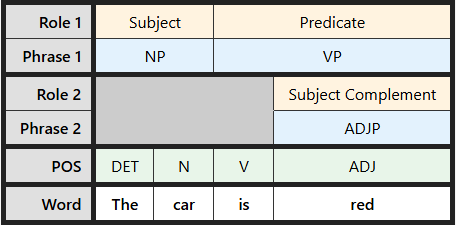
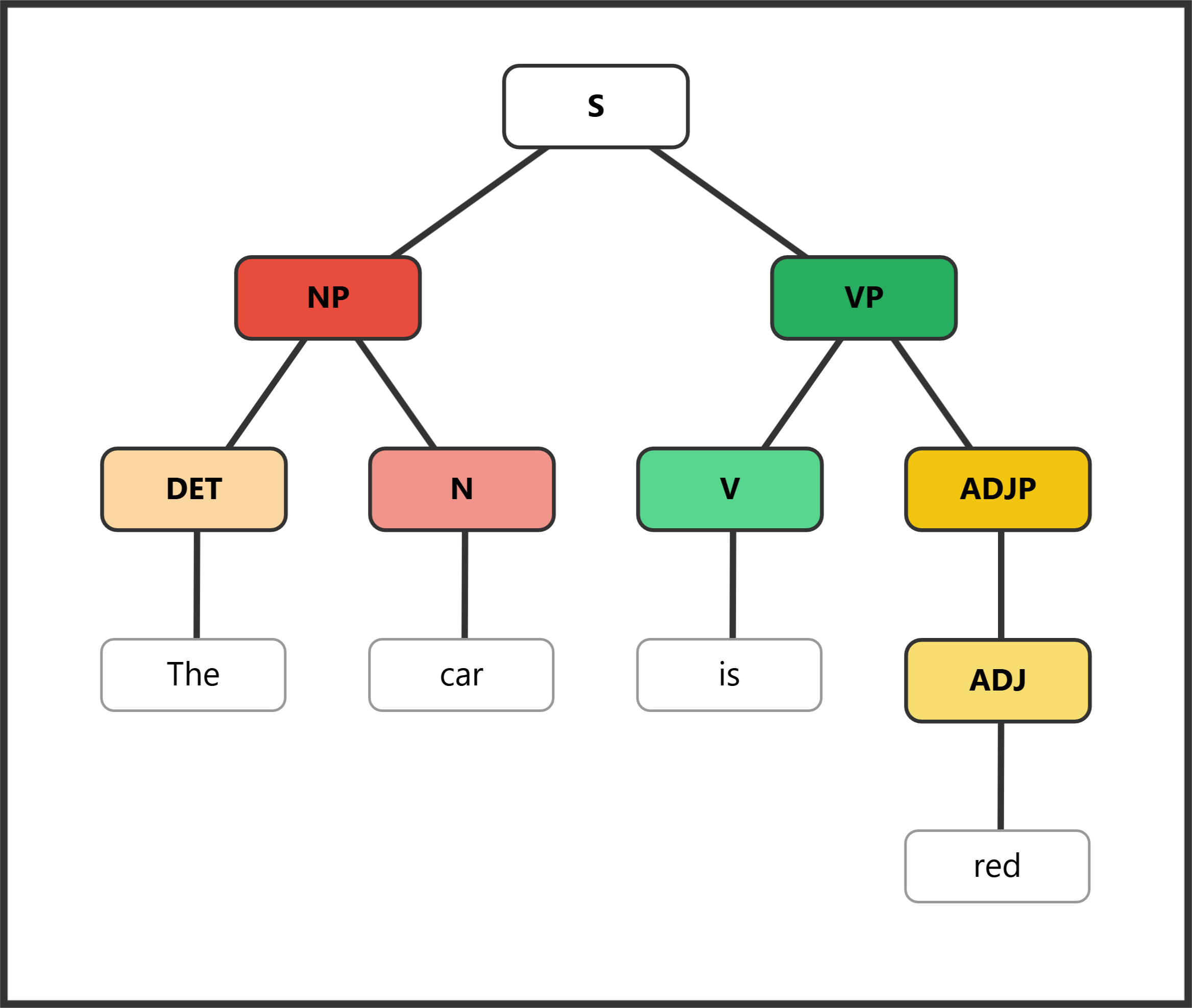
[S [NP [DET The] [N car]] [VP [V is] [ADJP [ADJ red]]]]
Attributive-Only and Predicative-Only Adjectives.
Some adjectives are restricted to one position:
-
Attributive only: the main reason (not
the reason is main); an utter disaster; the former president -
Predicative only: the child is asleep (not
the asleep child); she felt afraid; he is alone
Stacking Adjectivals.
A noun phrase can carry more than one modifier at once. Consider: the talented young American jazz musician from New Orleans who won the competition. Every element from talented to who won the competition is modifying musician.
When multiple adjectives precede a noun, they typically follow this order:
-
Determiner: the, a, my
-
Opinion: beautiful, interesting
-
Size: big, small
-
Age: old, new
-
Shape: round, square
-
Color: red, blue
-
Origin: French, American
-
Material: wooden, metal
-
Purpose/Type: cooking, reading
-
NOUN
-
a beautiful large old round red French wooden cooking pot
Post-modifiers stack in the order they are added, and each attaches to the preceding NP:
-
the book on the table that I mentioned
-
the man in the hat standing by the door

