Section 14.9 Complement Clause Structures
This section examines the three structural patterns of complement clauses introduced in Section 14.8: the complementizer-as-marker pattern (Pattern 1), the wh-pronoun-as-embedded-subject pattern (Pattern 2), and the wh-word-preceding-subject pattern (Pattern 3). Each pattern is illustrated with a labeling table, a tree diagram, and a bracket notation. The same surface position—say, direct object—can be filled by any of the three patterns; what differs is the internal structure of the clause.
Pattern 1: Complementizer + Full Clause.
The most common pattern. A complementizer (that, if, or whether) introduces the clause but plays no role inside it. The clause has a complete subject and predicate of its own:
Pattern 1 = COMP + Subject NP + Predicate VP
-
I believe that she is honest. (DO)
-
That she resigned surprised everyone. (Subject)
-
I wonder whether we should leave. (DO)
-
The question is whether to accept the offer. (Subject Complement)
When the clause is a direct object, the complementizer that can often be omitted with no change in meaning: I believe she is honest. In subject position, that cannot be dropped (She resigned surprised everyone is ungrammatical). In tree diagrams an omitted that is represented with an empty COMP node, marking the structural slot the complementizer would have occupied.
If and whether both introduce yes/no questions, but they are not always interchangeable. Use whether—not if—in subject position (Whether he comes remains to be seen) and before or not (I don’t know whether or not she’s coming).
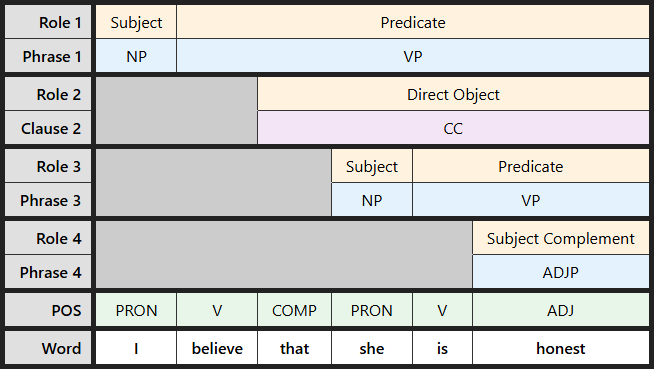
Labeling Table: I believe that she is honest.
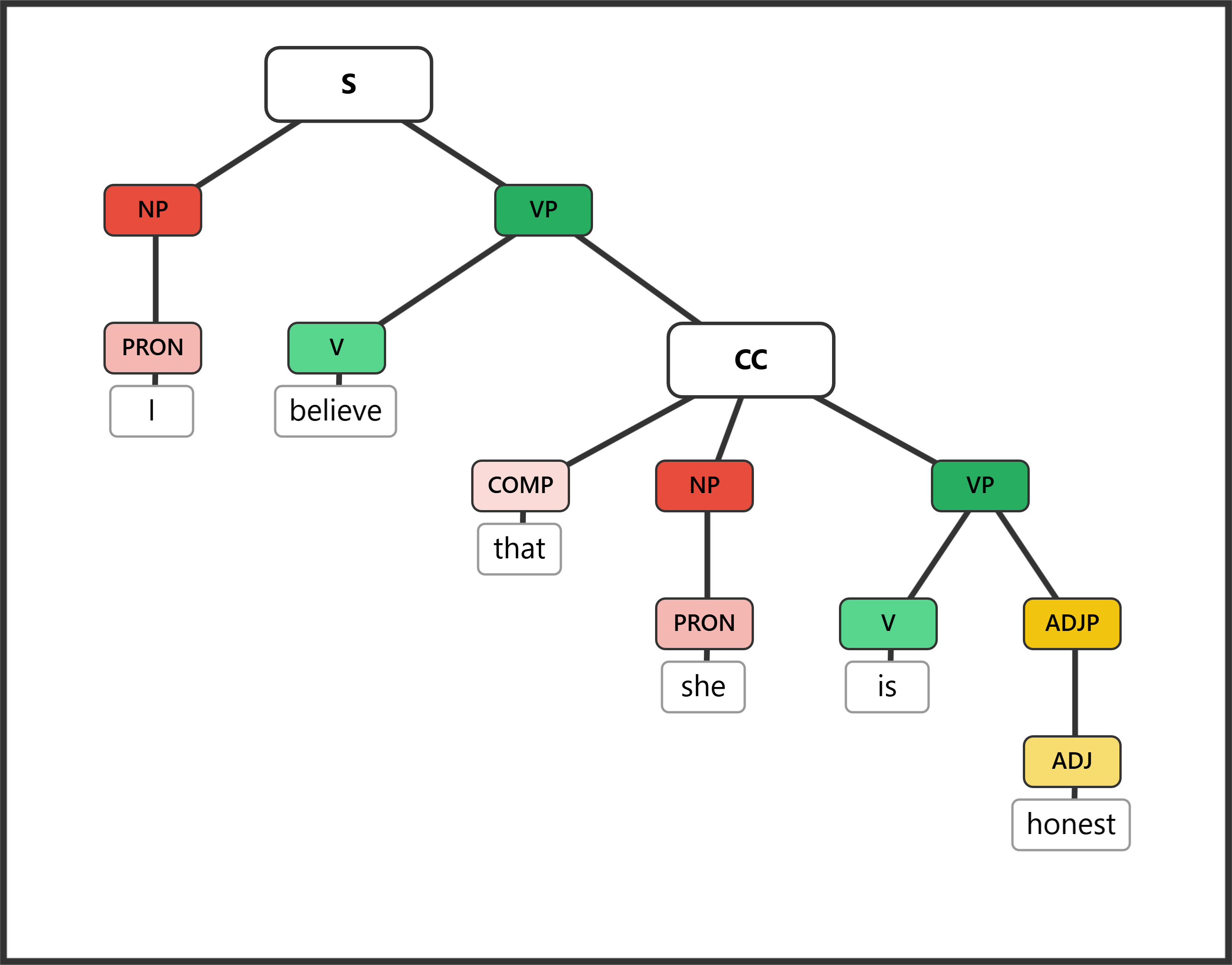
[S [NP [PRON I]] [VP [V believe] [CC [COMP that] [NP [PRON she]] [VP [V is] [ADJP [ADJ honest]]]]]]
The complement clause that she is honest fills the direct-object slot after believe. The complementizer that introduces the clause but plays no role inside it; the embedded subject is she and the embedded predicate is is honest.
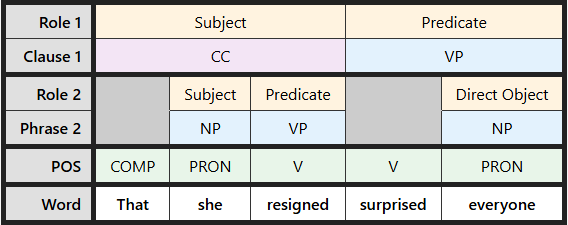
Labeling Table: That she resigned surprised everyone (CC as Subject).
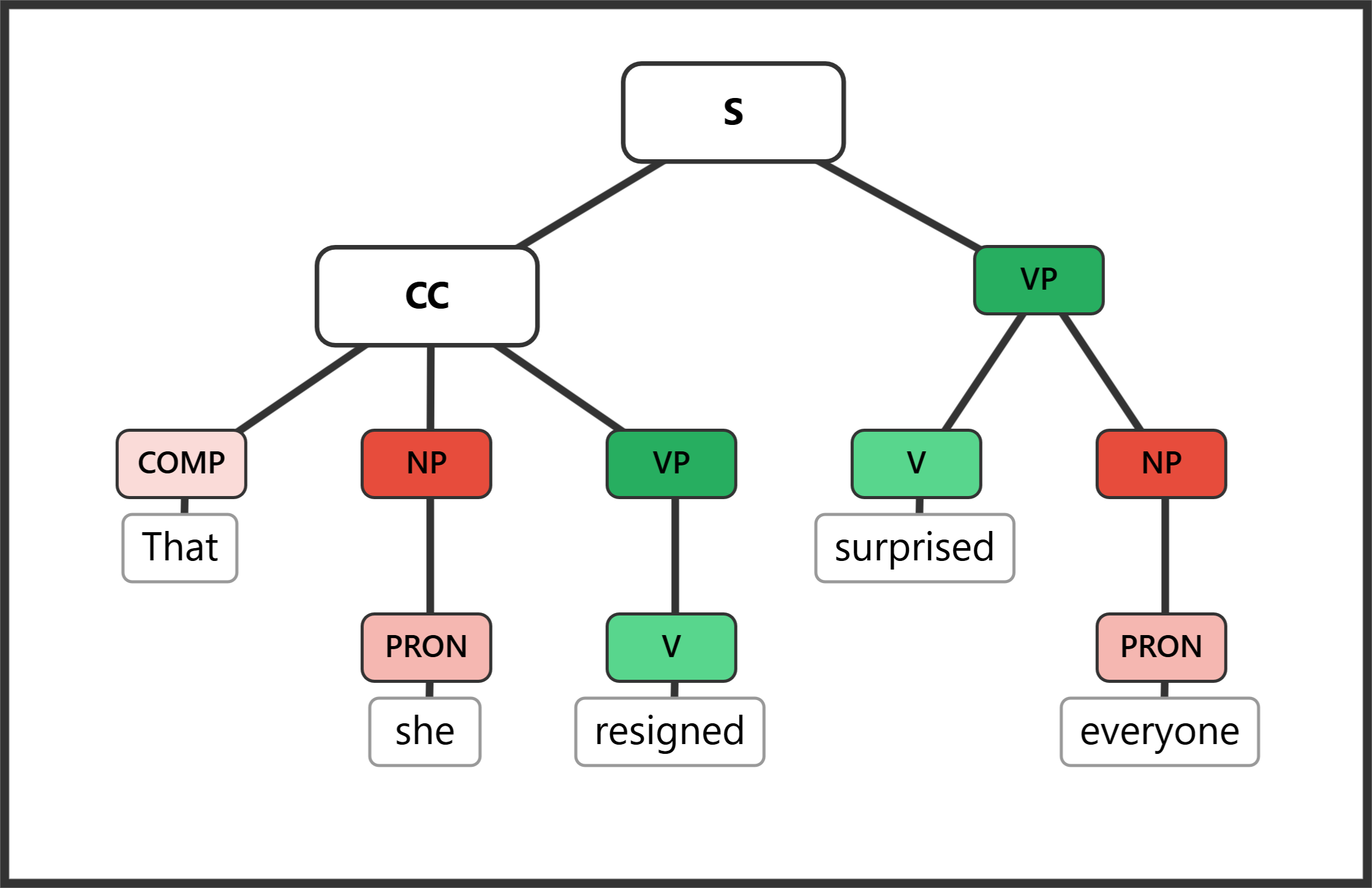
[S [CC [COMP That] [NP [PRON she]] [VP [V resigned]]] [VP [V surprised] [NP [PRON everyone]]]]
Same Pattern 1 structure—complementizer + full clause—filling subject position instead of direct-object position. Note that that cannot be dropped here, even though it can be in object position.
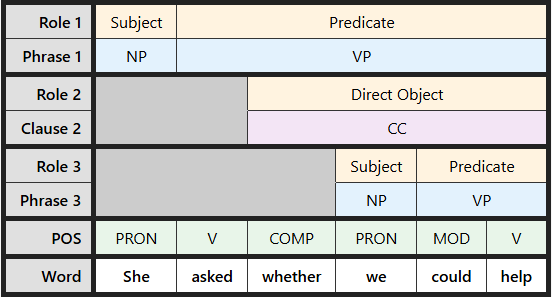
Labeling Table: She asked whether we could help.
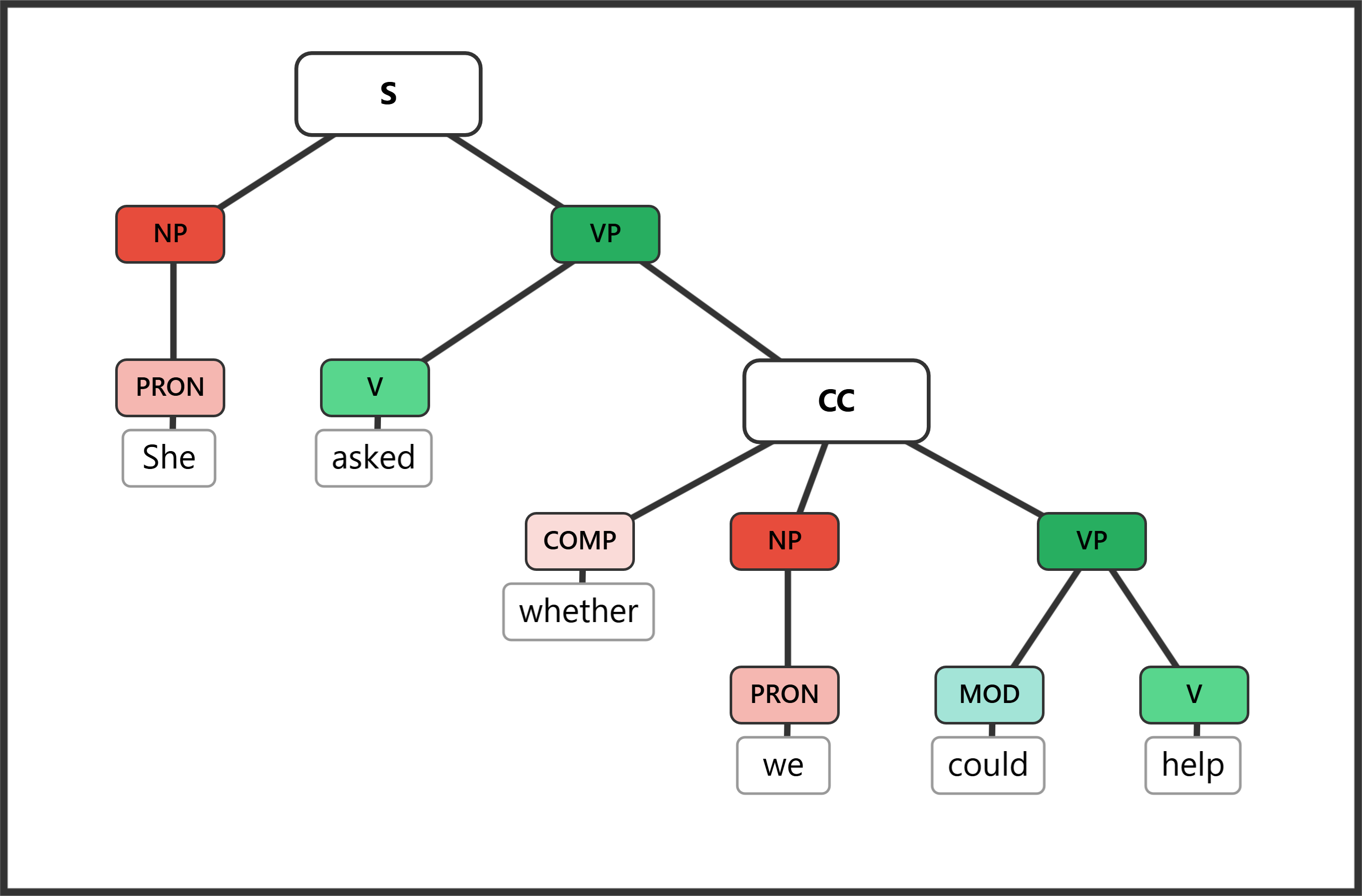
[S [NP [PRON She]] [VP [V asked] [CC [COMP whether] [NP [PRON we]] [VP [MOD could] [V help]]]]]
Pattern 1 with a different complementizer. whether signals that the embedded clause is a yes/no question rather than a statement, but the structural pattern—COMP plus full subject-predicate clause—is identical.
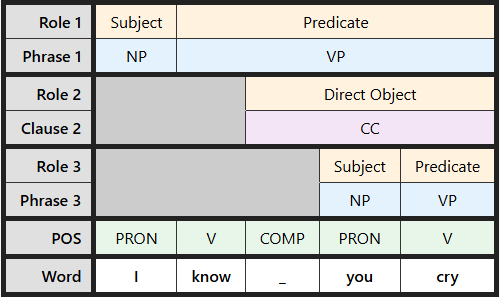
Labeling Table: I know you cry (Pattern 1 with empty complementizer).
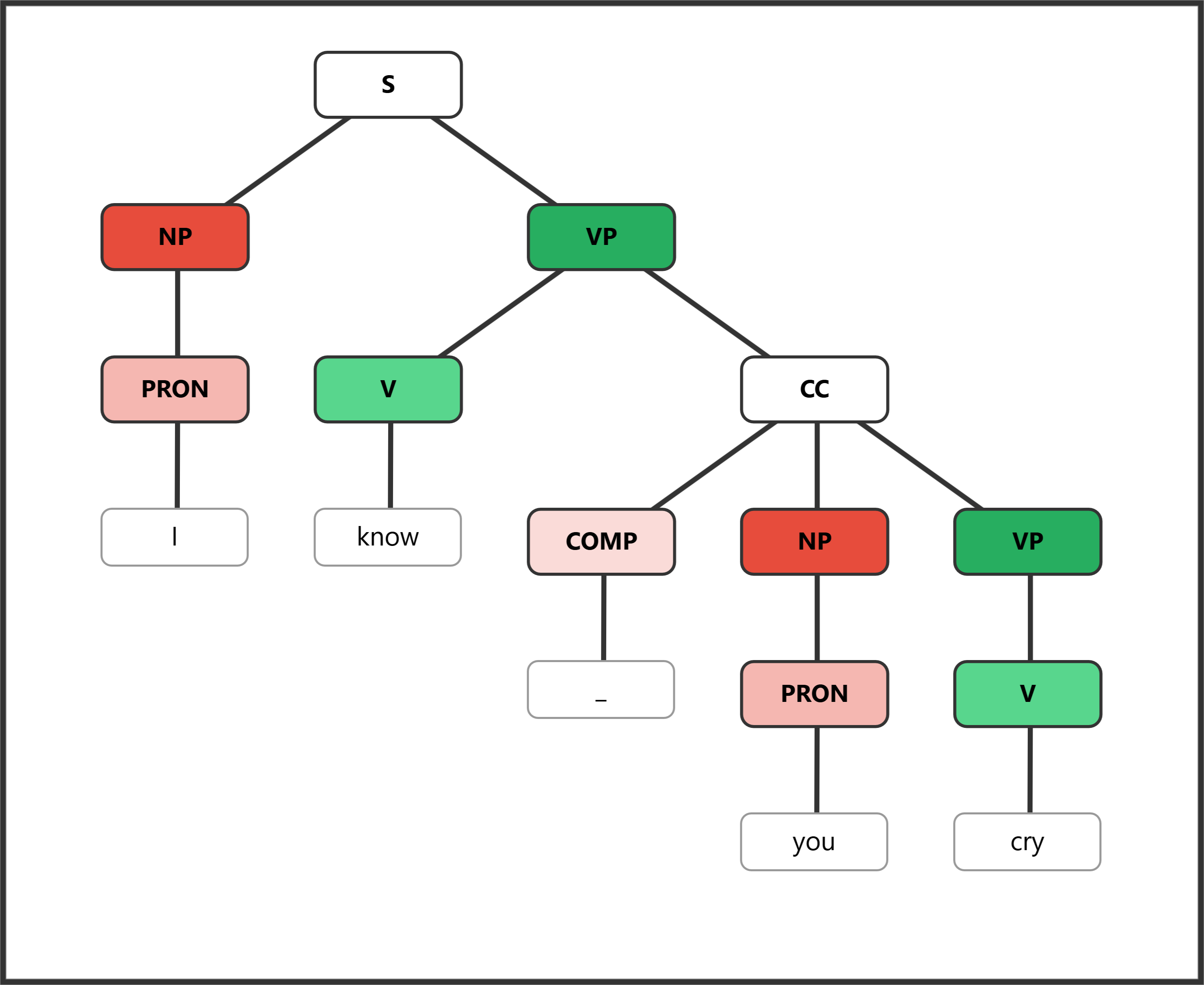
[S [NP [PRON I]] [VP [V know] [CC [COMP _] [NP [PRON you]] [VP [V cry]]]]]
Same Pattern 1 structure with the complementizer omitted. The COMP slot is shown empty in the bracket and table—the structural position is preserved even though no word fills it. This is parallel to the zero-relative pattern in relative clauses (Section 13.11): when the introducing word would have been a non-subject, English allows it to be dropped, but the structural slot remains.
Pattern 2: Wh-pronoun as Embedded Subject.
When a wh-word is itself the subject of the embedded clause, there is no separate subject NP and no COMP node. The wh-word fills the subject NP slot directly:
Pattern 2 = Wh-pronoun (as Subject NP) + Predicate VP
-
What happened was unexpected. (Subject; What = subject of happened)
-
I know who called. (DO; who = subject of called)
-
The committee will decide which proposal wins. (DO; which proposal = subject of wins)
This is the parallel of the Section 13.10 relative-clause pattern in which a relative pronoun fills the embedded subject NP. Here a wh-pronoun does the same job inside a complement clause.
Labeling Table: What happened was unexpected (wh-pronoun as embedded subject).
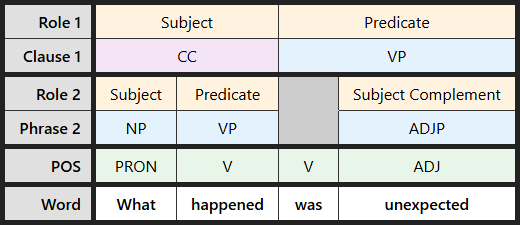
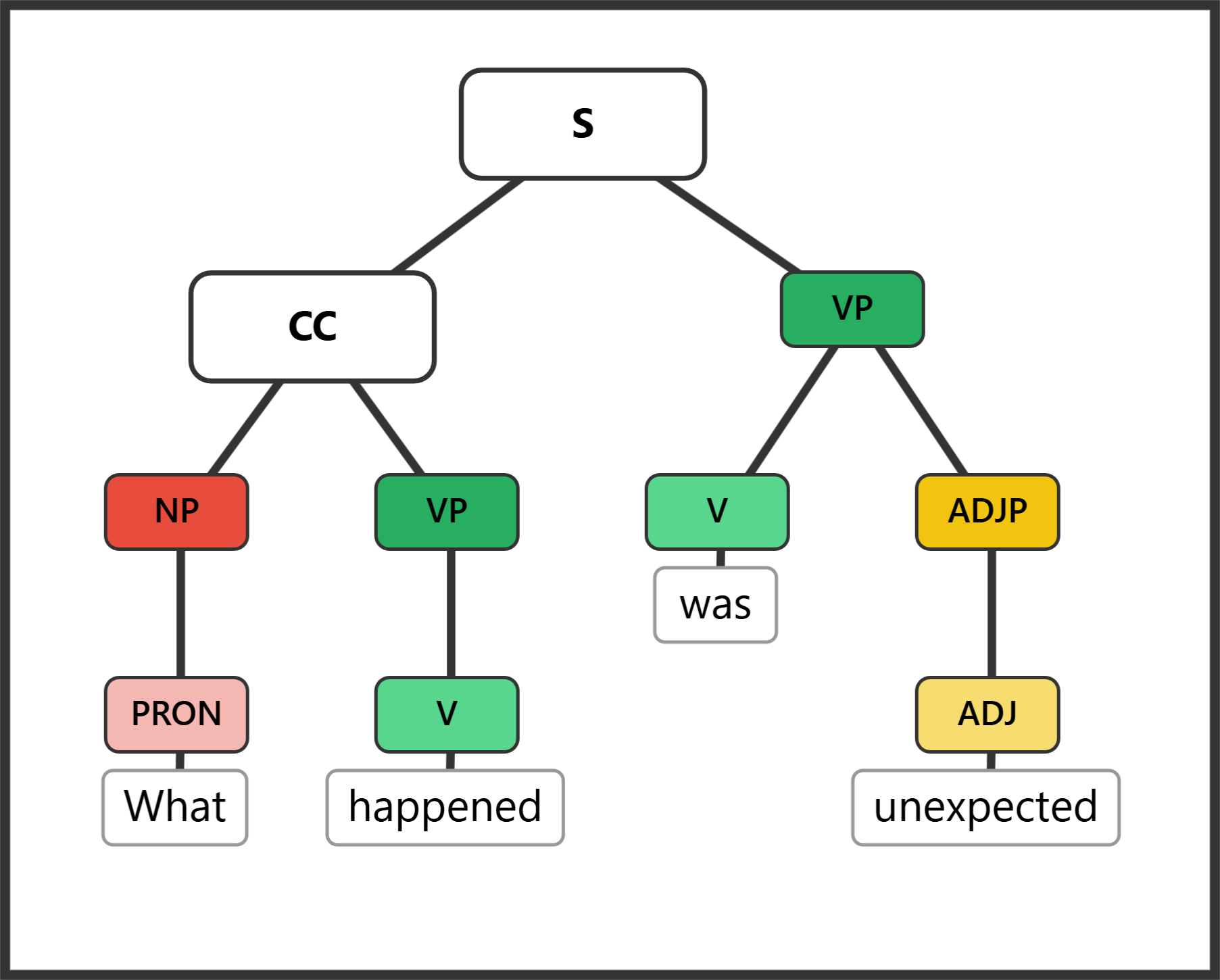
[S [CC [NP [PRON What]] [VP [V happened]]] [VP [V was] [ADJP [ADJ unexpected]]]]
The wh-word What serves a double duty: it introduces the embedded clause and fills its subject slot. There is no separate complementizer node—the wh-pronoun is the subject NP. The whole CC then occupies the matrix subject slot.
Pattern 3: Wh-word Preceding the Subject.
When a wh-word fills a non-subject role inside the embedded clause (object, adverbial, etc.), a separate subject NP follows it. The wh-word still introduces the clause, but it has been pulled from somewhere inside the predicate to the front:
Pattern 3 = Wh-word + Subject NP + Predicate VP
-
I know what she said. (DO; what = direct object of said)
-
She asked where he went. (DO; where = adverbial of went)
-
We discussed why the experiment failed. (DO; why = adverbial)
The word order inside the embedded clause is declarative, not interrogative: I know what she said, not I know what did she say. This is one of the most common error patterns in academic writing—students bring the question word order along with the wh-word, creating an indirect-question/direct-question hybrid that is not standard English.
Pattern 3 is also the only complement-clause pattern that can fill the object-of-preposition slot. about what he said is grammatical; about that he said is not. This pattern is common after verbs and adjectives that select prepositional complements: think about, talk about, interested in, curious about, worried about.
Labeling Table: We talked about what he said (CC as Object of Preposition).
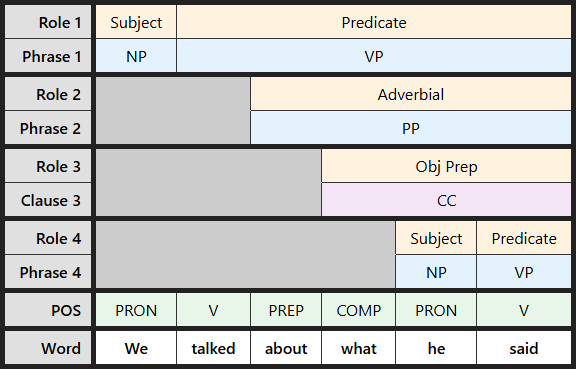
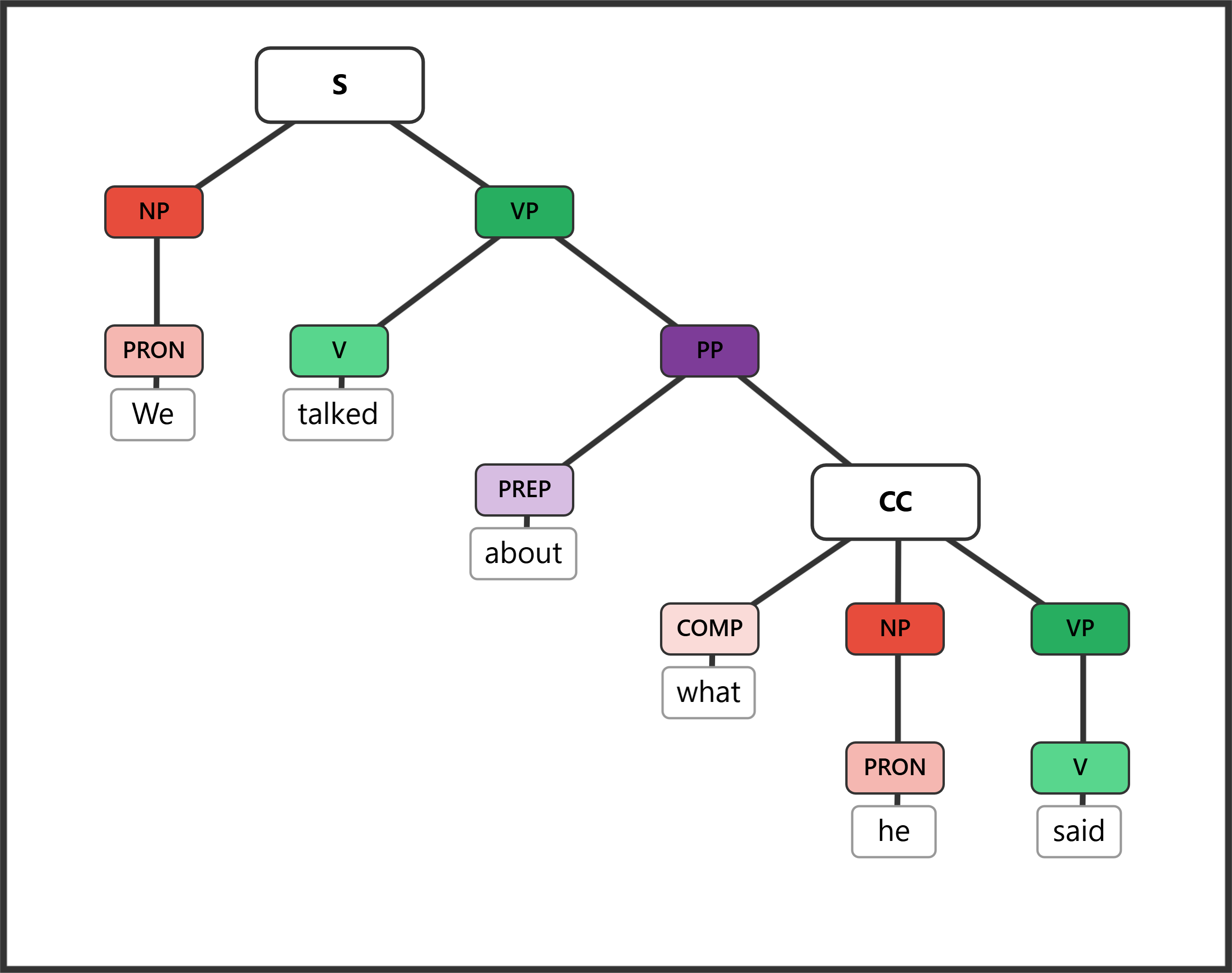
[S [NP [PRON We]] [VP [V talked] [PP [PREP about] [CC [COMP what] [NP [PRON he]] [VP [V said]]]]]]
The wh-word what sits at the front of the complement clause; the embedded subject (he) and embedded predicate (said) follow. what is the direct object of said, pulled to the clause-initial position.
Empty Complementizer (Omitted that).
In Pattern 1 with that in object position, the complementizer can be omitted: I believe she is honest. Structurally the slot is still there—it’s just unfilled. Some textbook traditions show this with an empty COMP node in the tree diagram; others simply omit the COMP node entirely. We use the convention from Chapter 13 (the empty-relativizer convention): show the omission as (that) in prose and use a normal Pattern 1 bracket with the omitted word in parentheses when it would otherwise be ambiguous.
Key Points.
-
Complement clauses come in three structural patterns. Pattern 1 has a separate complementizer (that, if, whether) and a separate subject NP. Pattern 2 has a wh-pronoun filling the embedded subject NP. Pattern 3 has a wh-word at the front and a separate subject NP after it.
-
The same surface position (subject, DO, SubjComp, OP) can be filled by any pattern—what differs is the structure inside the clause.
-
Only Pattern 3 (wh-word + separate subject) can serve as the object of a preposition.
-
Word order inside the embedded clause is always declarative: I know what she said, not
I know what did she say. -
Common matrix verbs that take complement-clause objects: believe, know, think, say, hope, realize, admit, claim, doubt, wonder, ask, tell, explain, decide, understand.

