Section 5.6 Adjectives
Adjectives are the descriptors of language. They modify nouns, telling us what kind of thing something is, what quality it has, or which one we mean. A tall building, a happy child, an interesting problem—in each case, the adjective narrows down the noun, adding specificity. But the range of qualities that adjectives can express is remarkably broad, extending well beyond simple physical description.
Consider the kinds of information adjectives convey. Physical qualities include size (tall, tiny, enormous), weight (heavy, light, massive), texture (rough, smooth, silky), and shape (round, flat, triangular). Evaluative adjectives express opinions or judgments: good, beautiful, terrible, delicious, boring. Age and temporal adjectives locate things in time: old, new, ancient, modern, recent. Color adjectives describe appearance: red, blue, green, dark, pale. And origin or material adjectives identify where something comes from or what it is made of: wooden, American, silk, digital, solar.
An important distinction exists between subjective and objective adjectives. Some adjectives express opinions that can vary from person to person—nice, wonderful, ugly, fascinating—while others state measurable or verifiable facts—rectangular, empty, dead, wooden. A building might be “beautiful” to one person and “hideous” to another, but if it is “rectangular”, that is an observable fact. This distinction matters because subjective adjectives can often be graded (more beautiful, most fascinating), while many objective adjectives resist grading (more rectangular, most wooden sound odd). The breadth of this semantic range—from personal judgment to physical measurement to origin and material—shows why the traditional definition "describes a noun" is too vague to be useful as a test for identifying adjectives.
What Adjectives Do.
Unlike nouns and verbs, which often carry the core meaning of a sentence, adjectives enrich and qualify. They answer questions like "What kind?" (a wooden table), "Which one?" (the third attempt), and "What is it like?" (She seems nervous.).
But adjectives also do subtler work. They can express temporary states (“She is tired”) or permanent properties (“The wall is brick”). They can classify nouns into types (“a solar panel”, “a criminal investigation”) in ways that go beyond mere description. They can even express the speaker’s emotional reaction to something (“an amazing performance”, “a terrible mistake”), blending description with evaluation.
This wide functional range creates a challenge: many words that "describe" nouns are not adjectives at all. In “the coffee table”, the word “coffee” describes what kind of table it is—but “coffee” is a noun, not an adjective. In “the running water”, the word “running” describes the water—but “running” is a verb form (a present participle). Description is a function that many word classes can perform; it does not reliably identify adjective form. This is why we need the morphological and syntactic tests that follow.
Morphological Tests for Adjectives.
Test 1: Comparative and superlative forms
Most adjectives can be graded—that is, they can express degrees of a quality:
-
tall → taller → tallest
-
happy → happier → happiest
-
beautiful → more beautiful → most beautiful
If a word can become comparative or superlative, it’s almost certainly an adjective. This test distinguishes adjectives from nouns and verbs, which cannot be graded this way (we don’t say taller book meaning "more of a book" or he walked the walkedest).
Test 2: The -ish test
Many adjectives accept the suffix -ish, meaning "somewhat":
-
tall → tallish
-
red → reddish
-
young → youngish
This is a quick informal test. If -ish sounds natural, you likely have an adjective.
Test 3: Adverb formation with -ly
Many adjectives can become adverbs by adding -ly:
-
happy → happily
-
quick → quickly
-
careful → carefully
This shows the close relationship between adjectives and adverbs—and also helps identify adjectives in the first place.
Syntactic Tests for Adjectives.
Test 1: The attributive position test
Adjectives can appear between a determiner and a noun—this position, directly before the noun, is called attributive position:
-
the tall man
-
a happy child
-
the interesting book
This is a defining characteristic. If a word can slot into "the ___ noun," it’s behaving as an adjective.
Test 2: The subject complement position test
Adjectives can follow linking verbs like be, seem, become, and appear—this position, after the verb, is called subject complement position:
-
The man is tall.
-
She seems happy.
-
The book appears interesting.
Most adjectives work in both positions. A few work in only one (see below).
Test 3: The very test
Adjectives can be modified by degree words like very, extremely, and quite:
-
very tall
-
extremely happy
-
quite interesting
If “very” sounds natural before a word, that word is likely an adjective. (Nouns and verbs don’t accept very: very book, very walked.)
Adjective Phrases: How Adjectives Work in Sentences.
Adjectives form phrases just as nouns and verbs do. An adjective phrase (AdjP) has an adjective as its head, with optional modifiers before and after.
A simple adjective phrase:
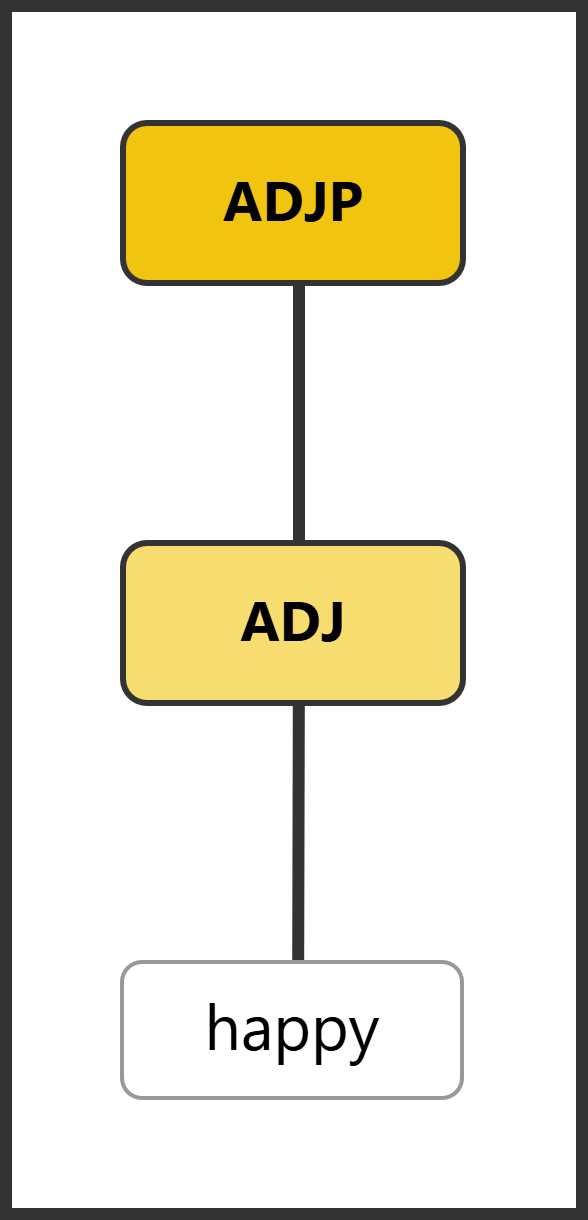
[ADJP [ADJ happy]]
An adjective phrase with a pre-modifier:
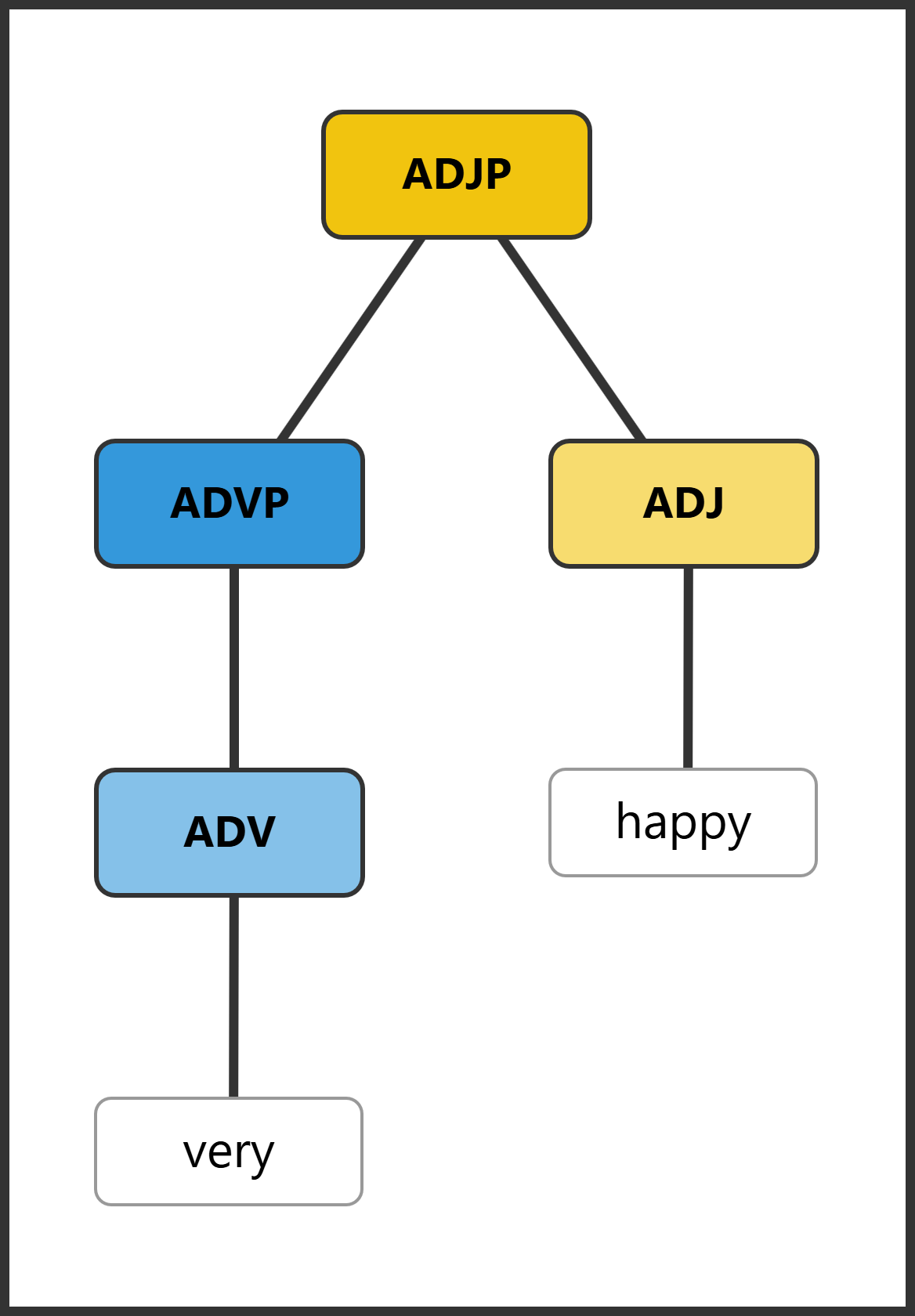
[ADJP [ADVP [ADV very]] [ADJ happy]]
The degree adverb “very” intensifies the adjective “happy”.
An adjective phrase with a post-modifier:
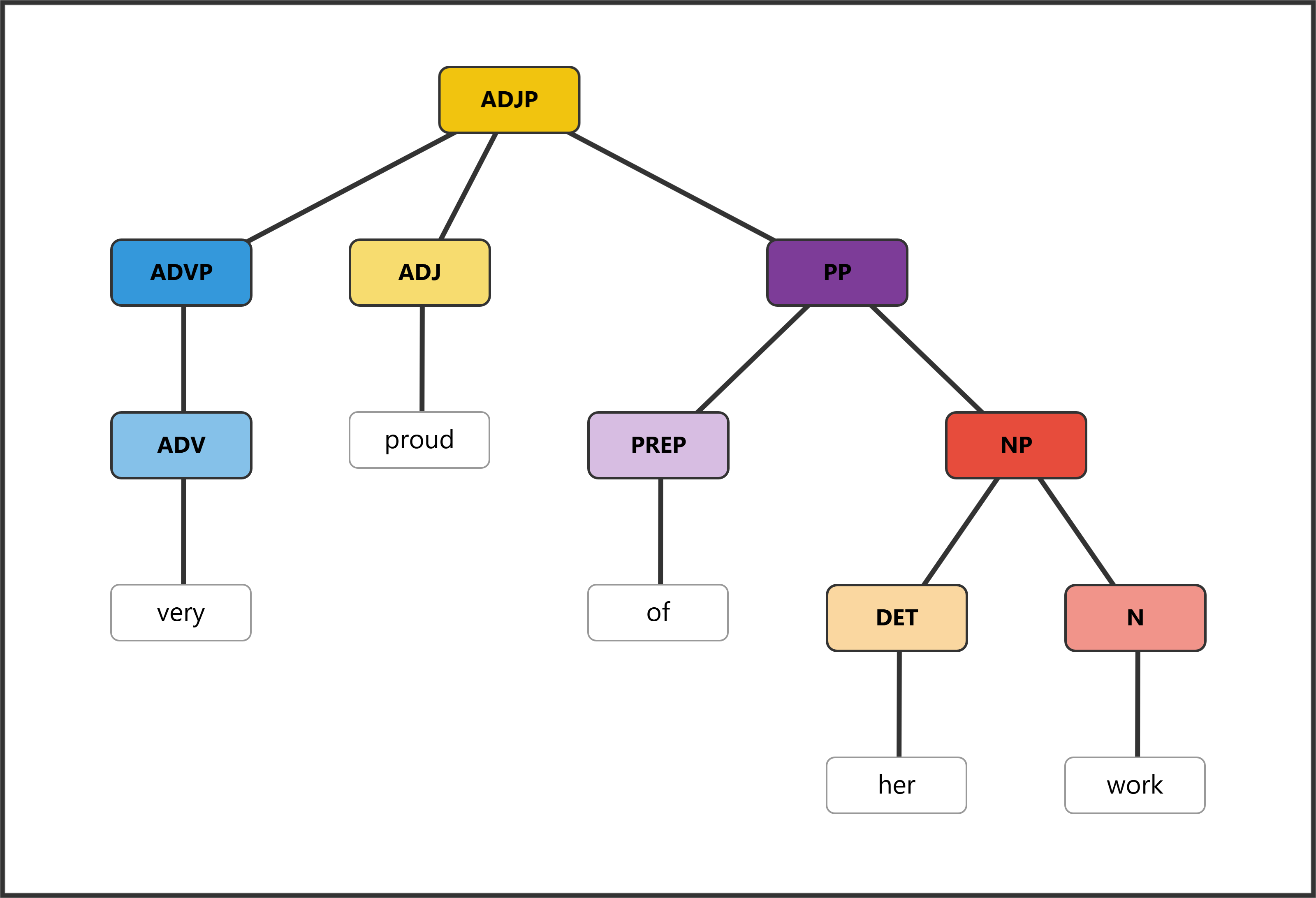
[ADJP [ADVP [ADV very]] [ADJ proud] [PP [PREP of] [NP [DET her] [N work]]]]
Here the adjective “proud” is modified both by the degree adverb “very” (pre-modifier) and by the prepositional phrase “of her work” (post-modifier).
Common pre-modifiers of adjectives:
-
Degree adverbs: very, extremely, somewhat, quite, rather
Common post-modifiers of adjectives:
-
Prepositional phrases: proud of her work, afraid of the dark, interested in linguistics, good at math
Where Adjective Phrases Appear.
Adjective phrases appear in two main positions:
-
Attributive position (before a noun): the [very tall] man
-
Subject complement position (after a linking verb): The man is [very tall].
When an AdjP appears attributively, it modifies the following noun directly. When it appears as a subject complement, it describes the subject of the sentence.
Identifying the Head Adjective.
Apply the same test: which word is essential?
“extremely proud of her remarkable achievement”
-
Remove extremely: proud of her remarkable achievement ✓
-
Remove of her remarkable achievement: extremely proud ✓
-
Remove proud: extremely of her remarkable achievement ✗
The head is “proud”. The adverb “extremely” and the PP “of her remarkable achievement” both modify it.
Special Classes of Adjectives.
Most adjectives are gradable—they can express degrees (taller, very tall). But some adjectives express absolute properties and resist grading:
-
dead — something is dead or not;
very deadsounds odd -
unique — traditionally, something is unique or not;
more uniqueis contested -
pregnant — grammatically ungradable, though metaphor sometimes changes this
Some adjectives are attributive-only (they can only appear before nouns):
-
the main reason ✓ /
The reason is main✗ -
a mere child ✓ /
The child is mere✗
Others are subject-complement-only (they can only appear after linking verbs):
-
The child is asleep ✓ /
the asleep child✗ -
She felt afraid ✓ /
the afraid woman✗

