Section 7.2 The Basic Structure of English Sentences
Every English sentence—from the simplest to the most complex—shares a fundamental structure.
S → NP + VP.
At its core, every sentence (S) divides into two parts:
-
A noun phrase (NP) functioning as the subject
-
A verb phrase (VP) functioning as the predicate
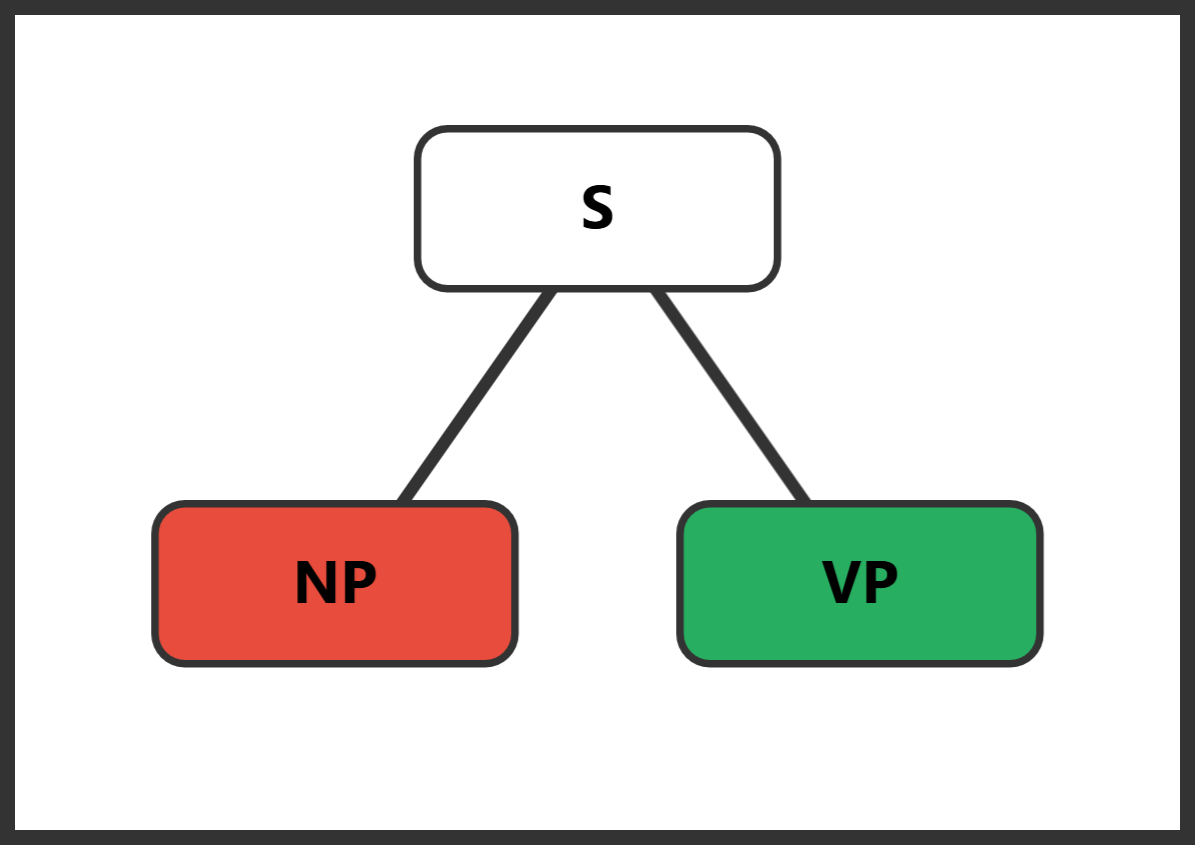
[S [NP] [VP]]
The subject NP tells us who or what the sentence is about. The predicate VP tells us what the subject does, is, or experiences.
Consider these sentences:
| Sentence | Subject NP | Predicate VP |
|---|---|---|
| Dogs bark. | Dogs | bark |
| The old man sat quietly. | The old man | sat quietly |
| My brilliant sister from Ohio won the prize. | My brilliant sister from Ohio | won the prize |
No matter how complex the sentence becomes, this basic division remains. The subject can grow elaborate (The extremely talented young musician from the small town in rural Pennsylvania who had never performed professionally before...) and the predicate can become equally elaborate (...suddenly found herself standing on the stage of Carnegie Hall). But the fundamental structure—subject NP plus predicate VP—persists.
What’s in the NP?
A noun phrase is built around a noun (its head). The simplest NP is just a noun or pronoun:
-
Dogs bark.
-
She arrived.
But NPs can include additional elements:
-
Determiners: the dog, my sister
-
Adjectives: the old dog, my brilliant sister
-
Prepositional phrases: the dog on the porch, my sister from Ohio
-
Relative clauses: the dog that barked, my sister who lives in Ohio
All of these elements cluster around the head noun, forming a unit—the noun phrase.
What’s in the VP?
A verb phrase is built around a verb (its head). The simplest VP is just a verb:
-
Dogs bark.
-
She arrived.
But VPs typically include additional elements:
-
Objects: She read the book.
-
Complements: He is a doctor. She became famous.
-
Adverbials: She arrived yesterday. He spoke loudly.
The verb phrase contains everything in the predicate—the verb itself plus whatever follows it.

