Section 11.10 Homework: Voice and Modals
Total estimated time: 45 minutes
Subsection 11.10.1 Part 1: Voice Identification
Instructions.
For each sentence, identify whether it is in active or passive voice. If passive, identify the actor (if present) and the original active construction.
Example (completed).
The report was written by the committee.
-
Voice: passive
-
Actor: the committee
-
Active version: The committee wrote the report.
Exercises.
Exercise 1. The researchers carefully analyzed the data.
-
Voice: _____
Exercise 2. Three errors were discovered in the code.
-
Voice: _____
-
Actor (if present): _____
Exercise 3. The new policy will be announced tomorrow.
-
Voice: _____
-
Actor (if present): _____
Exercise 4. Someone stole my bicycle last night.
-
Voice: _____
Exercise 5. The building was constructed in 1920.
-
Voice: _____
-
Actor (if present): _____
Subsection 11.10.2 Part 2: Voice Transformation
Instructions.
Convert each sentence to the opposite voice (active to passive or passive to active). Maintain the same tense and aspect.
Example (completed).
Active to passive: The architect has designed the new building.
Answer: The new building has been designed by the architect.
Exercises.
Exercise 6. Active to passive: The team is preparing the presentation.
-
Answer: _____
Exercise 7. Active to passive: Someone had stolen the documents before the investigation began.
-
Answer: _____
Exercise 8. Passive to active: The experiment was conducted by the research team.
-
Answer: _____
Exercise 9. Passive to active: The proposal will be reviewed by the committee next week.
-
Answer: _____
Exercise 10. Active to passive: The company will hire fifty new employees.
-
Answer: _____
Subsection 11.10.3 Part 3: Modal Meaning
Instructions.
For each sentence, identify the modal and classify its meaning using one of the following categories:
-
Ability
-
Possibility
-
Permission
-
Obligation/Necessity
-
Deduction
-
Advice
Example (completed).
You must submit the application by Friday.
-
Modal: must
-
Meaning: obligation/necessity
Exercises.
Exercise 11. She can speak three languages fluently.
-
Modal: _____
-
Meaning: _____
Exercise 12. That might be the correct answer, but I’m not certain.
-
Modal: _____
-
Meaning: _____
Exercise 13. You should apologize for your mistake.
-
Modal: _____
-
Meaning: _____
Exercise 14. He must be exhausted after running the marathon.
-
Modal: _____
-
Meaning: _____
Exercise 15. May I leave the room early?
-
Modal: _____
-
Meaning: _____
Exercise 16. They could have won the game if they had practiced more.
-
Modal: _____
-
Meaning: _____
Exercise 17. Explain the difference between the two uses of must:
-
a) You must wear a seatbelt. (Meaning type: _____)
-
b) She’s not answering the phone. She must be asleep. (Meaning type: _____)
Subsection 11.10.4 Part 4: Diagramming Voice and Modals
Instructions.
For each sentence, complete the labeling table, write the bracket notation, and draw a tree diagram. Use the abbreviations from the Diagram Examples section (MOD for modals, AUX for auxiliaries, V for main verbs).
Example (completed).
She can swim.
| Role | Subj | Pred | |
| Phrase | NP | VP | |
| Word | She | can | swim |
| POS | PRON | MOD | V |
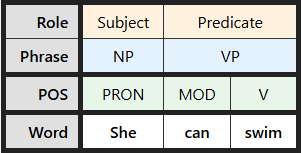
Bracket notation:
[S [NP [PRON She]] [VP [MOD can] [V swim]]]
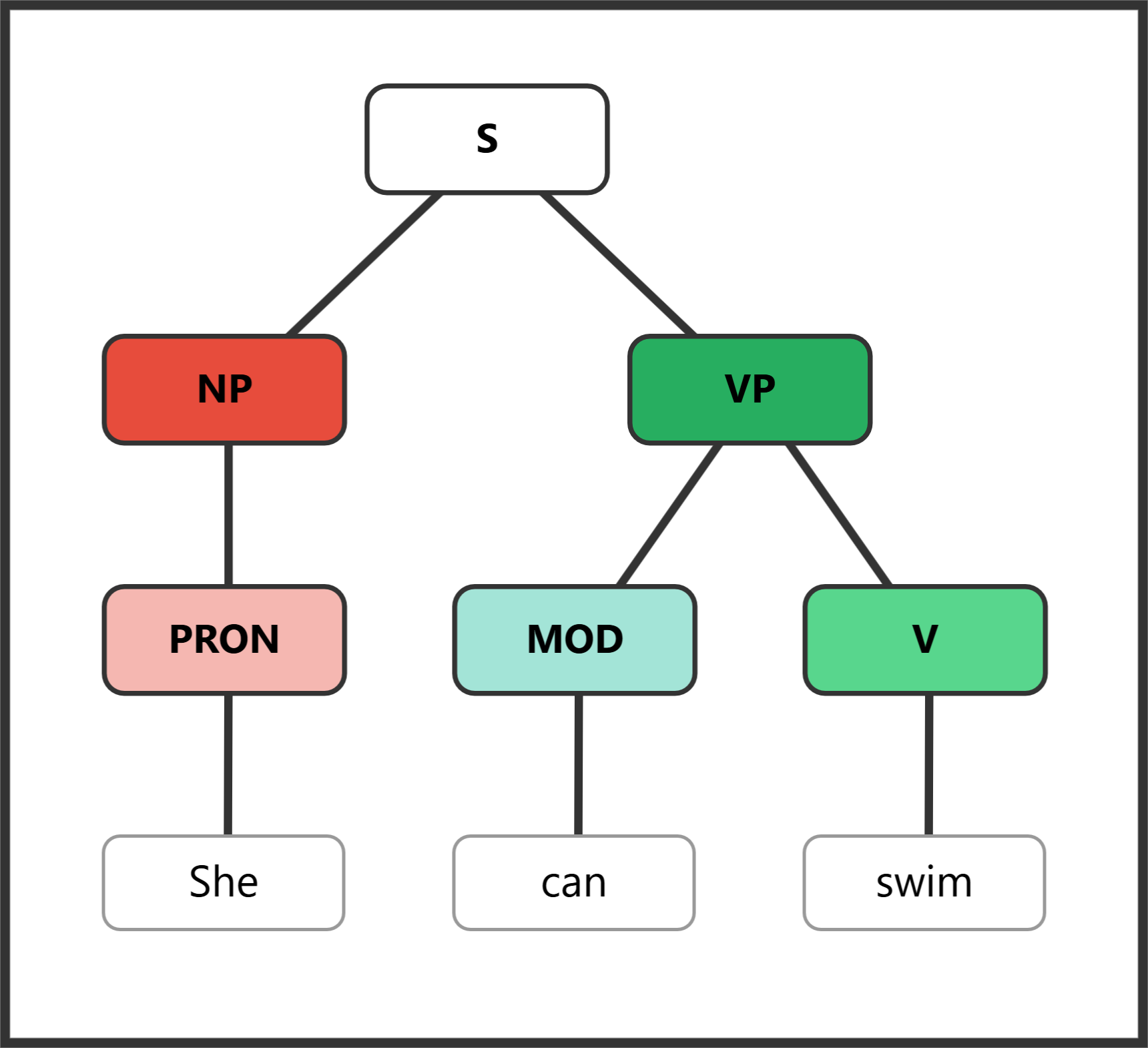
Exercises.
Exercise 18. The letter was delivered yesterday.
| Role | |||||
| Phrase | |||||
| Word | The | letter | was | delivered | yesterday |
| POS |
-
Bracket notation: _____
-
Diagram:
Exercise 19. She must leave before noon.
| Role | |||||
| Phrase | |||||
| Word | She | must | leave | before | noon |
| POS |
-
Bracket notation: _____
-
Diagram:
Exercise 20. The report can be finished tomorrow.
| Role | ||||||
| Phrase | ||||||
| Word | The | report | can | be | finished | tomorrow |
| POS |
-
Bracket notation: _____
-
Diagram:
Exercise 21. He should have called earlier.
| Role | |||||
| Phrase | |||||
| Word | He | should | have | called | earlier |
| POS |
-
Bracket notation: _____
-
Diagram:
Subsection 11.10.5 Part 5: Analysis and Application
Instructions.
Read the passage below and answer the questions.
Passage.
The new policy was announced yesterday by the CEO. All employees must submit their feedback by next Friday. According to management, the changes should improve workplace efficiency. Some workers believe the policy might create additional challenges. However, the final decision will be made after all responses have been reviewed.
Exercises.
Exercise 22. Identify all passive voice constructions in the passage. For each, explain why the writer might have chosen passive over active voice.
-
Passive construction 1: _____
-
Reason: _____
-
Passive construction 2: _____
-
Reason: _____
Exercise 23. Identify the modals in the passage and classify each as expressing certainty/possibility or obligation/permission:
-
Modal 1: _____ — Type: _____
-
Modal 2: _____ — Type: _____
-
Modal 3: _____ — Type: _____

