Section 13.11 Relative Clause Structures
This section examines the internal structure of relative clauses in detail: the inventory of relative pronouns and adverbs, the distinction between that and which, the zero relative (contact clause), and how each pattern appears in labeling tables and tree diagrams.
Formation.
A relative clause consists of a relative word followed by clause content:
Relative Clause = Relative Word + Subject + Predicate (or: Relative Word as Subject + Predicate)
-
the book that I read (that = object of read)
-
the student who won (who = subject of won)
Relative Pronouns.
| Pronoun | Use | Example |
|---|---|---|
| who | subject (people) | the man who arrived |
| whom | object (people, formal) | the man whom I saw |
| whose | possessive (people/things) | the author whose book I read |
| which | subject/object (things) | the book which I read |
| that | subject/object (people/things) | the book that I read |
Relative Adverbs.
| Adverb | Use | Example |
|---|---|---|
| where | place | the city where I was born |
| when | time | the day when we met |
| why | reason | the reason why she left |
That vs. Which.
In American English:
-
That is preferred for restrictive clauses
-
Which is preferred for non-restrictive clauses
-
Restrictive: The book that I recommended is excellent.
-
Non-restrictive: This book, which I recommended, is excellent.
Three Structural Patterns.
Section 13.10 introduced the two-way structural split between relative pronouns that fill the embedded subject slot and relative pronouns that precede a separate subject. There is also a third pattern in which the relative pronoun is omitted entirely. The three patterns differ both visually (in the labeling table) and structurally (in the tree). Each is demonstrated below with a labeling table, a tree diagram, and the corresponding bracket notation.
Pattern 1: Relativizer as the Embedded Subject.
The relative pronoun fills the subject NP slot inside the embedded clause and is followed directly by the embedded predicate. There is no separate subject NP — the relative pronoun is the subject.
Pattern 1 = REL (as Subject NP) + Predicate VP
-
the student who won the award (who = subject of won)
-
the players who practiced (who = subject of practiced)
-
the book that changed my life (that = subject of changed)
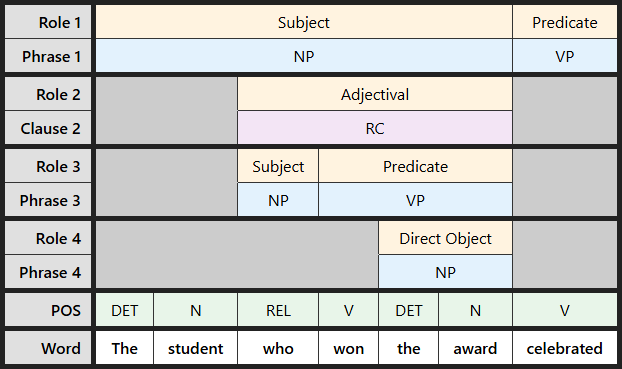
Labeling Table: The student who won the award celebrated (Pattern 1).
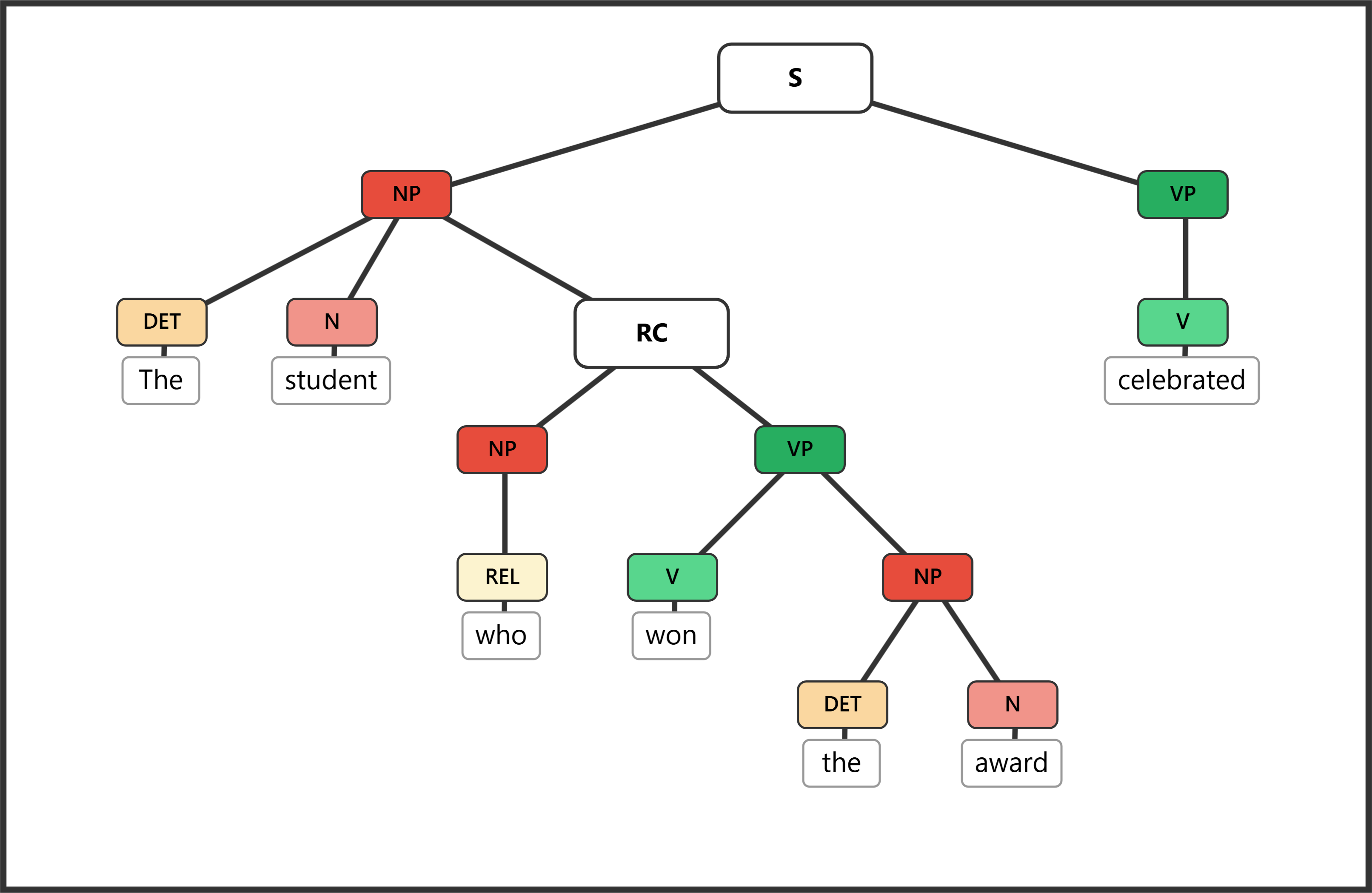
[S [NP [DET The] [N student] [RC [NP [REL who]] [VP [V won] [NP [DET the] [N award]]]]] [VP [V celebrated]]]
Notice that the embedded subject NP wraps the relativizer directly:
[NP [REL who]]. The whole RC is an Adjectival modifying student; inside it, who is Subject and won the award is Predicate.
Pattern 2: Relativizer Preceding the Embedded Subject.
The relative pronoun fills a non-subject role inside the embedded clause (typically direct object). A separate subject NP follows the relativizer, and the embedded predicate follows after that. The relative pronoun has been pulled from somewhere inside the predicate to the front of the clause.
Pattern 2 = REL + Subject NP + Predicate VP
-
the author whom the critics praised (whom = direct object of praised)
-
the book that the students read (that = direct object of read)
-
the report which the committee approved (which = direct object of approved)
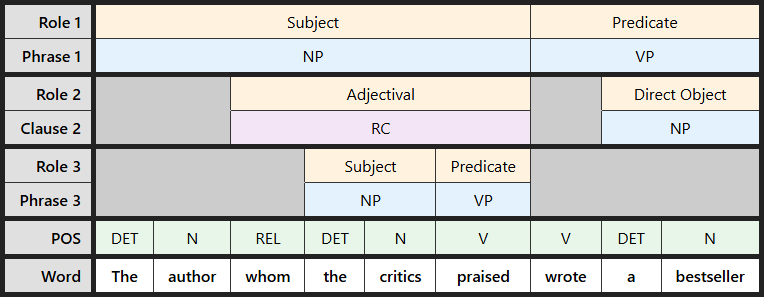
Labeling Table: The author whom the critics praised wrote a bestseller (Pattern 2).
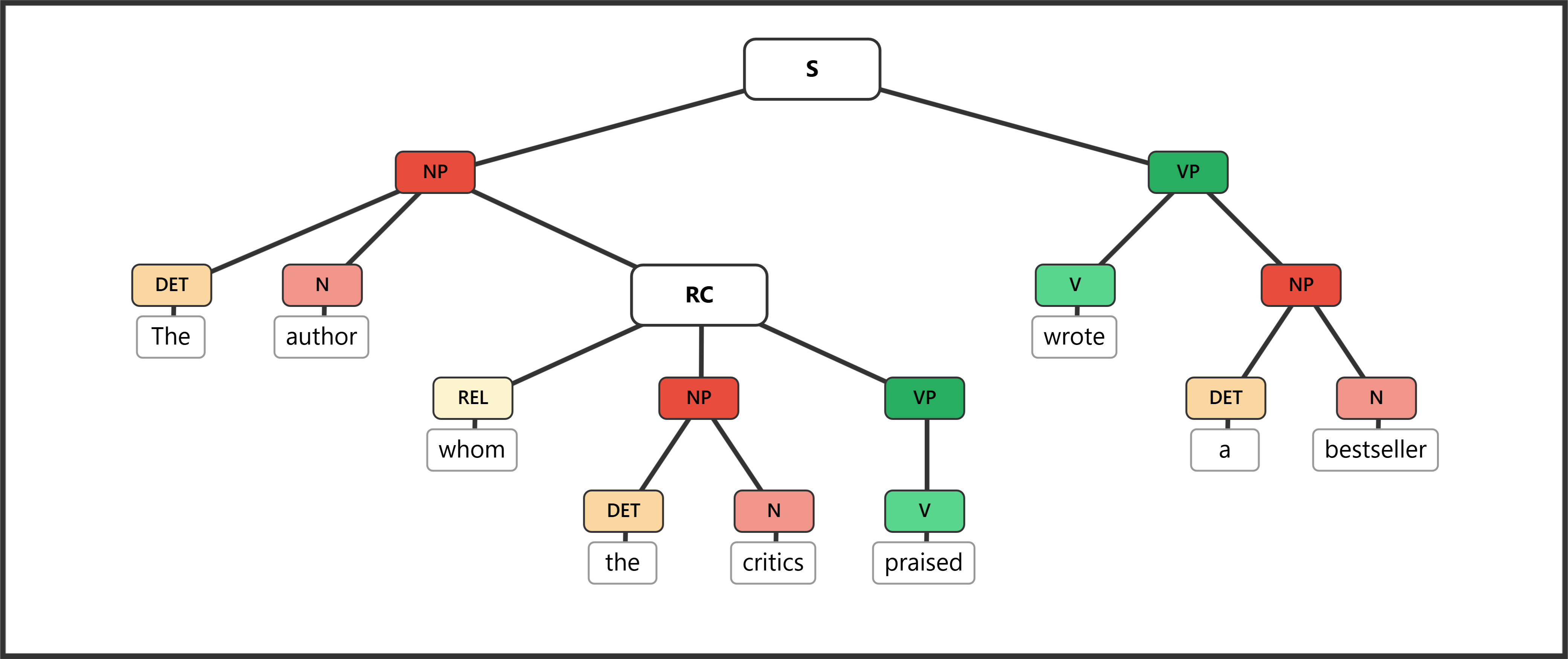
[S [NP [DET The] [N author] [RC [REL whom] [NP [DET the] [N critics]] [VP [V praised]]]] [VP [V wrote] [NP [DET a] [N bestseller]]]]
Here the RC has three children: a bare
[REL whom] at the front (no NP wrapper, because the relativizer is not the embedded subject), the embedded subject NP the critics, and the embedded predicate VP praised. whom is the direct object of praised in the underlying meaning, but in the surface order it appears at the clause edge.
Pattern 3: Empty Relativizer (Zero Relative).
When the relative pronoun is the object, it can be omitted entirely. The resulting clause is sometimes called a zero relative or contact clause. The bracket notation reflects the omission by leaving the REL node out: the RC contains only the embedded subject NP and the embedded predicate VP, with no introducing word at all.
Pattern 3 = (no relativizer) + Subject NP + Predicate VP
-
the book (that) I read
-
the man (whom) I saw
-
the person (that) she called
The omission is only possible when the relativizer would have been a non-subject (Pattern 2). It cannot be done when the relativizer is the embedded subject (Pattern 1):
-
the man who arrived (not
the man arrived)
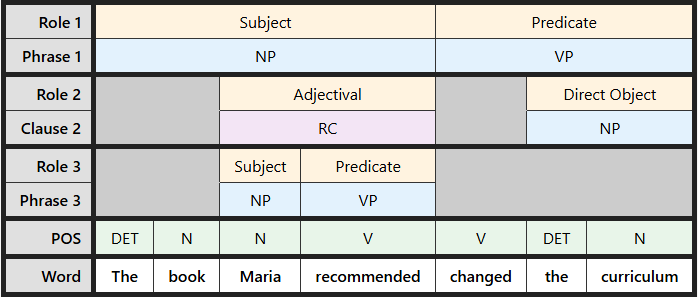
Labeling Table: The book Maria recommended changed the curriculum (Pattern 3).
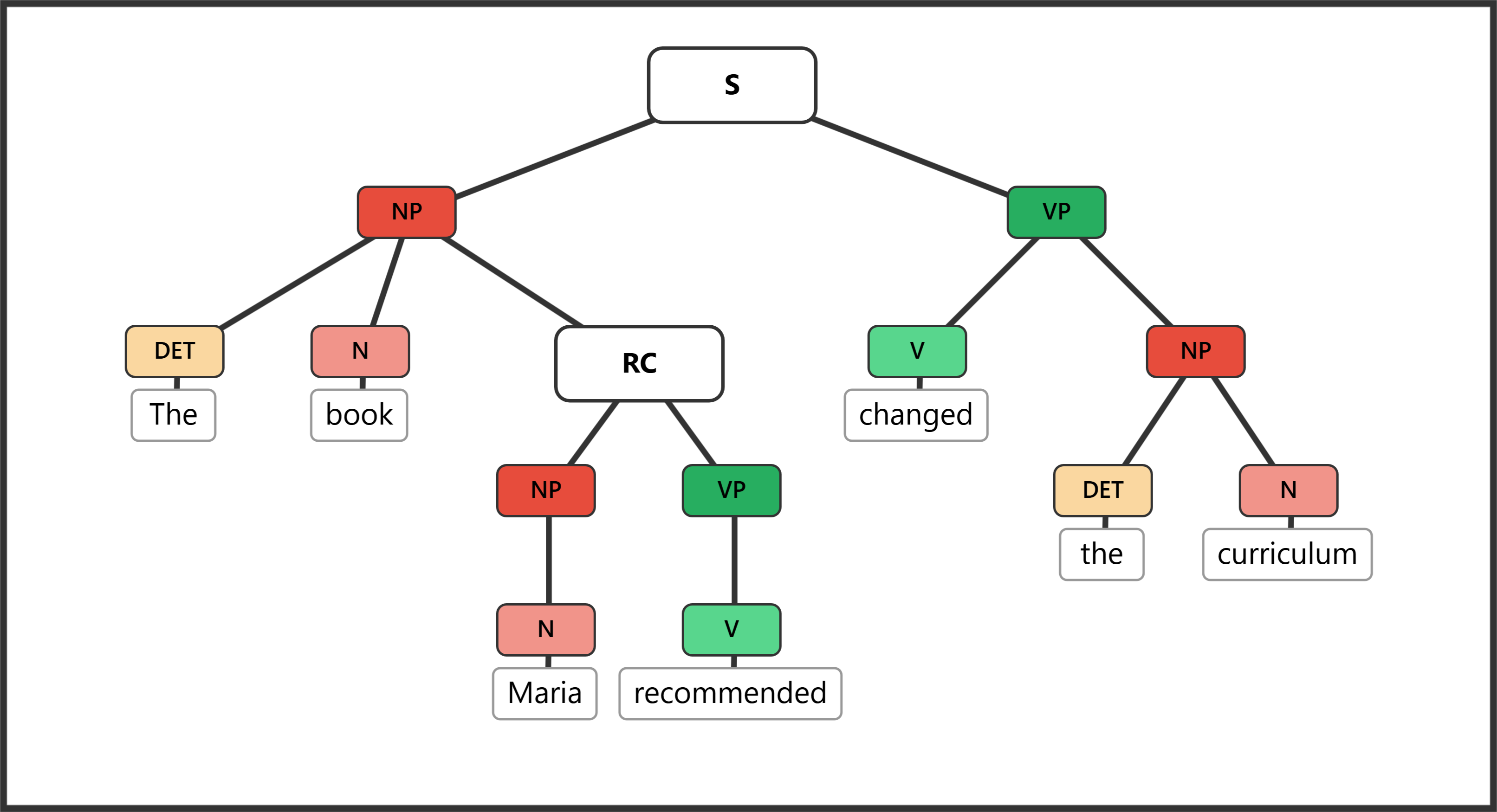
[S [NP [DET The] [N book] [RC [NP [N Maria]] [VP [V recommended]]]] [VP [V changed] [NP [DET the] [N curriculum]]]]
The RC has only two children — the embedded subject NP Maria and the embedded predicate VP recommended. There is no REL node at all. The structural difference between Pattern 1 and Pattern 3 is subtle but important: in Pattern 1 the inner NP wraps a REL (
[NP [REL who]]), whereas in Pattern 3 the inner NP is a regular noun phrase ([NP [N Maria]]) and the relativizer position is empty.
Key Points.
-
Relative clauses always follow the noun they modify (post-modification).
-
The relative pronoun simultaneously connects the clause and fills a role within it (subject, object, or possessive).
-
Pattern 1: Relativizer fills the embedded subject slot. Pattern 2: Relativizer precedes a separate embedded subject. Pattern 3: Relativizer is omitted entirely (only possible when it would have filled a non-subject role).
-
Restrictive relative clauses use that; non-restrictive use which (American English convention).

