Section 7.6 Sentence Labeling Tables
Tree diagrams reveal the full hierarchical structure of a sentence, but they are not the only analytical tool available. Sentence labeling tables provide a complementary approach: they arrange the words of a sentence in columns and label each word’s part of speech, the phrase it belongs to, and its grammatical role. Labeling tables are imperfect—they cannot always capture the full range of connections and hierarchy the way a tree diagram can. However, they can be a useful tool to aid you in building diagrams or to capture additional information about sentences, for instance by identifying roles played by various elements of the sentence. Throughout this textbook, we will provide pre-made tables that help to guide you toward your analysis.
The Table Format.
A sentence labeling table has four rows:
-
Role (top row): The grammatical function of a word or group of words in the sentence.
-
Phrase: The phrase type that the word belongs to (NP, VP, PP, ADJP, ADVP).
-
Word: The actual words of the sentence, one per column.
-
Part of Speech, abbreviated POS (bottom row): The word-level category (N, V, DET, ADJ, ADV, PREP, etc.).
Each column represents one word. When a role or phrase spans multiple words, the label appears in the first column of that group, and the remaining columns in the group are left empty.
Introducing Roles.
For now, we introduce only two roles: Subject and Predicate. The Subject is the NP daughter of S—the noun phrase that tells us who or what the sentence is about. The Predicate is the verb phrase that tells us what the subject does or is.
In the Phrase row, the verb that anchors the predicate is labeled VP. In the table, the VP label applies to just the main verb itself—it does not span objects, complements, or adverbials the way the VP node does in a tree diagram. Later chapters will introduce additional roles such as Direct Object, Indirect Object, Subject Complement, and Adverbial.
How to Complete a Table.
When you are given a sentence labeling table, work from the bottom up:
-
Step 1—Part of Speech: Identify the part of speech for each word (N, V, DET, ADJ, ADV, PREP, etc.).
-
Step 2—Phrase: Group words into phrases and label each phrase type (NP, VP, PP, ADJP, ADVP).
-
Step 3—Role: Assign grammatical roles to the phrases (Subject, Predicate).
Example 1: "The dog barked.".
Let us walk through this simple intransitive sentence.
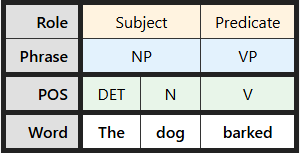
Step 1—Part of Speech: “The” is a DET, “dog” is a N, “barked” is a V.
Step 2—Phrase: “The dog” forms an NP. “Barked” is the VP.
Step 3—Role: The NP “The dog” is the Subject. The VP “barked” is the Predicate.
The completed table:
| Role | Subject | Predicate | |
|---|---|---|---|
| Phrase | NP | VP | |
| Word | The | dog | barked |
| POS | DET | N | V |
Compare this with the tree diagram for the same sentence:
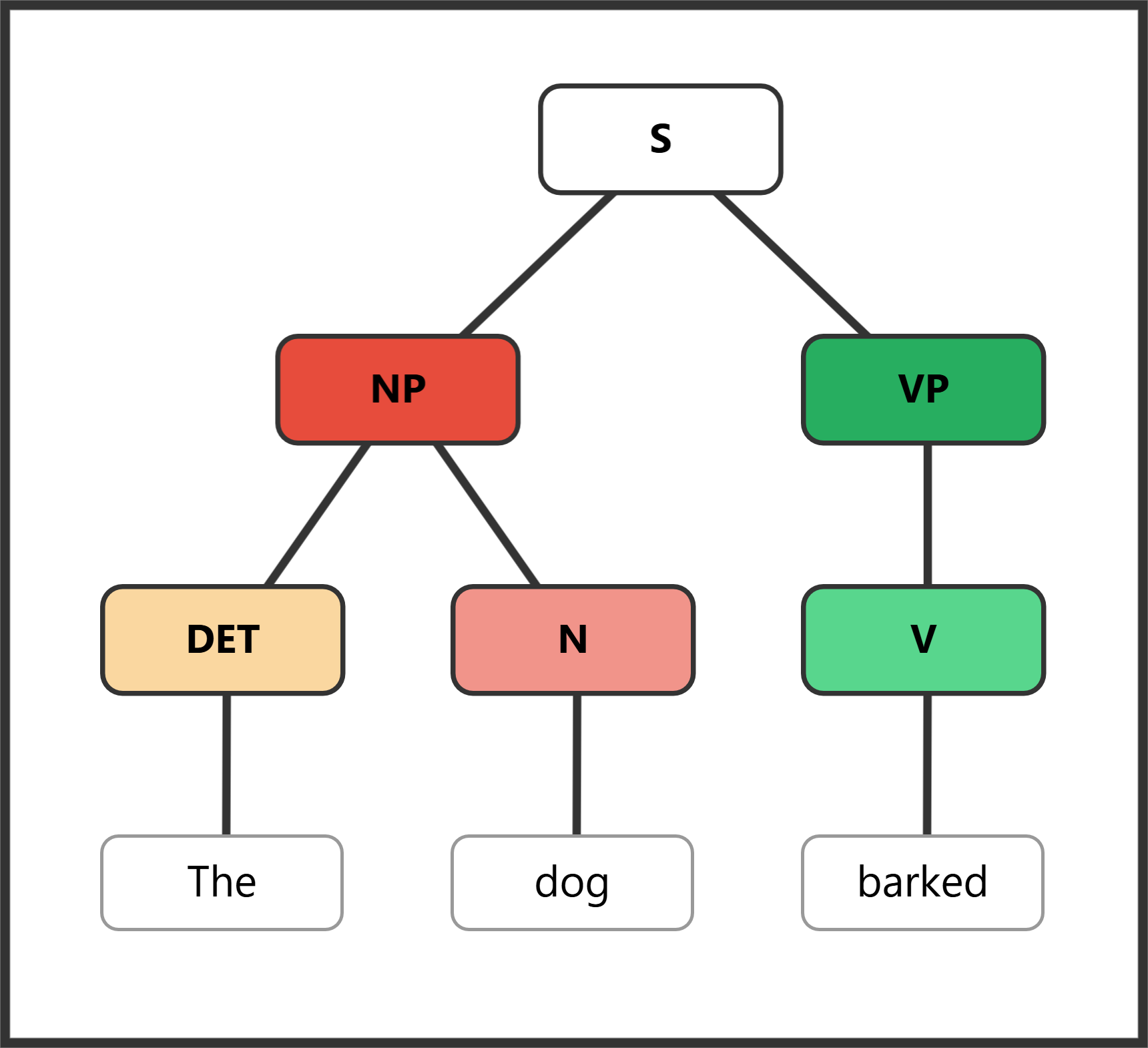
[S [NP [DET The] [N dog]] [VP [V barked]]]
Notice that the tree shows “The” and “dog” are both inside the NP—the tree captures this containment relationship visually. The table lists them as separate columns sharing the NP label, but it cannot show the hierarchical nesting the way the tree does.
Example 2: "The cat chased the mouse.".
Now let us try a transitive sentence.
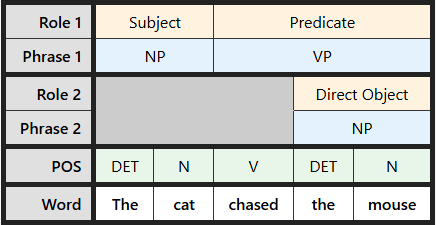
Step 1—Part of Speech: “The” is a DET, “cat” is a N, “chased” is a V, “the” is a DET, “mouse” is a N.
Step 2—Phrase: “The cat” forms an NP. “Chased” is the VP. “The mouse” forms another NP.
Step 3—Role: The NP “The cat” is the Subject. The VP “chased” is the Predicate. But what about “the mouse”? It is a noun phrase that receives the action—it is the object of the verb. However, we have not yet introduced the Direct Object role in our table system, so we leave the Role cell empty for now. The words still receive their POS and Phrase labels.
| Role | Subject | Predicate | |||
|---|---|---|---|---|---|
| Phrase | NP | VP | NP | ||
| Word | The | cat | chased | the | mouse |
| POS | DET | N | V | DET | N |
And the corresponding tree:
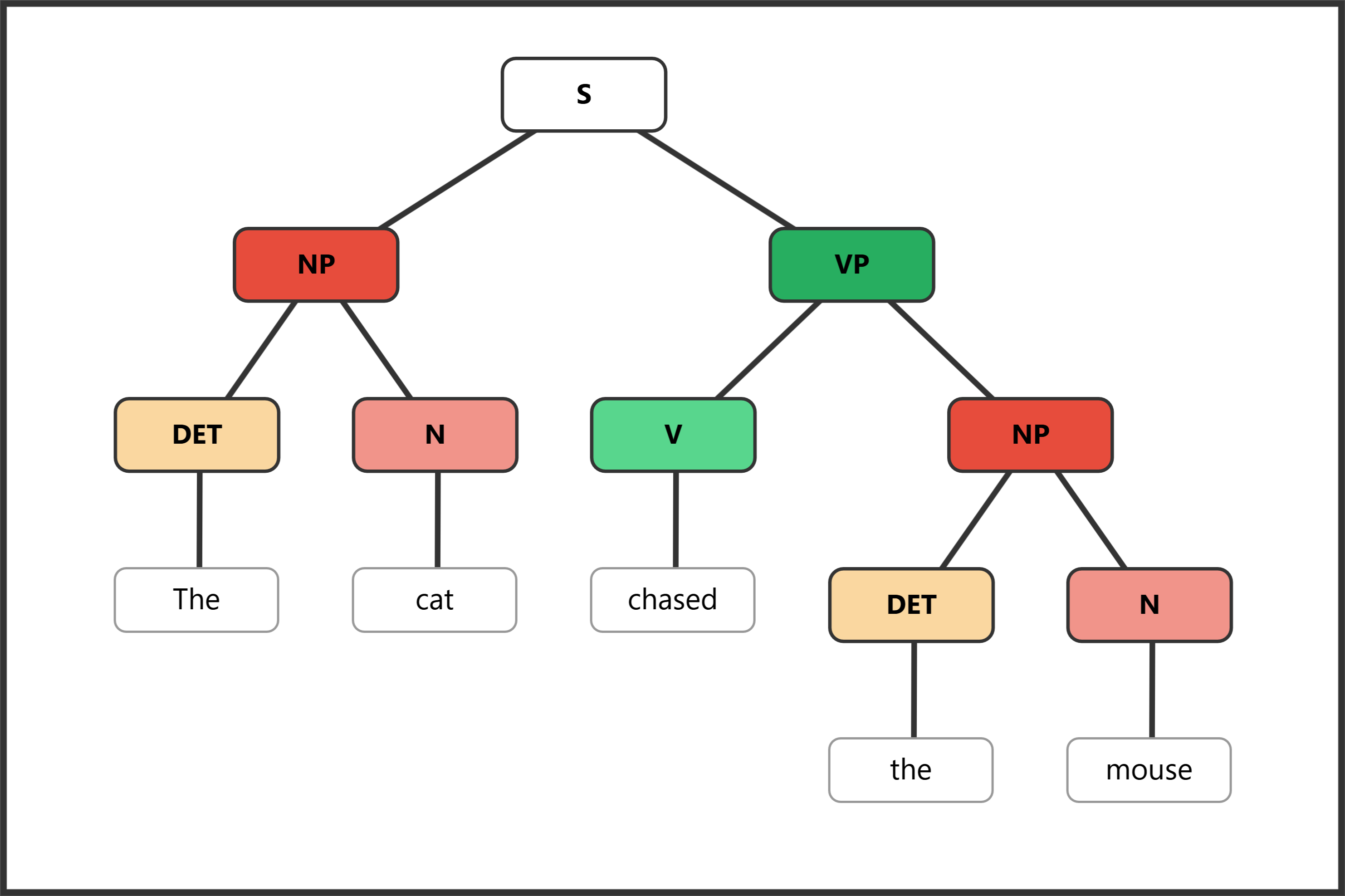
[S [NP [DET The] [N cat]] [VP [V chased] [NP [DET the] [N mouse]]]]
The tree makes clear what the table cannot easily show: the object NP “the mouse” is inside the VP, dominated by the VP node. In the table, “the mouse” simply appears as a separate NP to the right of the verb—the containment relationship is invisible.
Tables and Trees Together.
Tables and trees are complementary tools. Tables excel at quickly cataloging parts of speech, phrases, and roles in a linear format. Trees excel at showing hierarchical structure—which phrases contain other phrases, and how elements relate to each other structurally. For full analysis, use both: the table to identify the pieces and the tree to show how they fit together.

