Section 7.5 How Structure Determines Meaning
One of the most important lessons of syntax is that meaning depends on structure, not just on the words themselves. The same words in different structures produce different meanings.
Structural Ambiguity.
When a sentence has two possible structures, it is structurally ambiguous.
Example: “I saw the man with binoculars.”
This sentence has two readings:
-
I used binoculars to see the man. (PP modifies VP)
-
I saw the man who had binoculars. (PP modifies NP)
A student encountering this sentence for the first time might instinctively begin diagramming by attaching “with binoculars” to the VP—after all, it seems natural to read it as describing the act of seeing. But look at what happens when we consider the alternative structure, where “with binoculars” attaches to the NP “the man” instead. The two trees below make the structural difference visible.
Structure 1 (PP attaches to VP—“with binoculars” describes how I saw):
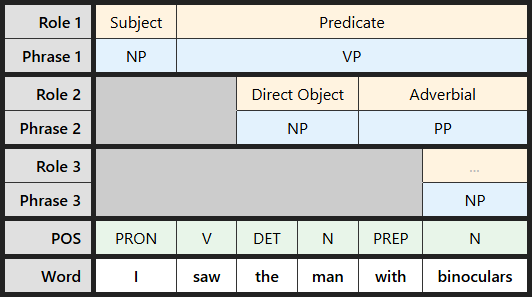
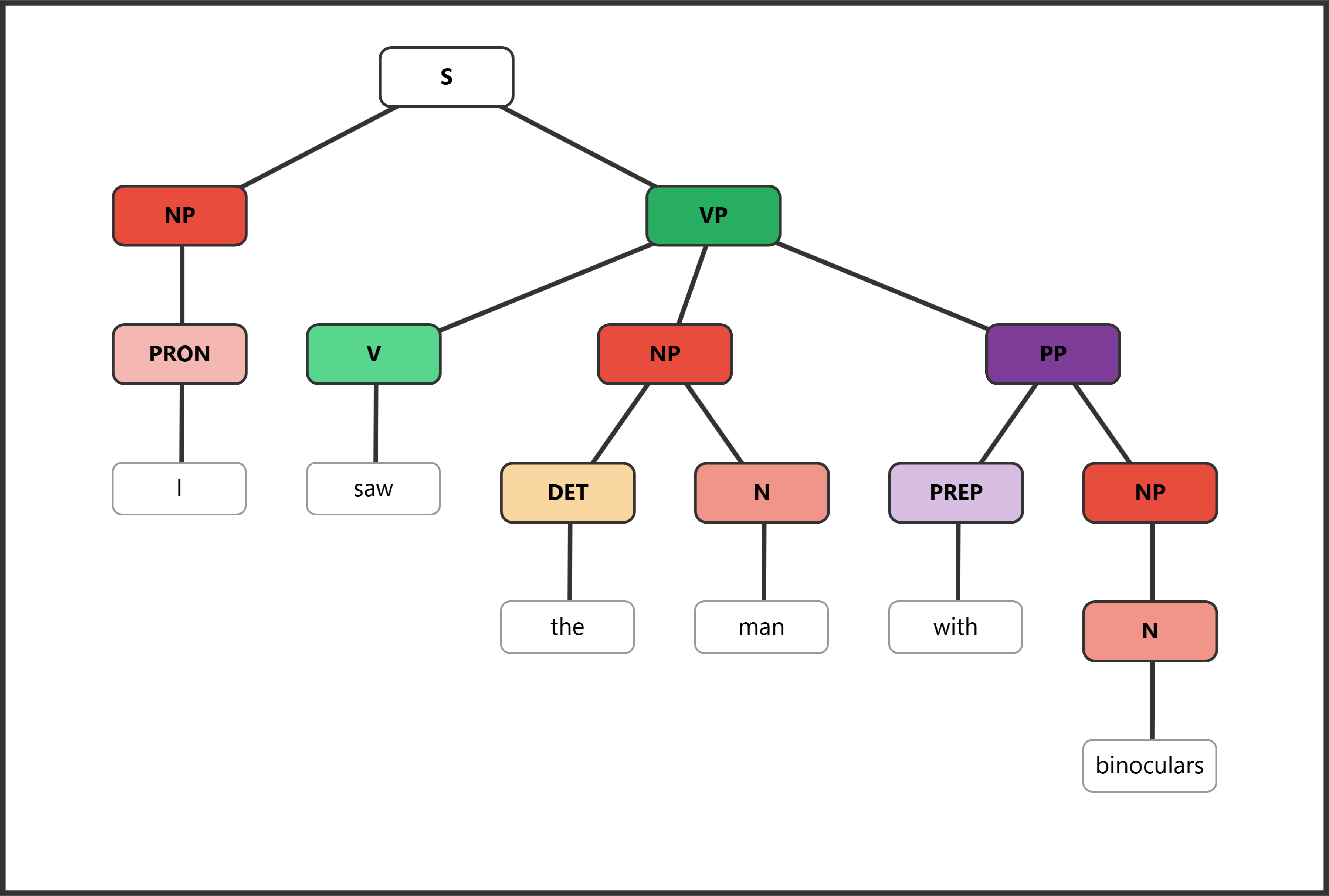
[S [NP [PRON I]] [VP [V saw] [NP [DET the] [N man]] [PP [PREP with] [NP [N binoculars]]]]]
Structure 2 (PP attaches to NP—“with binoculars” describes which man):
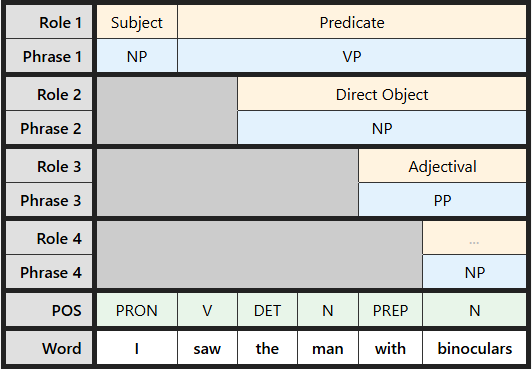
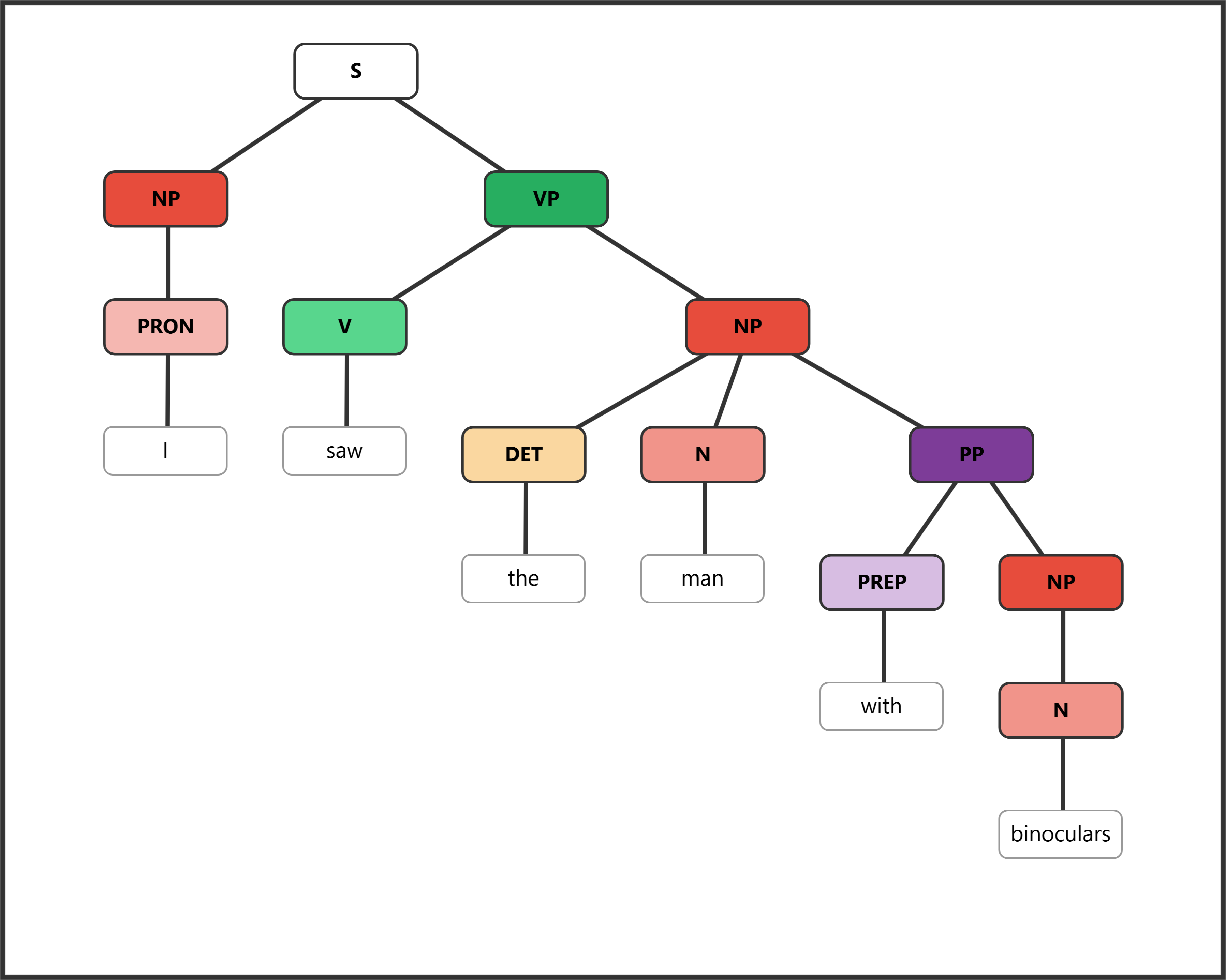
[S [NP [PRON I]] [VP [V saw] [NP [DET the] [N man] [PP [PREP with] [NP [N binoculars]]]]]]
The diagrams make the ambiguity explicit. In Structure 1, the PP “with binoculars” is a daughter of VP—it modifies the verb “saw”, telling us how I saw. In Structure 2, the PP is a daughter of the object NP—it modifies “the man”, telling us which man I saw. The words are identical, but the tree structures are different, and so are the meanings.
More Examples of Structural Ambiguity.
Example: “Flying planes can be dangerous.”
-
Reading 1: The activity of flying planes is dangerous.
-
Reading 2: Planes that are flying can be dangerous.
Example: “Old men and women gathered.”
-
Reading 1: Old men, and women (of any age)
-
Reading 2: Old people of both genders
In each case, the ambiguity arises from structural options—different ways of grouping the words.
Why This Matters.
Understanding structural ambiguity matters for several reasons:
For reading: Recognizing that a sentence has multiple possible structures helps you interpret texts accurately.
For writing: Awareness of structural ambiguity helps you avoid writing sentences that could be misread. If a sentence has an unintended reading, restructure it.
For analysis: Structural ambiguity demonstrates that meaning is not just in the words—it’s in how the words are organized.

