Section 5.5 Verbs
Verbs are the engine of the sentence. While nouns name things, verbs make things happen—or describe states of being. Every complete sentence requires a verb, and the verb determines much of the sentence’s structure: how many participants are needed, what time frame is being discussed, whether the action is complete or ongoing. Without a verb, a sentence is just a collection of nouns and modifiers with no predication—no assertion about what is happening, what has happened, or what might happen.
The semantic range of verbs is far broader than the traditional label "action words" suggests. While many verbs do express physical actions—run, build, write, throw, cook—others describe mental activities: think, calculate, analyze, imagine, consider. These mental action verbs involve no observable physical movement, yet they clearly describe something the mind does.
Beyond actions, many verbs describe states—conditions that simply exist without any action occurring. Cognitive state verbs like know, believe, and understand describe what the mind holds rather than what it does. Emotional state verbs like love, fear, and desire name feelings that persist without any effort. Relational verbs like own, possess, resemble, and deserve describe how entities stand in relation to one another. None of these involve any action at all, yet they are unquestionably verbs.
Still other verbs express occurrences or changes: happen, become, appear, grow, develop, emerge. Perception verbs like see, hear, feel, notice, and taste describe sensory experiences that are neither fully active nor fully passive. Communication verbs like say, tell, ask, explain, and argue describe the exchange of information. This enormous semantic diversity means that defining verbs as "action words" captures only a fraction of what verbs actually do. Words like know, own, and resemble are verbs that describe no action whatsoever.
Semantics vs. Grammar.
Semantically, verbs express actions (run, build, think), states (know, believe, own), or occurrences (happen, become, appear). But as with nouns, we identify verbs more reliably through grammatical tests.
The inadequacy of semantic definitions becomes clear when we look at borderline cases. Consider the verb “have” in “She has a sister”. What "action" is being performed? None—“have” simply describes a relationship. Or consider “seem” in “He seems tired”. The verb “seem” doesn’t describe an action, a state the subject controls, or even a clear event—it expresses an appearance or impression. Yet “seem” is the verb in this sentence, the word around which the entire predicate is organized.
Even within the category of action verbs, meaning can be slippery. Is “sleeping” an action? We say “She is sleeping”, and “sleep” passes every verb test—but it describes inactivity rather than activity. What about “waiting”? The person who waits may be doing nothing at all, yet “wait” is clearly a verb. These examples show that trying to identify verbs by asking "Is this an action?" leads to confusion. Instead, we rely on the morphological and syntactic tests that follow.
Morphological Tests for Verbs.
Verbs in English have a distinctive set of forms—more than any other word class. If a word can take these various forms, it’s a verb.
Test 1: Past tense formation
Verbs can be marked for past tense:
-
walk → walked
-
see → saw
-
go → went
This is perhaps the most diagnostic test. If you can put a word into past tense, it’s a verb: "Yesterday, I ___ed" (or an irregular past form).
Test 2: Third-person singular present
Verbs take -s when the subject is third-person singular (he, she, it):
-
I walk → she walks
-
I see → he sees
This is the only agreement marking English verbs still carry, but it’s a reliable indicator of verb-hood.
Test 3: Progressive form (-ing)
Verbs can take the -ing suffix to form the progressive:
-
walk → walking
-
see → seeing
Every verb in English can take -ing. If you can add -ing to a word and use it after be ("She is ___ing"), it’s a verb.
Test 4: Participial forms
Verbs have a past participle form (used with have and in passives):
-
walk → walked (regular)
-
see → seen (irregular)
-
go → gone (irregular)
Syntactic Tests for Verbs.
Test 1: The modal test
Verbs can follow modal words like can, will, might, should, must:
-
can walk
-
will see
-
might go
If a word can slot into "She can ___," it’s a verb.
Test 2: The infinitive test
Verbs can follow to:
-
to walk
-
to see
-
to understand
The "to ___" construction (called the infinitive) is available only to verbs.
Test 3: The negation test
Verbs can be negated, typically using do + not:
-
She does not walk.
-
I did not see it.
Verb Phrases: How Verbs Work in Sentences.
Just as nouns head noun phrases, verbs head verb phrases (VP). The verb phrase contains the main verb plus any complements or modifiers it requires. What makes verb phrases especially interesting is that different verbs require different structures.
An intransitive verb phrase (no object required):
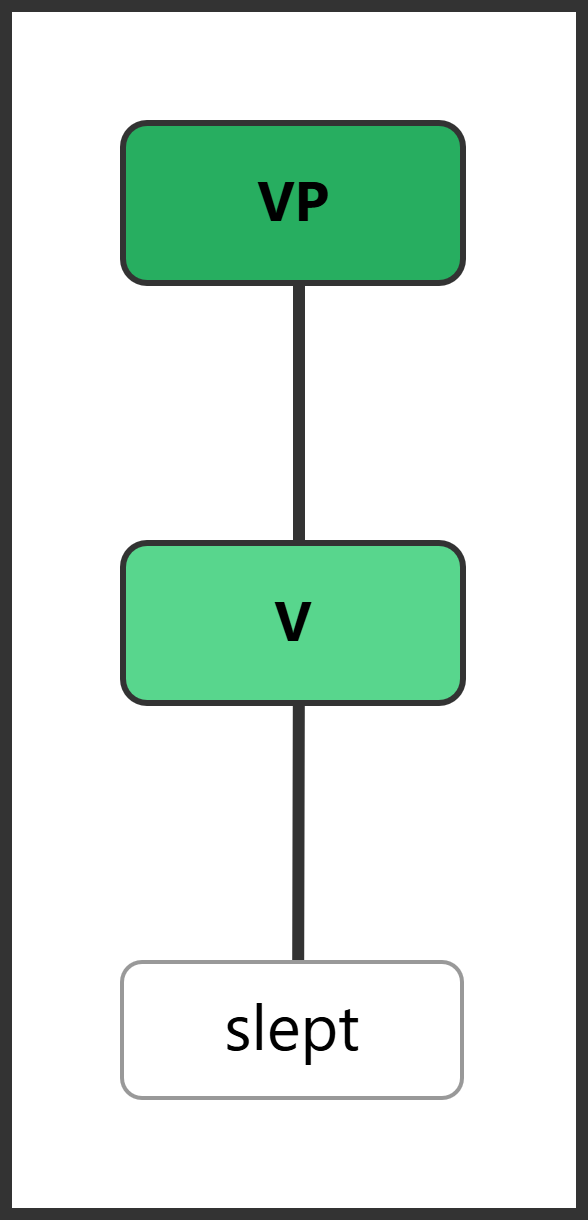
[VP [V slept]]
The verb “slept” needs nothing after it—the subject can just sleep.
A transitive verb phrase (requires an object):
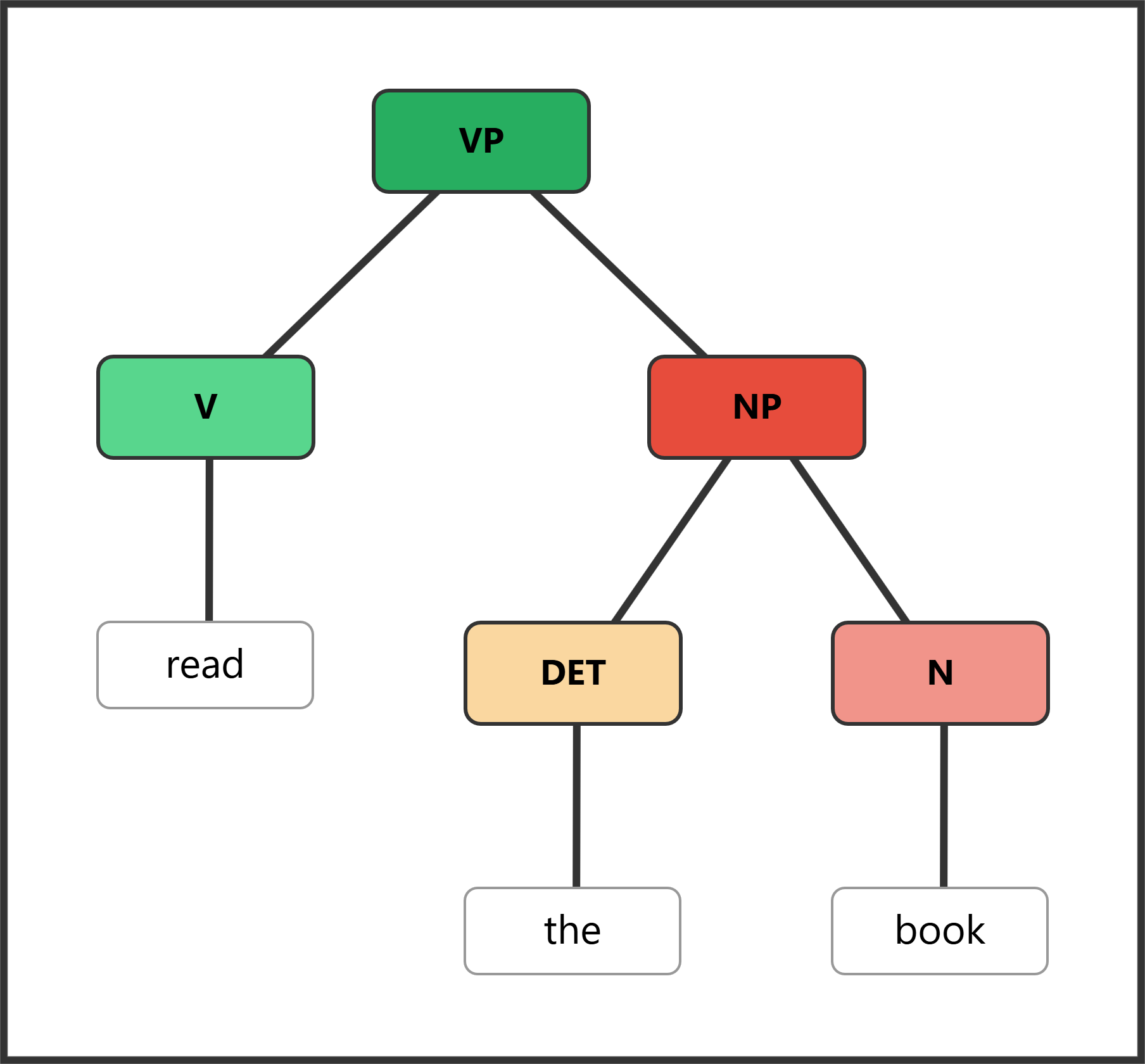
[VP [V read] [NP [DET the] [N book]]]
The verb “read” requires something to be read—the NP “the book” is its direct object.
A ditransitive verb phrase (requires two objects):
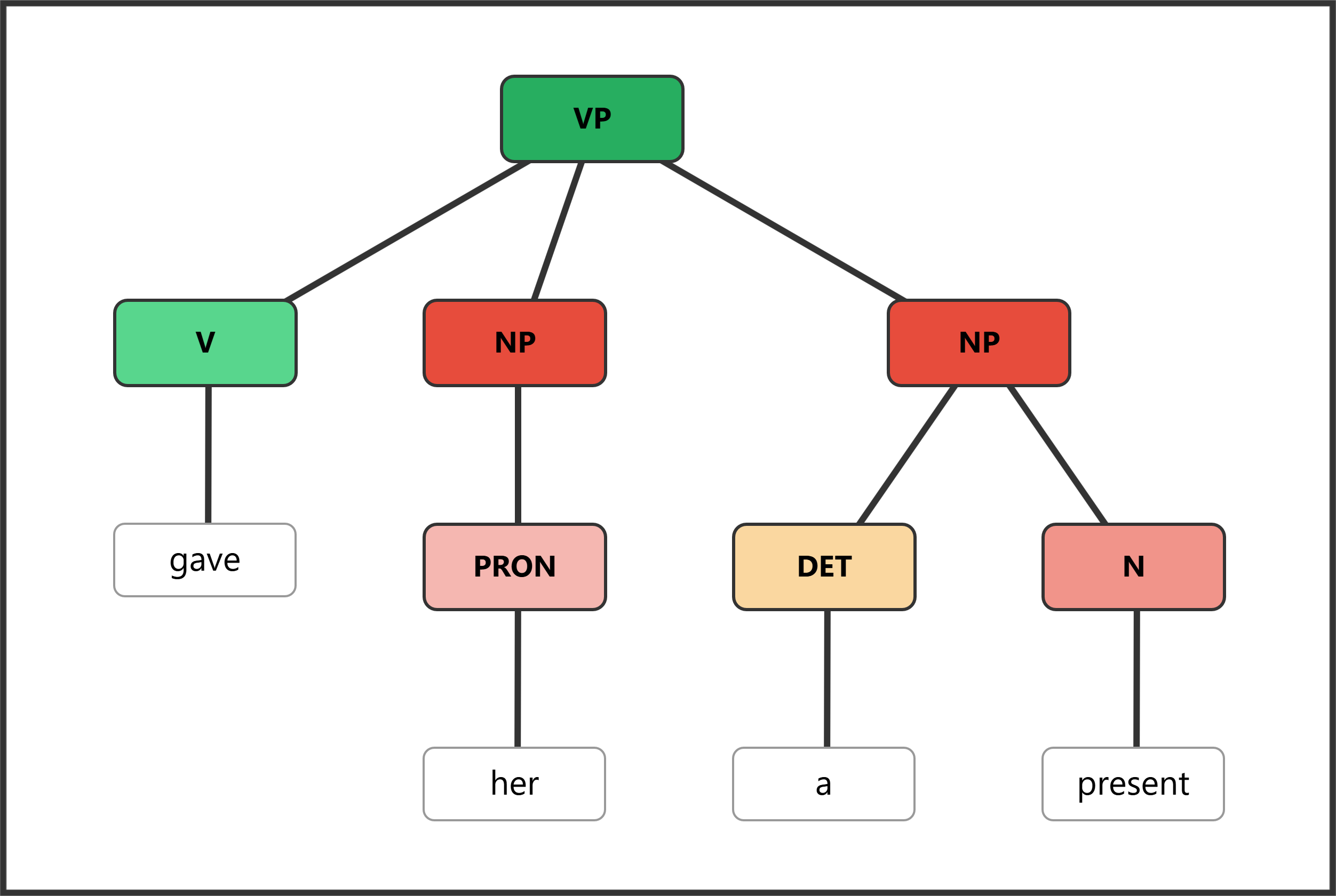
[VP [V gave] [NP [PRON her]] [NP [DET a] [N present]]]
The verb “gave” requires both a recipient (her) and a thing given (a present).
This property—that verbs dictate what must follow them—is called the verb’s valency. Chapter 8 explores valency patterns in detail. For now, notice that the verb is truly the head of the VP: it determines the entire structure of the phrase.
Identifying the Head Verb.
In a verb phrase, the head verb is the word that carries the core meaning of the action or state. In complex verb phrases with auxiliaries, the main verb is the head:
-
She has been reading the book. — Head: reading (main verb)
-
They might have arrived early. — Head: arrived (main verb)
-
The report was written yesterday. — Head: written (main verb)
The auxiliaries (has, been, might, have, was) add grammatical information about tense, aspect, or voice, but the main verb supplies the core meaning.

