Section 11.8 Forming and Transforming Voice
Now that you can identify active and passive constructions, this section shows you how to form passives and how to convert between the two voices. The transformation is mechanical—there is a fixed set of steps—but it interacts with tense and aspect in ways that require attention.
Active to Passive: Step by Step.
To convert an active sentence to passive, follow these four steps. We will use Maria wrote the report as our example, showing the active and passive versions side by side at each step so you can see exactly what moves:
Step 1. Move the direct object into the subject position.
-
Active: Maria wrote the report.
-
Passive (so far): The report...
Step 2. Add the appropriate form of be, matching the original tense and aspect.
-
Active: Maria wrote the report. (past tense)
-
Passive (so far): The report was... (was = past tense of be)
Step 3. Change the main verb to its past participle form.
-
Active: Maria wrote the report.
-
Passive (so far): The report was written...
Step 4. Optionally place the original subject in a by-phrase.
-
Active: Maria wrote the report.
-
Passive: The report was written by Maria.
Here is a second example with a present tense sentence: The chef prepares dinner.
-
Object → subject: Dinner...
-
Add be (present tense, singular to match dinner): Dinner is...
-
Past participle: Dinner is prepared...
-
By-phrase: Dinner is prepared by the chef.
Passive to Active: Step by Step.
The reverse process undoes each of those steps. We will use The report was written by Maria:
Step 1. Find the actor (in the by-phrase, or supply one if omitted).
-
Passive: The report was written by Maria.
-
Actor identified: Maria
Step 2. Make the actor the new subject.
-
Active (so far): Maria...
Step 3. Remove be and restore the main verb to its active form, matching tense.
-
Passive: The report was written... (was = past tense)
-
Active (so far): Maria wrote... (past tense restored)
Step 4. Move the passive subject to the direct object position.
-
Passive: The report was written by Maria.
-
Active: Maria wrote the report.
When the actor is missing (actorless passive), you must supply a subject. Common choices include a generic subject like someone, people, or they: My bicycle was stolen. → Someone stole my bicycle.
Passive across Tense and Aspect.
Passive voice combines with all the tense-aspect patterns you learned in Chapter 10. The form of be changes to match, but the main verb always appears as a past participle:
| Tense-Aspect | Active | Passive |
|---|---|---|
| Present simple | writes | is written |
| Past simple | wrote | was written |
| Present progressive | is writing | is being written |
| Past progressive | was writing | was being written |
| Present perfect | has written | has been written |
| Past perfect | had written | had been written |
| Future (modal) | will write | will be written |
| Modal | can write | can be written |
Notice the pattern: the passive always inserts a form of be before the past participle. In the progressive passive (is being written), there are two forms of be—one for the progressive (is) and one for the passive (being). In the perfect passive (has been written), been is the past participle of be, which is itself part of the passive construction.
Ditransitive Verbs: Which Object Promotes?
Some verbs take two objects—an indirect object and a direct object. When you passivize these, either object can become the subject, though the result may sound more or less natural:
-
Active: The teacher gave the students a quiz.
-
Passive (indirect object promoted): The students were given a quiz. (natural)
-
Passive (direct object promoted): A quiz was given to the students. (also grammatical)
In most cases, promoting the indirect object (the person) sounds more natural in English than promoting the direct object (the thing).
The Get-Passive.
The be-passive is not the only passive construction in English. There is a second one, formed with get, that is common in spoken and informal written language. The two constructions overlap in meaning but carry a different feel: the get-passive tends to suggest that something happened suddenly, unexpectedly, or with significant consequence for the subject.
-
He got fired last week. (sudden, consequential)
-
She got promoted to manager. (noteworthy change)
-
They got married in June. (change of state)
Compare the neutral be-passive with the more vivid get-passive:
-
She was promoted. — neutral report
-
She got promoted. — something happened to her, with a sense of event
-
He was hit by a car. — factual
-
He got hit by a car. — sudden, dramatic
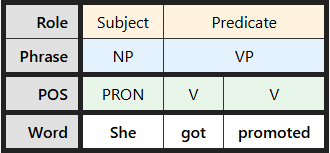
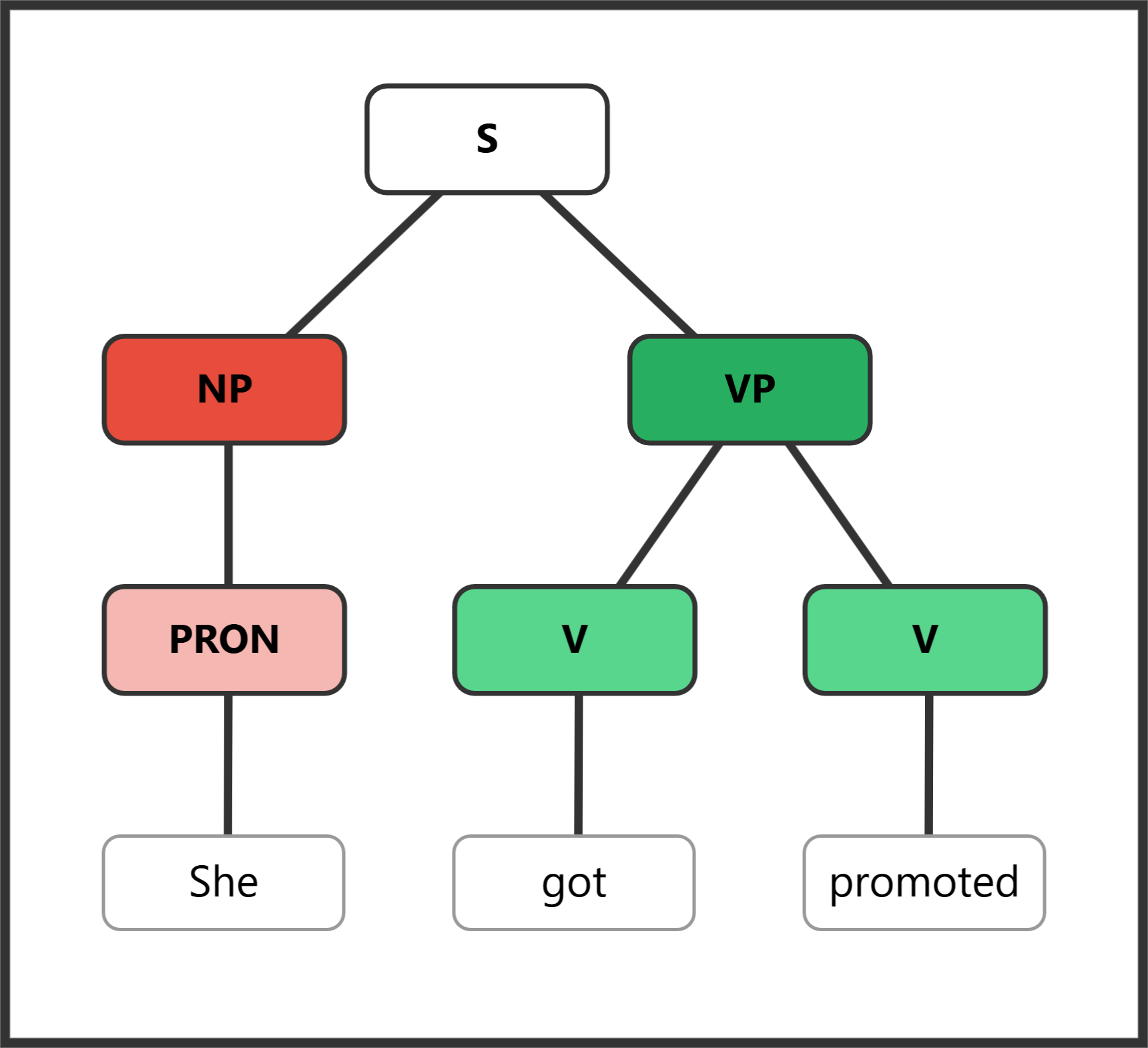
[S [NP [PRON She]] [VP [V got] [V promoted]]]
The get-passive is more informal than the be-passive and is generally avoided in academic and formal writing. However, it is extremely common in everyday speech and has been gaining ground in written English for decades.

