Section 7.3 Tree Diagrams: Reading and Interpreting
This textbook uses tree diagrams (also called phrase structure trees or constituent trees) to represent sentence structure. Tree diagrams show how words group into phrases and phrases group into larger structures.
The Components of a Tree.
Nodes: Points in the tree, labeled with category symbols (S, NP, VP, N, V, etc.). Each node represents either a word or a phrase.
Branches: Lines connecting nodes, showing which elements belong together. Elements connected to the same higher node form a unit.
Dominance: A node dominates everything beneath it. The S node at the top dominates the entire sentence. An NP node dominates everything in that noun phrase.
Common Labels.
| Label | Meaning | Examples |
|---|---|---|
| S | Sentence | Complete clause |
| NP | Noun phrase | the dog, she, my old friend |
| VP | Verb phrase | runs, ate the sandwich, is happy |
| PP | Prepositional phrase | in the house, with enthusiasm |
| ADJP | Adjective phrase | very tall, happy |
| ADVP | Adverb phrase | quickly, very slowly |
| N | Noun | dog, happiness, Sarah |
| V | Verb | run, is, consider |
| ADJ | Adjective | tall, blue, interesting |
| ADV | Adverb | quickly, never, there |
| DET | Determiner | the, a, my, this |
| PRON | Pronoun | she, it, they |
| PREP | Preposition | in, on, with, to |
| CONJ | Conjunction | and, but, or |
| AUX | Auxiliary | has, will, been, can |
Reading a Simple Tree.
Example: “The dog barked.”
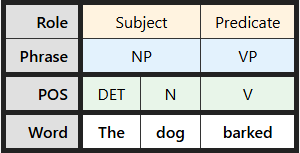
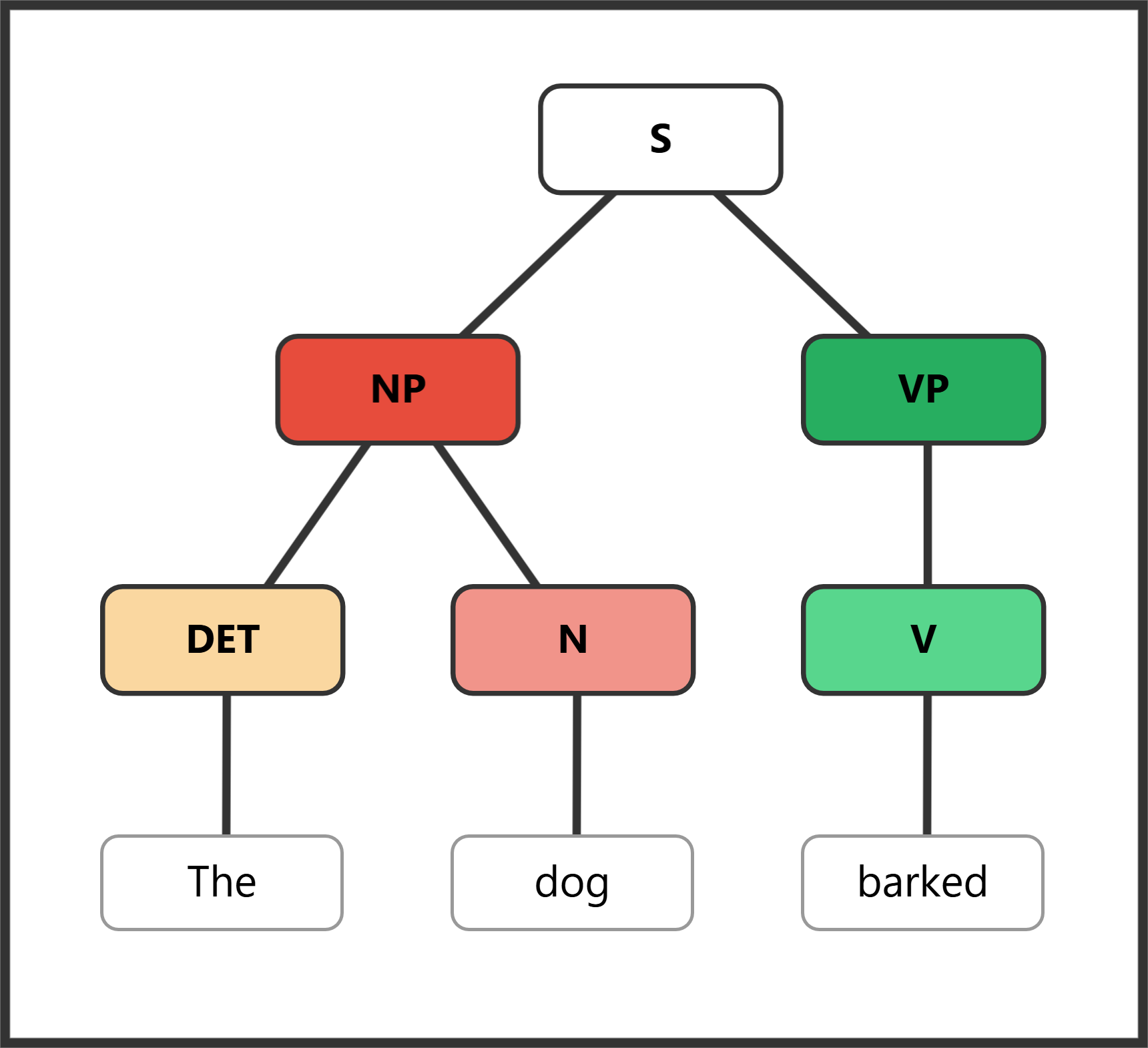
[S [NP [DET The] [N dog]] [VP [V barked]]]
Reading from the top:
-
The S (sentence) divides into NP and VP
-
The NP contains DET (determiner) + N (noun): “the dog”
-
The VP contains just V (verb): “barked”
-
The words themselves appear at the bottom
The tree shows that “the” and “dog” form a unit (the NP), and this unit is the subject of the verb “barked”.
A More Complex Example.
Example: “The young artist from Paris painted beautiful landscapes.”
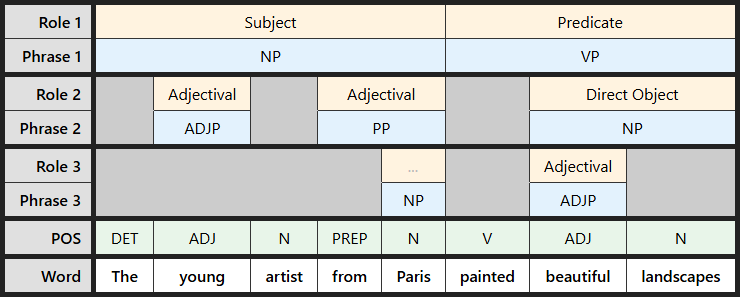
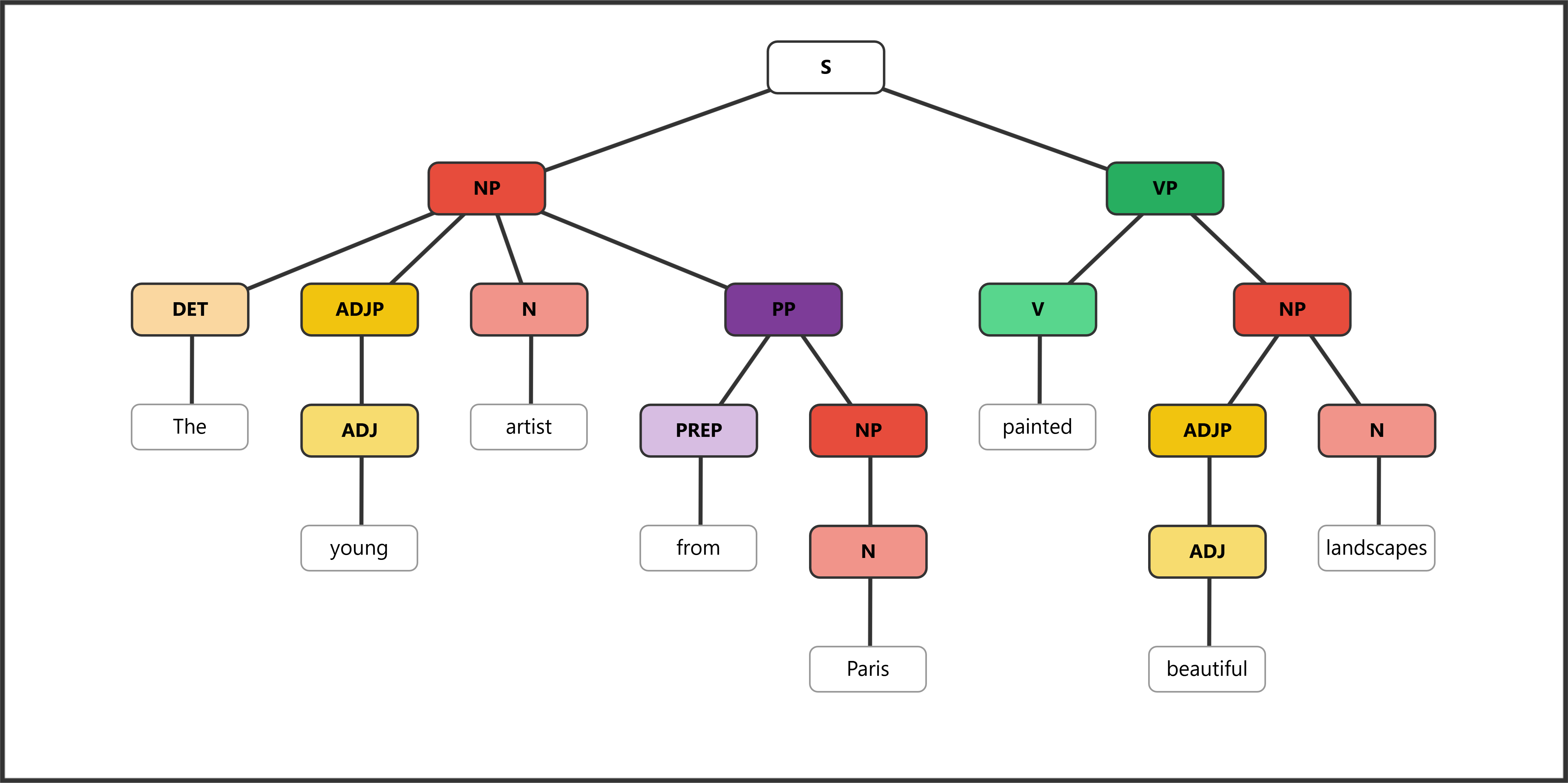
[S [NP [DET The] [ADJP [ADJ young]] [N artist] [PP [PREP from] [NP [N Paris]]]] [VP [V painted] [NP [ADJP [ADJ beautiful]] [N landscapes]]]]
This tree shows:
-
The subject NP contains: DET + ADJP + N + PP
-
The PP “from Paris” is inside the subject NP—it modifies “artist”
-
The VP contains: V + object NP
-
The object NP contains: ADJP + N
Why Trees Show Hierarchy.
Notice that the tree is not just a flat list of words. It shows grouping. “The young artist from Paris” is a unit; “beautiful landscapes” is a unit. These units can be moved, replaced, and manipulated as wholes.
For instance, you can replace the entire subject NP with a pronoun:
-
The young artist from Paris painted... → She painted...
You can move the entire object NP to the front for emphasis:
-
Beautiful landscapes, the young artist from Paris painted.
These operations work on constituents—groups that the tree identifies as units.

