Section 11.2 Modal Auxiliaries
Consider how much meaning rides on a single word in sentences like these: You can leave, You may leave, You must leave, You should leave, You will leave. The main verb is identical each time; what changes is the modal, and with it the entire relationship between the speaker, the listener, and the action. Can signals ability or permission. Must signals necessity or a logical conclusion. Should signals obligation or advice. These small words carry enormous pragmatic weight, and distinguishing them from each other—and from the primary auxiliaries you studied in Chapter 10—requires careful attention to both grammar and meaning.
Modal auxiliaries add meanings related to possibility, necessity, permission, ability, and prediction. Unlike primary auxiliaries (be, have, do), modals have distinct grammatical properties that set them apart from every other verb class in English.
The Nine Modals.
English has exactly nine modal auxiliaries. Their basic meanings are summarized in the table below, though as you will see in the following sections, each one can carry multiple readings depending on context:
| Modal | Basic Meaning |
|---|---|
| can | ability, possibility, permission |
| could | past ability, possibility, polite request |
| will | future, willingness, prediction |
| would | hypothetical, polite request, past habit |
| shall | future (formal), suggestion |
| should | obligation, expectation, advice |
| may | permission, possibility |
| might | possibility (weaker than may) |
| must | necessity, strong obligation, logical conclusion |
Properties of Modals.
What makes modals a distinct class is not just their meaning but their grammar. All nine share these properties, and no other English verbs behave this way:
-
No -s in third person: She can go. (not
She cans go.) -
No to infinitive: You must leave. (not
You must to leave.) -
Cannot combine directly:
She can must go. -
Form questions by inversion: Can she go?
-
Form negatives with not: She cannot go.
The NICE Properties.
Properties 5 and 6 above are part of a broader pattern that linguists call the NICE properties—four behaviors shared by all auxiliary verbs (both modals and primary auxiliaries like be, have, and do). NICE stands for:
-
Negation: Auxiliaries can take not directly. She cannot go. / She has not finished. Main verbs need do-support: She does not go.
-
Inversion: Auxiliaries can swap positions with the subject to form questions. Can she go? / Has she finished? Main verbs need do-support: Does she go?
-
Code: Auxiliaries can stand alone in short answers and tag questions without repeating the main verb. “Can she swim?” — “Yes, she can.” / “She can swim, can’t she?”
-
Emphasis: Auxiliaries can be stressed to add emphasis. She CAN swim! (I’m insisting on this.) Main verbs use do: She DOES swim!
The NICE properties are what define the auxiliary class in English. What makes modals special within that class is that they also have properties 1–4 from the list above: no inflection, no infinitive, no participle forms, and no stacking. No other verbs in English combine all of these restrictions.
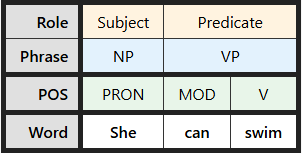
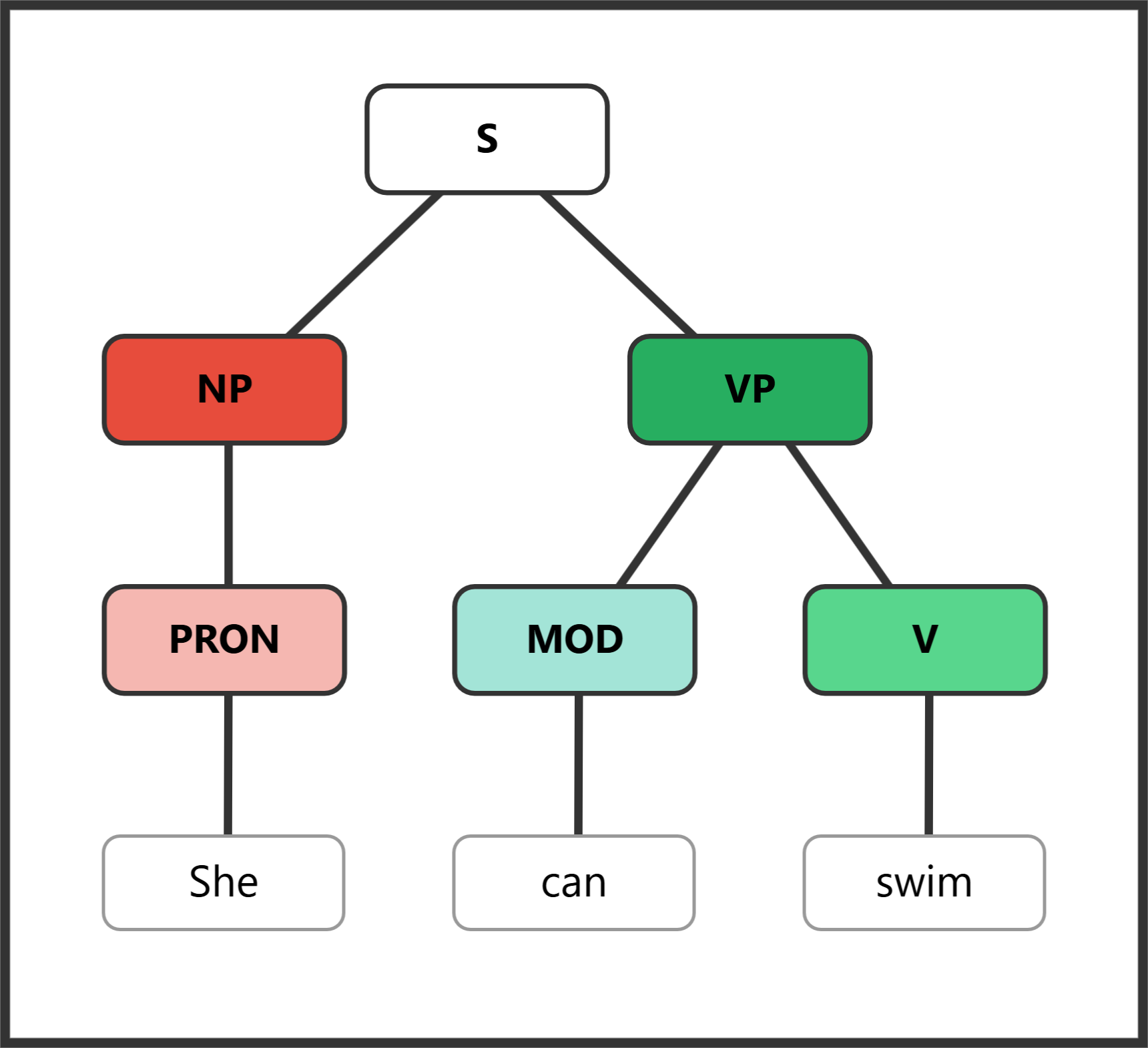
[S [NP [PRON She]] [VP [MOD can] [V swim]]]

