Section 8.2 Arguments vs. Adverbials
One of the most important distinctions in sentence grammar is between elements that are required by the verb and elements that are optional add-ons. Not everything inside a predicate holds the same structural status. Some phrases are essential to the verb’s meaning; others simply provide extra context. Knowing the difference prevents a common analytical error: mistaking an optional modifier for a core argument, or overlooking an argument because it looks like a modifier.
Understanding the difference between arguments (the core elements belonging to a verb’s structure) and adverbials (optional modifiers) is crucial for sentence analysis.
Arguments.
Arguments are the elements that fill the positions a verb opens up in a sentence—its subject, objects, and complements. Together they form the core structure that gives the sentence its basic meaning. The arguments present in any given sentence depend on which verb is used and how it is being used.
-
Subject (present in all finite sentences)
-
Direct object (for transitive verbs)
-
Indirect object (for ditransitive verbs)
-
Subject complement (for linking verbs)
-
Object complement (for some transitive verbs)
It is tempting to say that arguments are “required by the verb,” and this is often true—but it needs some care. Not every verb demands multiple arguments. What varies is the set of argument positions a verb can fill:
-
Always intransitive verbs take only a subject and open no further argument positions. Sneeze, arrive, and collapse are examples:
She arrived the stationis ungrammatical because arrive simply has no slot for a direct object. -
Always transitive verbs require both a subject and a direct object. Devour and resemble are always transitive:
He devouredis incomplete on its own. -
Flexible verbs can appear with or without certain arguments. Eat is intransitive in We ate and transitive in We ate dinner. Give can be ditransitive (She gave Marcus a book) or transitive (She gave a donation).
The key point is this: when an argument is present, removing it leaves the sentence incomplete or fundamentally changes its meaning. That is what distinguishes arguments from adverbials.
Test: If you remove an argument, the sentence becomes ungrammatical or changes meaning dramatically.
“She put the book on the table.”
-
Remove the book:
She put on the table.✗ -
Remove on the table:
She put the book.✗ -
All three elements are arguments of “put”.
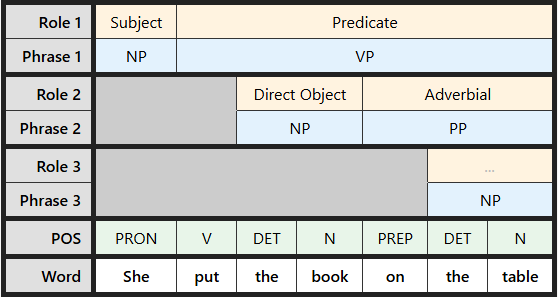
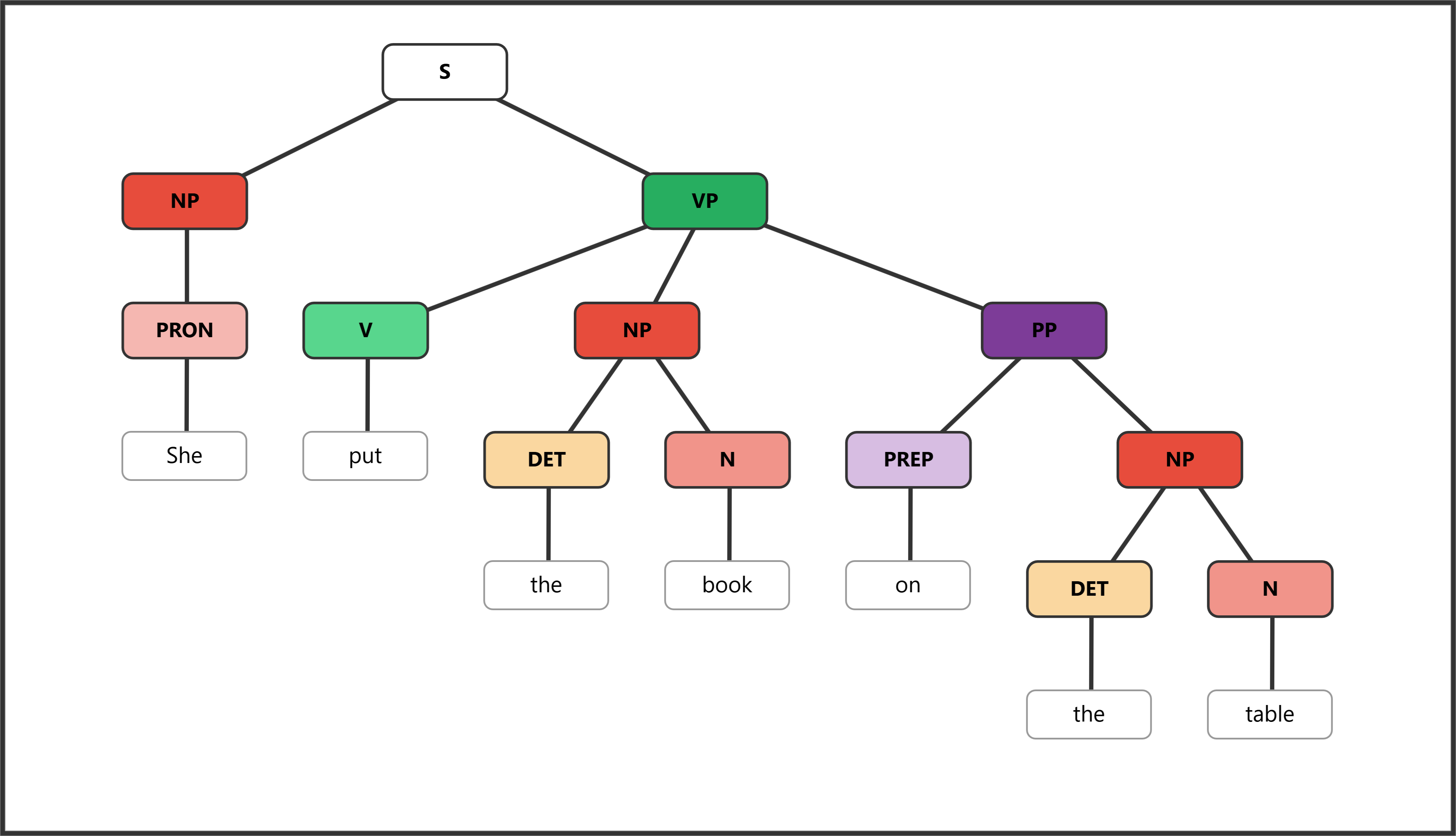
[S [NP [PRON She]] [VP [V put] [NP [DET the] [N book]] [PP [PREP on] [NP [DET the] [N table]]]]]
Adverbials.
Adverbials provide additional information about time, place, manner, reason, etc. They are optional—the sentence is grammatical without them.
Examples:
-
Accidents happen on Mondays. (when)
-
She spoke quietly. (how)
-
Unfortunately, we lost. (attitude)
-
He works at the hospital every day. (where, when)
Test: If you remove an adverbial, the sentence remains grammatical.
“She spoke quietly in the library.”
-
Remove quietly: She spoke in the library. ✓
-
Remove in the library: She spoke quietly. ✓
-
Both are adverbials—optional modifiers.
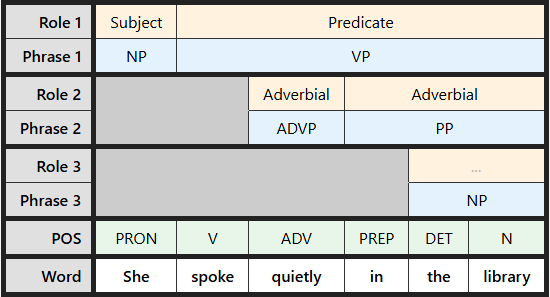
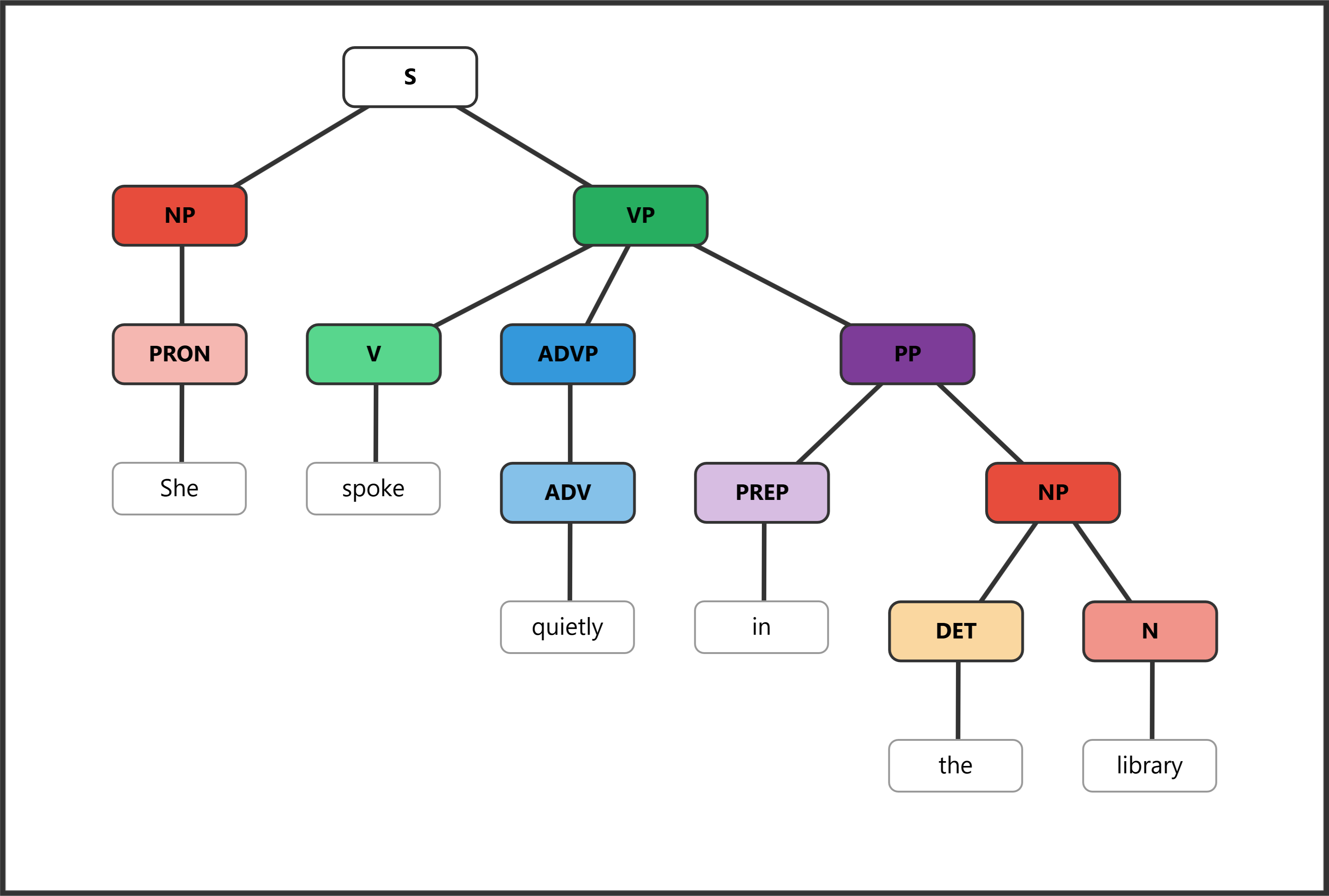
[S [NP [PRON She]] [VP [V spoke] [ADVP [ADV quietly]] [PP [PREP in] [NP [DET the] [N library]]]]]
Distinguishing Arguments from Adverbials.
| Arguments | Adverbials |
|---|---|
| Part of the verb’s argument structure | Optional |
| Limited in number per verb | Unlimited |
| Cannot be moved as freely | Often movable |
| Removal changes grammaticality | Removal leaves grammatical sentence |
Compare:
-
She put the book on the table. (argument—required by put)
-
She read the book on the table. (adverbial—optional location)

