Section 9.8 Punctuation in Compound and Complex Sentences
Getting punctuation right in compound and complex sentences is not a matter of following arbitrary rules. Each rule reflects the grammatical relationship between the clauses involved. Independent clauses are complete thoughts; they require more than a comma to connect them, which is why comma splices are errors. Dependent clauses, by contrast, announce their incompleteness through subordinating words, and punctuation follows predictably from their position. Understanding why the rules exist makes them far easier to apply correctly and consistently.
Compound Sentences: Coordinating Conjunctions.
As introduced in the previous section, a coordinating conjunction joins two independent clauses with a comma before the conjunction:
-
It rained, and we stayed inside.
Additional Ways to Connect Independent Clauses.
Coordinating conjunctions are not the only way to join independent clauses grammatically. A semicolon can connect two closely related independent clauses without any conjunction at all:
-
It rained; we stayed inside.
The semicolon signals that the two clauses are closely connected in thought—more connected than a period would suggest, but without the explicit relationship a conjunction provides. Use a semicolon when the connection between the ideas is clear enough that no conjunction is needed.
A conjunctive adverb (see Section 9.3) may appear in the second clause to make the relationship explicit. Remember that the conjunctive adverb is an adverb within its clause—it is the semicolon that does the grammatical work of joining the clauses:
-
It rained; therefore, we stayed inside.
Conjunctive adverbs can also begin a new sentence after a period—the default when the ideas are less tightly connected:
-
It rained. Therefore, we stayed inside.
In both cases, a comma follows the conjunctive adverb. Using only a comma between the clauses—without a semicolon or period—produces a comma splice.
Complex Sentences.
Dependent clause first: comma after the clause
-
When it rained, we stayed inside.
Dependent clause last: usually no comma
-
We stayed inside when it rained.
Compound-Complex Sentences.
A compound-complex sentence contains at least two independent clauses and at least one dependent clause. It combines both types of connection at once: coordination joins the independent clauses, while a subordinating conjunction introduces the dependent clause. Punctuation follows both sets of rules simultaneously.
Apply the rules together:
-
Comma before a coordinating conjunction joining two independent clauses
-
Comma after an initial dependent clause
Dependent clause first:
-
When the storm began, the hikers sought shelter, and they waited for hours.
Dependent clause in the middle:
-
The evidence was strong, but she declined because she had other plans.
The comma before but joins the two independent clauses. No comma is needed before the dependent clause because she had other plans because it follows its main clause.
Compound-complex sentences are natural and common in well-developed prose. They allow a writer to present parallel developments (through coordination) while precisely specifying cause, time, or condition (through subordination) all within one sentence. Used deliberately, they give writing both accuracy and variety.
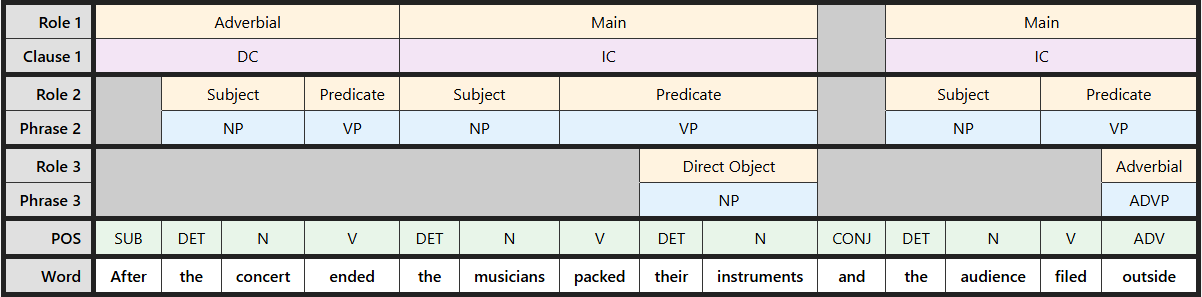
The labeling table and tree diagram below show the full structure of a compound-complex sentence: After the concert ended, the musicians packed their instruments, and the audience filed outside.
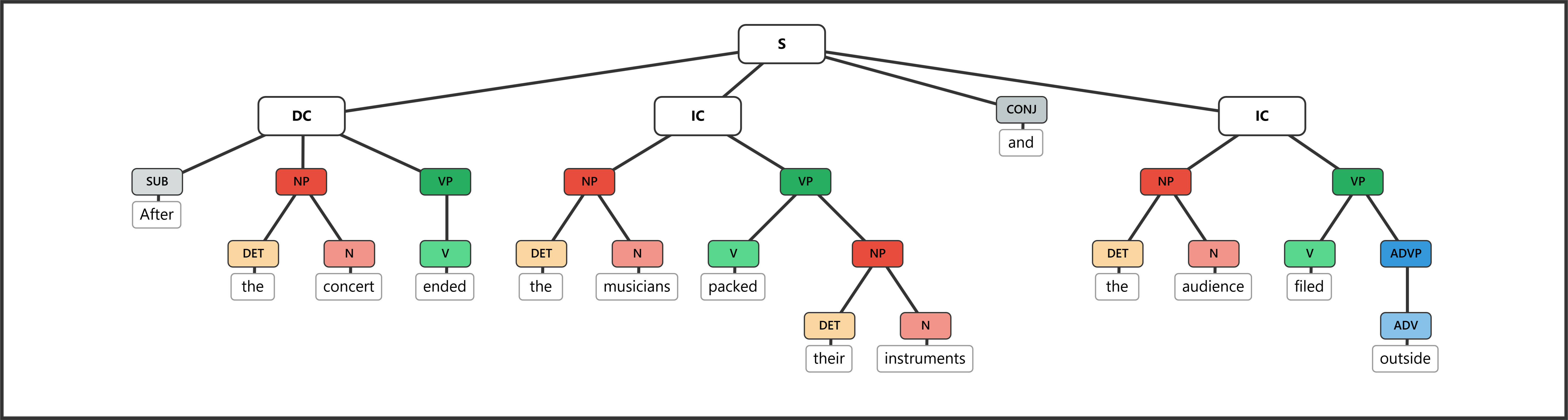
[S [DC [SUB After] [NP [DET the] [N concert]] [VP [V ended]]] [IC [NP [DET the] [N musicians]] [VP [V packed] [NP [DET their] [N instruments]]]] [CONJ and] [IC [NP [DET the] [N audience]] [VP [V filed] [ADVP [ADV outside]]]]]
The dependent clause After the concert ended receives the role Adverbial (it specifies time), while both independent clauses are labeled Main. The coordinating conjunction and joins the two independent clauses, making this a compound sentence; the subordinating conjunction after introduces the dependent clause, making it also complex.

