Section 14.11 Homework: Nominals
Subsection 14.11.1 Part 1: Identification and Classification (approx. 10 minutes)
Instructions.
For each sentence, identify the underlined nominal, classify its form, and identify its function in the sentence. Use the reference tables below.
| Nominal Forms | Example |
|---|---|
| Noun Phrase (NP) | the interesting book |
| Pronoun | she, him, them |
| Present Participle Phrase (Gerund Phrase) | swimming every morning |
| Infinitive Phrase | to win the race |
| Complement Clause | that she resigned, what she said, whether he comes |
| Nominal Functions | Diagnostic |
|---|---|
| Subject | Sits before the main verb; answers “who/what is doing or being something?” |
| Direct Object | Follows a transitive verb; answers “verb what?” or “verb whom?” |
| Indirect Object | Sits between the verb and the direct object; answers “to whom?” or “for whom?” |
| Object of Preposition | Follows a preposition; completes the prepositional phrase |
| Subject Complement | Follows a linking verb (be, seem, become); renames or describes the subject |
| Object Complement | Follows the direct object after verbs like elect, name, call, consider; renames the direct object |
Example (completed).
Swimming every morning has improved my health.
-
Form: present participle phrase (gerund phrase)
-
Function: subject
Exercises.
Exercise 1. I don’t know whether she received my message.
Form:
Function:
Exercise 2. The problem is that we lack sufficient funding.
Form:
Function:
Exercise 3. To learn a new language requires dedication and practice.
Form:
Function:
Exercise 4. What the scientist discovered changed the field of biology.
Form:
Function:
Exercise 5. She enjoys reading mystery novels on rainy afternoons.
Form:
Function:
Exercise 6. He asked who would be attending the conference.
Form:
Function:
Exercise 7. Her greatest fear is making a mistake in public.
Form:
Function:
Subsection 14.11.2 Part 2: Sentence Combining with Nominals (approx. 10 minutes)
Instructions.
Combine each pair of sentences into a single sentence by turning one of them into the requested nominal form (present participle phrase, infinitive phrase, or complement clause) in the requested position. The first sentence in each pair contains a placeholder noun (a fact, a habit, a plan, a question); the second supplies the content that fills the placeholder. Use the reference table below as a quick reminder of the available forms.
| Form | Example fragment |
|---|---|
| Present participle phrase (gerund phrase) | studying every night |
| Infinitive phrase | to study abroad |
| Complement clause (that) | that the exam will be on Friday |
| Complement clause (wh) | why the experiment failed |
Example (completed).
Combine using a complement clause as direct object:
The chair announced a decision. The committee will reconvene tomorrow.
Combined: The chair announced that the committee will reconvene tomorrow.
Exercises.
Exercise 8. Combine using a complement clause (with that) as direct object:
The teacher announced a fact. The exam will be on Friday.
Combined: __________
Exercise 9. Combine using a present participle phrase as subject:
A daily habit improves grades. Students study every night.
Combined: __________
Exercise 10. Combine using an infinitive phrase as direct object:
Maria made a plan. Maria will study abroad next year.
Combined: __________
Exercise 11. Combine using a complement clause (with a wh-word) as direct object:
The student asked a question. Why did the experiment fail?
Combined: __________
Exercise 12. Combine using a present participle phrase as object of a preposition:
Maria won the chess tournament. Maria practiced every day.
Combined: __________
Subsection 14.11.3 Part 3: Sentence Completion (approx. 5 minutes)
Instructions.
Complete each sentence with the requested nominal structure.
Example (completed).
Add a complement clause as direct object: The scientists discovered __________.
Answer: The scientists discovered that the cells could regenerate.
Exercises.
Exercise 13. Add a present participle phrase as subject: __________ can be challenging for new employees.
Exercise 14. Add a complement clause (with a wh-word) as direct object: The detective investigated __________.
Exercise 15. Add an infinitive phrase as subject complement: Her goal this year is __________.
Exercise 16. Add a complement clause (with that) as subject: __________ surprised everyone at the meeting.
Exercise 17. Add a present participle phrase as object of a preposition: She succeeded by __________.
Subsection 14.11.4 Part 4: Diagramming Nominals
Instructions.
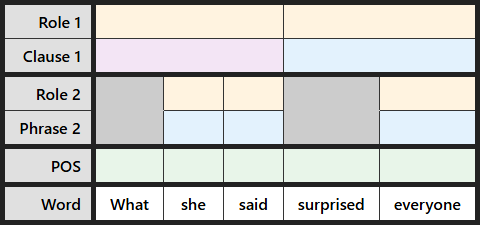
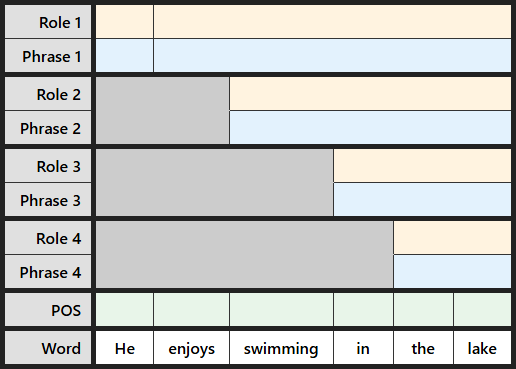
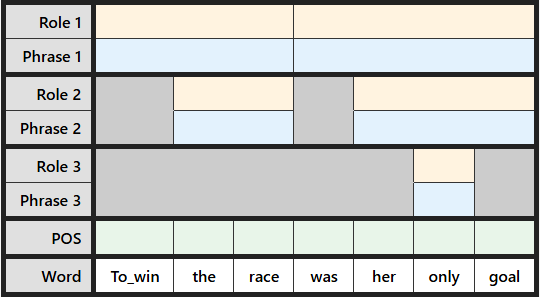
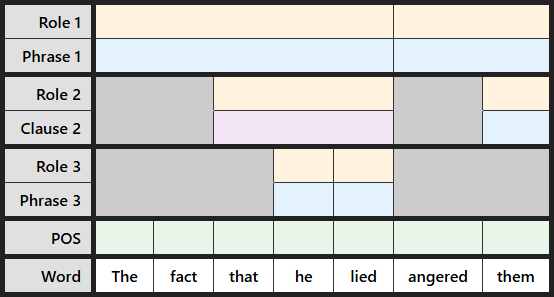
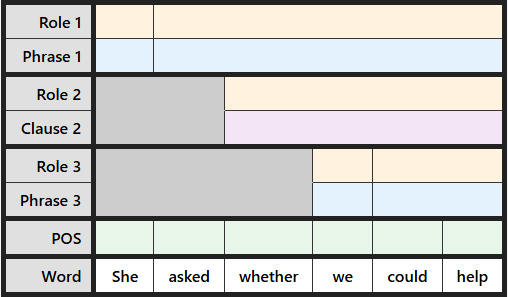
For each sentence, complete the labeling table (Role, Phrase, Word, POS), write the bracket notation, and draw a tree diagram. Pay special attention to nominal elements: complement clauses, present participle phrases, and infinitive phrases functioning as subjects, objects, or complements.
Exercises.
Exercise 18. What she said surprised everyone.
-
Bracket notation: _____
-
Diagram:
Exercise 19. He enjoys swimming in the lake.
-
Bracket notation: _____
-
Diagram:
Exercise 20. To win the race was her only goal.
-
Bracket notation: _____
-
Diagram:
Exercise 21. The fact that he lied angered them.
-
Bracket notation: _____
-
Diagram:
Exercise 22. She asked whether we could help.
-
Bracket notation: _____
-
Diagram:
Subsection 14.11.5 Part 5: Analysis and Application (approx. 10 minutes)
Prose Impact: Choosing Among Nominal Forms.
Exercise 23. The two paragraphs below describe the same sequence of events. Paragraph A uses mostly noun phrases and pronouns in its nominal slots. Paragraph B fills the same slots with complement clauses, present participle phrases, and infinitive phrases. Read both, then answer the questions that follow.
Paragraph A.
The decision divided the staff. The chairperson called a vote. The outcome surprised the team. The minority report contained the strongest arguments. The press release was a careful attempt at unity.
Paragraph B.
That the staff was divided became clear at once. Calling a vote was the chairperson’s only option. What happened next surprised the team. Reading the minority report revealed the strongest arguments. To project unity required a careful press release.
a) Identify two nominals from Paragraph A and label each one’s form (NP, pronoun, etc.) and function (subject, direct object, etc.).
b) Identify two nominals from Paragraph B and label each one’s form (complement clause, present participle phrase, infinitive phrase) and function.
c) How does the rhythm or pacing of the two paragraphs differ? Read each one aloud if it helps you decide.
d) One paragraph foregrounds entities and outcomes; the other foregrounds actions and processes. Which is which? Point to a specific sentence in each that supports your answer.
e) Which version would feel more at home in a quickly written news report? Which in an analytical essay or formal article? Explain why—appeal to specific features of the nominals used.
Total estimated time: 40 minutes

