Section 5.7 Adverbs
Adverbs are the most versatile and varied word class in English. While nouns name, verbs act, and adjectives describe nouns, adverbs do a bit of everything: they can modify verbs, adjectives, other adverbs, and even entire sentences. This versatility makes them both useful and tricky to identify. In fact, linguists sometimes joke that "adverb" is the category where we put everything that does not fit neatly anywhere else.
The semantic categories of adverbs reveal just how broad this word class is. Manner adverbs describe how something happens: quickly, carefully, silently, awkwardly, gracefully. Time adverbs tell us when something happens: yesterday, soon, already, eventually, now. Place adverbs identify where something happens: here, there, everywhere, outside, nearby. Frequency adverbs indicate how often something occurs: always, never, rarely, sometimes, often. Degree adverbs express the extent or intensity of something: very, extremely, somewhat, barely, completely.
Beyond these core categories, comment or attitude adverbs express the speaker’s stance toward what is being said: unfortunately, clearly, obviously, hopefully, surprisingly. And connecting adverbs signal logical relationships between ideas: therefore, however, consequently, nevertheless, meanwhile. This enormous range—from describing how someone walks to expressing the speaker’s attitude toward an entire proposition to connecting one argument to the next—is precisely why the traditional definition "modifies a verb" captures only a fraction of what adverbs actually do. A word like “very” never modifies a verb at all; a word like “unfortunately” modifies an entire sentence rather than any single verb within it; and a word like “however” serves a logical connecting function that has nothing to do with modifying anything in the traditional sense.
The Versatility Challenge.
Consider these sentences:
-
She spoke quietly. (modifies verb)
-
She is extremely talented. (modifies adjective)
-
She works very hard. (modifies adverb)
-
Unfortunately, she couldn’t attend. (modifies entire sentence)
In all four cases, the highlighted word is an adverb—but each is doing different work. This versatility is what makes adverbs both powerful and tricky to identify.
The challenge deepens when we consider that adverbs can appear in many different positions within a sentence. A manner adverb might appear after the verb (“She spoke quietly”), before the verb (“She quietly spoke”), or even at the beginning of the sentence (“Quietly, she spoke”). A frequency adverb like “always” typically appears before the main verb (“She always arrives early”) but after an auxiliary (“She has always arrived early”). A sentence adverb like “fortunately” most naturally appears at the start of a sentence but can also be inserted parenthetically (“She was, fortunately, unharmed”). This positional flexibility sets adverbs apart from other word classes, which tend to occupy more predictable slots in the sentence.
Because adverbs are so varied, no single semantic definition can capture them all. A manner adverb like “slowly” seems quite different from a degree adverb like “very”, which in turn seems different from a sentence adverb like “obviously”. What unites them is not meaning but grammar: they share certain morphological and syntactic properties that distinguish them from nouns, verbs, and adjectives. The tests below identify those shared properties.
Morphological Tests for Adverbs.
Test 1: The -ly suffix
Many adverbs are formed by adding -ly to adjectives:
-
quick → quickly
-
happy → happily
-
careful → carefully
This is a reliable pattern: if you see -ly on what looks like an adjective, you probably have an adverb. But be careful—some -ly words are adjectives (friendly, lovely, costly), and many common adverbs don’t end in -ly at all (fast, well, always, never, here, there).
Test 2: Comparative/superlative forms
Some adverbs can be graded, just like adjectives:
-
fast → faster → fastest
-
soon → sooner → soonest
-
quickly → more quickly → most quickly
But many common adverbs cannot: very-er, always-est, therefore-er. For these, we must rely on syntactic tests.
Syntactic Tests for Adverbs.
Test 1: Modifying verbs
This is the classic adverb function. Adverbs appear near verbs and describe how, when, where, or how often the action occurs:
-
She spoke quietly. (how)
-
He always arrives late. (frequency)
-
They suddenly disappeared. (manner/time)
Test 2: Modifying adjectives
Adverbs, especially degree adverbs, can intensify or qualify adjectives:
-
a very tall building
-
an extremely difficult problem
-
surprisingly easy
This is how very, quite, extremely, and rather typically function.
Test 3: Modifying other adverbs
Adverbs can stack, with one adverb modifying another:
-
She spoke very quietly.
-
He runs quite fast.
-
It happened rather suddenly.
Test 4: Modifying sentences
Some adverbs can modify an entire sentence, typically appearing at the beginning and expressing the speaker’s attitude:
-
Unfortunately, I can’t attend.
-
Clearly, we have a problem.
-
Apparently, they’ve left.
These are called sentence adverbs or commenting adverbs.
Test 5: The attributive position test (negative)
Here’s a crucial way to distinguish adverbs from adjectives: adverbs cannot appear in attributive position (between a determiner and a noun):
-
the tall man ✓ (tall is an adjective)
-
the quickly man✗ (quickly is an adverb) -
the often problem✗ (often is an adverb)
If a word can appear in "the ___ noun" position, it’s an adjective. If it cannot, it might be an adverb.
Adverb Phrases: How Adverbs Work in Sentences.
Adverbs form phrases, though adverb phrases (AdvP) tend to be simpler than noun or verb phrases. An AdvP has an adverb as its head, often with another adverb (typically a degree modifier) modifying it.
A simple adverb phrase:
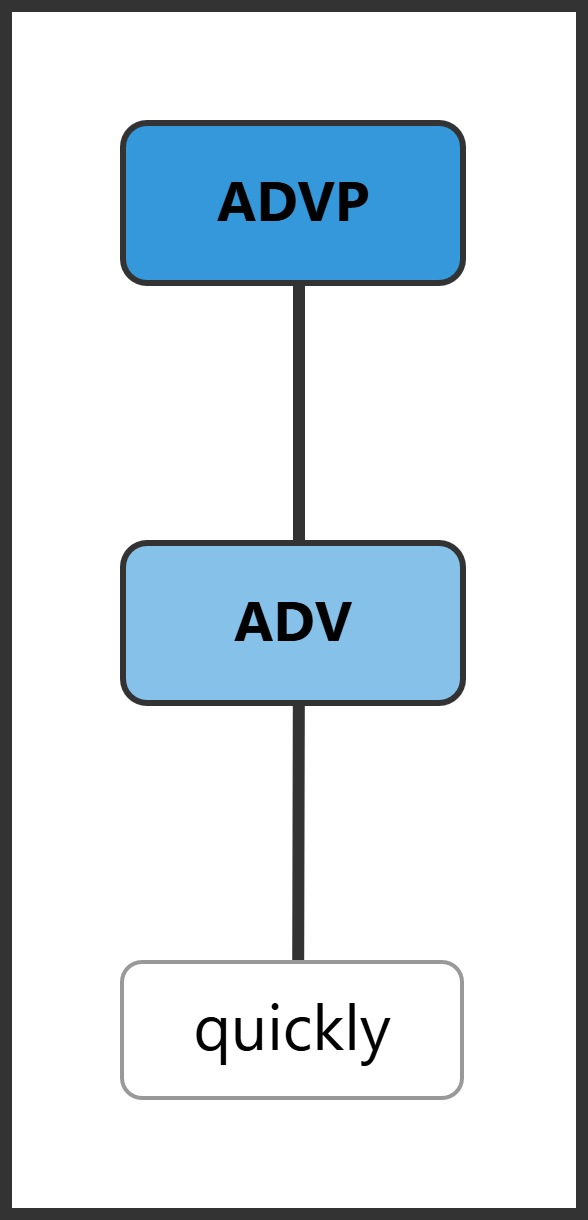
[ADVP [ADV quickly]]
An adverb phrase with a degree modifier:
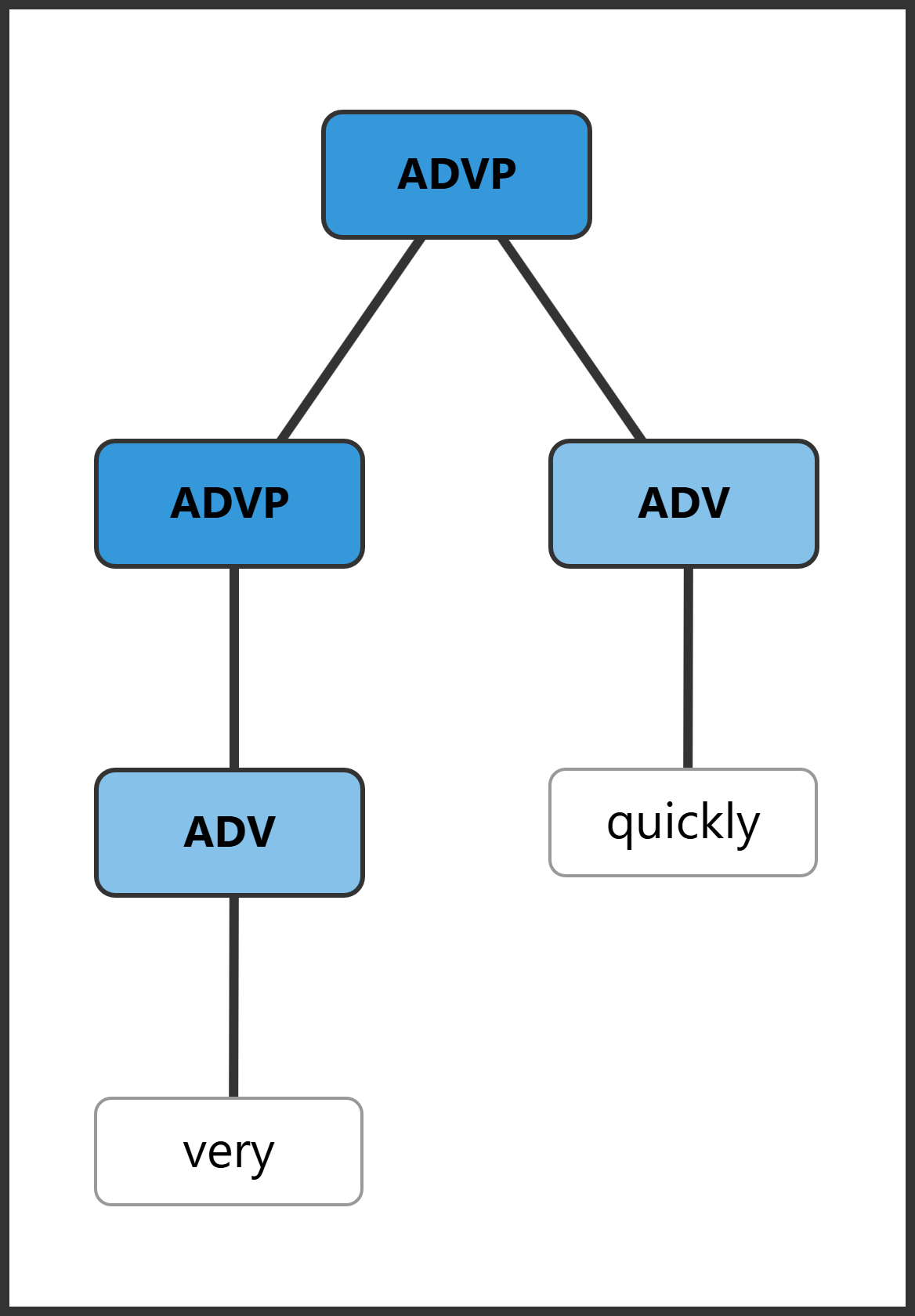
[ADVP [ADVP [ADV very]] [ADV quickly]]
The degree adverb “very” intensifies the manner adverb “quickly”.
Adverb phrases can grow by stacking degree modifiers:
-
quickly
-
very quickly
-
rather too quickly
Where Adverb Phrases Function.
The traditional definition—"adverbs modify verbs"—captures only part of the picture. Adverb phrases can modify several different elements:
-
Modifying verbs: She spoke [very quietly].
-
Modifying adjectives: She is [extremely] talented.
-
Modifying other adverbs: She works [very] hard.
-
Modifying sentences: [Unfortunately], she couldn’t attend.
In all four cases, an adverb is doing the modifying—but each targets a different element.
Identifying the Head Adverb.
As with other phrase types, the head is the essential word:
“quite remarkably quickly”
-
Remove quite: remarkably quickly ✓
-
Remove remarkably: quite quickly ✓
-
Remove quickly: quite remarkably (changes meaning significantly—quickly is the main manner adverb)
In this case, “quickly” is the head—it expresses the core manner meaning. “Quite” and “remarkably” are degree modifiers that intensify it.
Semantic Categories of Adverbs.
Adverbs are often classified by what question they answer:
| Type | Examples | Question Answered |
|---|---|---|
| Manner | quickly, carefully, well | How? |
| Time | yesterday, soon, already | When? |
| Place | here, there, everywhere | Where? |
| Frequency | often, rarely, sometimes, always | How often? |
| Degree | very, extremely, somewhat | To what extent? |
| Sentence/Comment | unfortunately, clearly, obviously | Speaker’s attitude? |

