Section 13.1 Adjectives vs. Adjectivals: Form vs. Function
If someone asks you to find the adjectivals in a sentence, you might instinctively look for adjectives—words like tall, red, or interesting. That is a reasonable first instinct, but it conflates two different things. An adjective names a form—a class of words with recognizable properties (Chapter 5). The word adjectival names a function—a role in a sentence—which many different forms can fill. Keeping these two ideas separate is the foundation of everything in this chapter.
Adjective as Form.
An adjective is a part of speech—a word class with particular morphological and syntactic characteristics. Adjectives can be graded (tall, taller, tallest), appear between determiners and nouns (the tall man), follow linking verbs (The man is tall), and be modified by very (very tall). Examples: tall, beautiful, interesting, happy, red.
Adjectival as Function (Role in a Sentence).
An adjectival is any word, phrase, or clause that functions to modify a noun, answering questions like which one? or what kind? The key insight: all attributive adjectives are adjectivals, but not all adjectivals are adjectives.
Consider an adjective phrase filling the adjectival role:
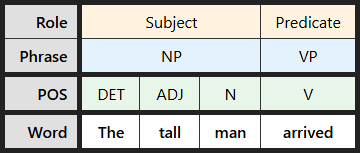
[S [NP [DET The] [ADJ tall] [N man]] [VP [V arrived]]]
Now compare a prepositional phrase filling the same adjectival role:
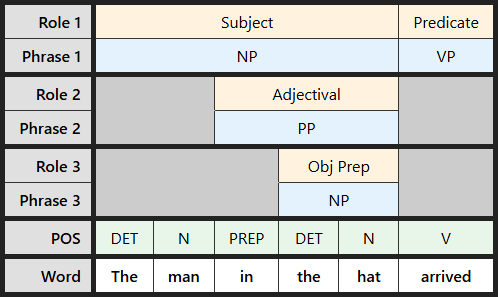
[S [NP [DET The] [N man] [PP [PREP in] [NP [DET the] [N hat]]]] [VP [V arrived]]]
Both tall and in the hat answer the question which man? and both modify the noun man. Their forms are different—an adjective phrase and a prepositional phrase—but their function is the same.
Semantic Roles.
In addition to their structural form, adjectivals are classified by the type of information they provide about the noun. Chapter 5 introduced adjective categories; the same semantic roles apply to all adjectival structures:
| Semantic Role | Question Answered | Example |
|---|---|---|
| Quality/Opinion | What kind? | a beautiful painting |
| Size | How big? | a large building |
| Age | How old? | an ancient ruin |
| Color/Shape | What color/shape? | a round red ball |
| Origin/Material | Where from? Made of? | a French wooden chair |
| Classification | What type? | a government report |
| Identification | Which one? | the book that I mentioned |
| Description | What is it like? | the report published last year |
See Chapter 5 for a fuller treatment of adjective categories. The rest of this chapter focuses on the structural forms that fill the adjectival role and how their position and restrictiveness affect meaning.

