Section 12.7 Participial Phrase Adverbials
Participial phrases can function adverbially, compressing information that might otherwise require a full adverbial clause into a compact modifier. English has two participle forms, and both can serve as adverbials—but they work differently and express different relationships to the main clause.
Present Participles (-ing).
The present participle—the -ing form of a verb—creates adverbial phrases that typically express simultaneous action, reason, or attendant circumstance. The action in the participial phrase is happening at the same time as (or just before) the action in the main clause. Present participial adverbials most often appear in initial position, set off by a comma, or in final position after the main clause:
-
Knowing the answer, she raised her hand. (reason—she raised her hand because she knew)
-
Arriving at the station, we bought our tickets. (time—when/upon arriving)
-
She left the room, slamming the door behind her. (attendant circumstance—simultaneous action)
-
He sat in the corner, reading quietly. (attendant circumstance)
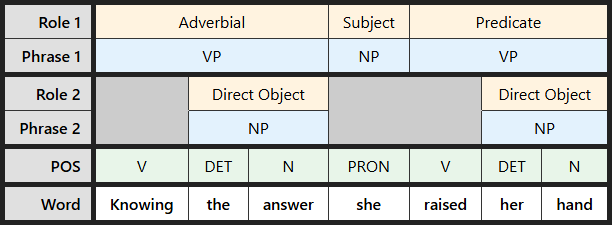
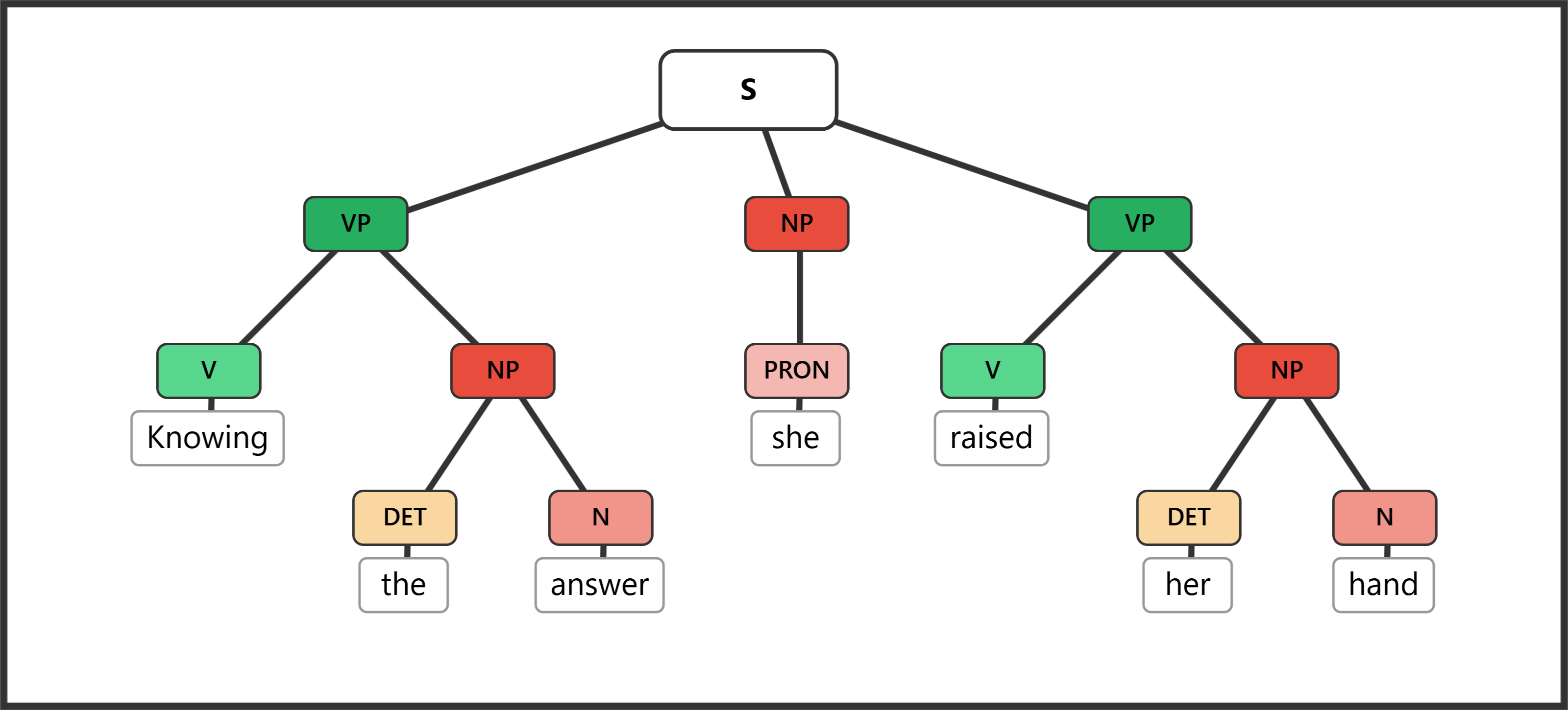
[S [VP [V Knowing] [NP [DET the] [N answer]]] [NP [PRON she]] [VP [V raised] [NP [DET her] [N hand]]]]
Past Participles (-ed/-en).
The past participle—the -ed or -en form of a verb—creates adverbial phrases that typically express a state or condition that serves as the reason for the main clause action. Where present participles describe ongoing actions, past participles describe completed states. They almost always appear in initial position:
-
Exhausted from the journey, he collapsed on the couch. (state as reason—he collapsed because he was exhausted)
-
Convinced by the evidence, the jury reached a verdict. (state as reason)
-
Surrounded by reporters, the senator refused to comment. (circumstance)
Notice the difference in meaning: Exhausting the runners, the race continued (present—the race is doing the exhausting) versus Exhausted from the race, the runners collapsed (past—the runners are in a state of exhaustion). The present participle implies an active, ongoing process; the past participle implies a completed state.
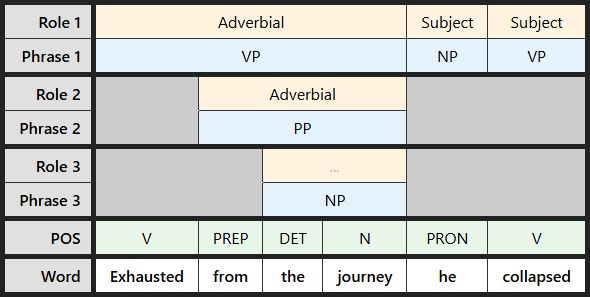
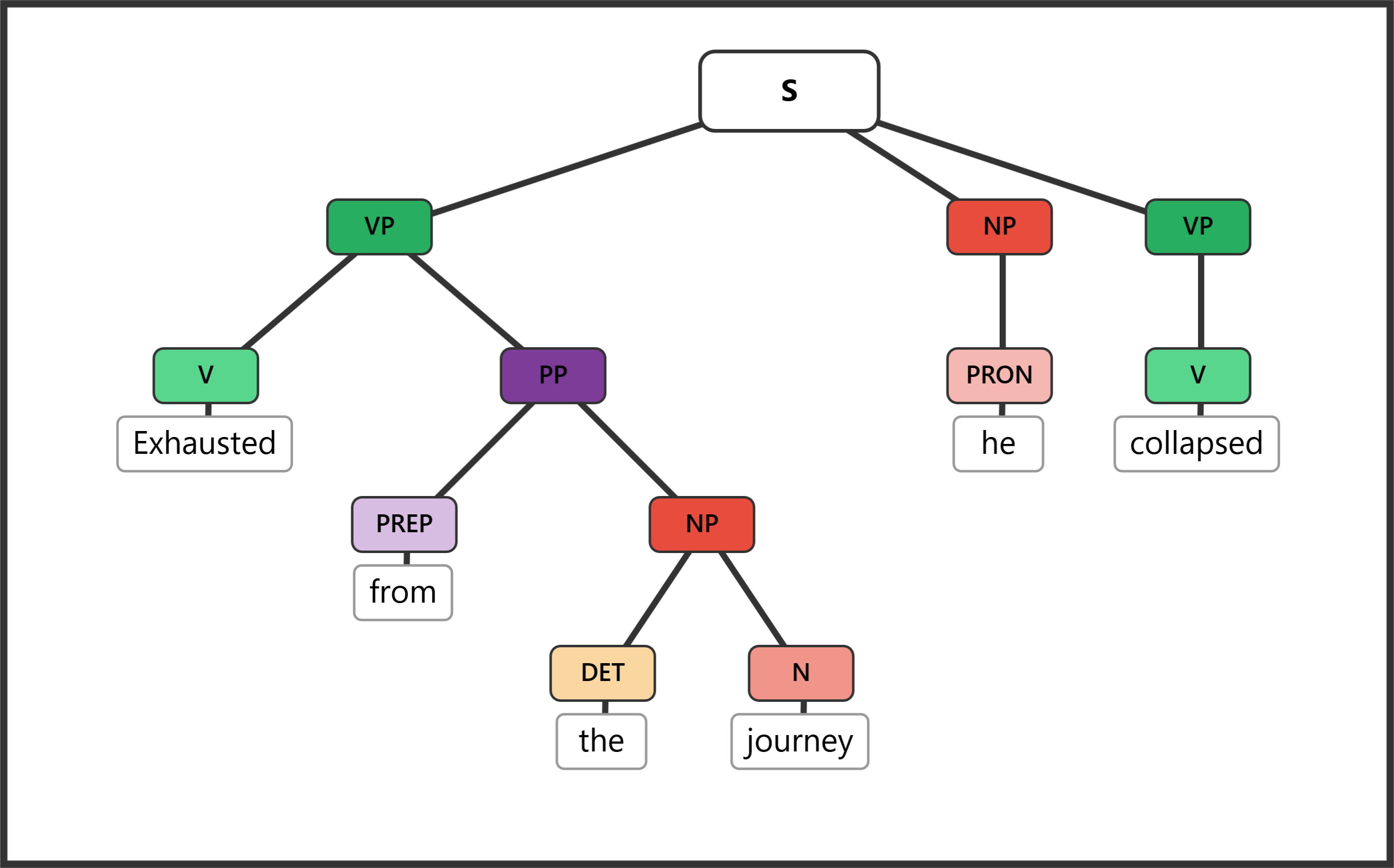
[S [VP [V Exhausted] [PP [PREP from] [NP [DET the] [N journey]]]] [NP [PRON he]] [VP [V collapsed]]]
Perfect Participles (having + past participle).
The perfect participle emphasizes that one action was completed before the main clause action began:
-
Having finished the report, she submitted it immediately. (completion before submission)
-
Having been warned twice, he changed his approach. (passive perfect—warnings preceded the change)
Dangling Participles.
Whether present or past, a participial phrase must clearly modify the subject of the main clause. When it does not, the result is a dangling participle—a common error:
-
Walking through the park, the flowers were beautiful.(Who was walking? Not the flowers.) -
Walking through the park, I noticed the beautiful flowers. ✓
Participial Adverbials vs. Participial Adjectivals.
A participial phrase modifying a noun is adjectival (Chapter 13): The woman standing by the door waved. A participial phrase modifying the main clause verb is adverbial: Standing by the door, she waved. Position is often the deciding factor: initial participial phrases are typically adverbial; post-nominal ones are typically adjectival.

