Section 7.7 Step-by-Step Sentence Analysis
When you encounter a sentence to analyze, there are two complementary approaches: top-down and bottom-up. Both arrive at the same tree, but they start from different ends. Learning both gives you flexibility—you can choose whichever feels more natural for a given sentence, or combine elements of both.
Subsection 7.7.1 Top-Down Analysis
In a top-down analysis, you start with the whole sentence and progressively divide it into smaller units.
-
Step 1—Divide S into NP + VP: Identify where the subject ends and the predicate begins. The subject NP is the "who or what" of the sentence. Everything else is the VP.
-
Step 2—Find the head noun and head verb: In the subject NP, identify the head noun—the central noun the phrase is built around. In the VP, identify the head verb.
-
Step 3—Identify additional elements: Look at the remaining words. Are they modifiers (DET, ADJ, ADV, PP) that add information about the head? Are they objects that complete the verb? Determine which node each element attaches to.
-
Step 4—Draw the tree: Starting from S at the top, draw branches for each division you identified. Label every node.
-
Step 5—Complete the sentence table: Fill in POS, Phrase, and Role for each word.
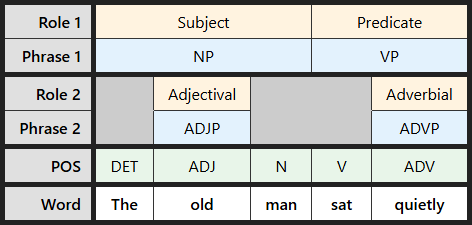
Worked Example: "The old man sat quietly.".
Step 1—Divide S into NP + VP: The subject is “The old man” (who sat?). The predicate is “sat quietly” (what did the man do?).
Step 2—Find the heads: The head noun of the NP is “man”. The head verb of the VP is “sat”.
Step 3—Identify additional elements:
-
In the NP: “The” is a DET modifying “man”. “Old” is an ADJ inside an ADJP, also modifying “man”.
-
In the VP: “Quietly” is an ADV inside an ADVP, modifying the verb “sat”.
Step 4—Draw the tree:
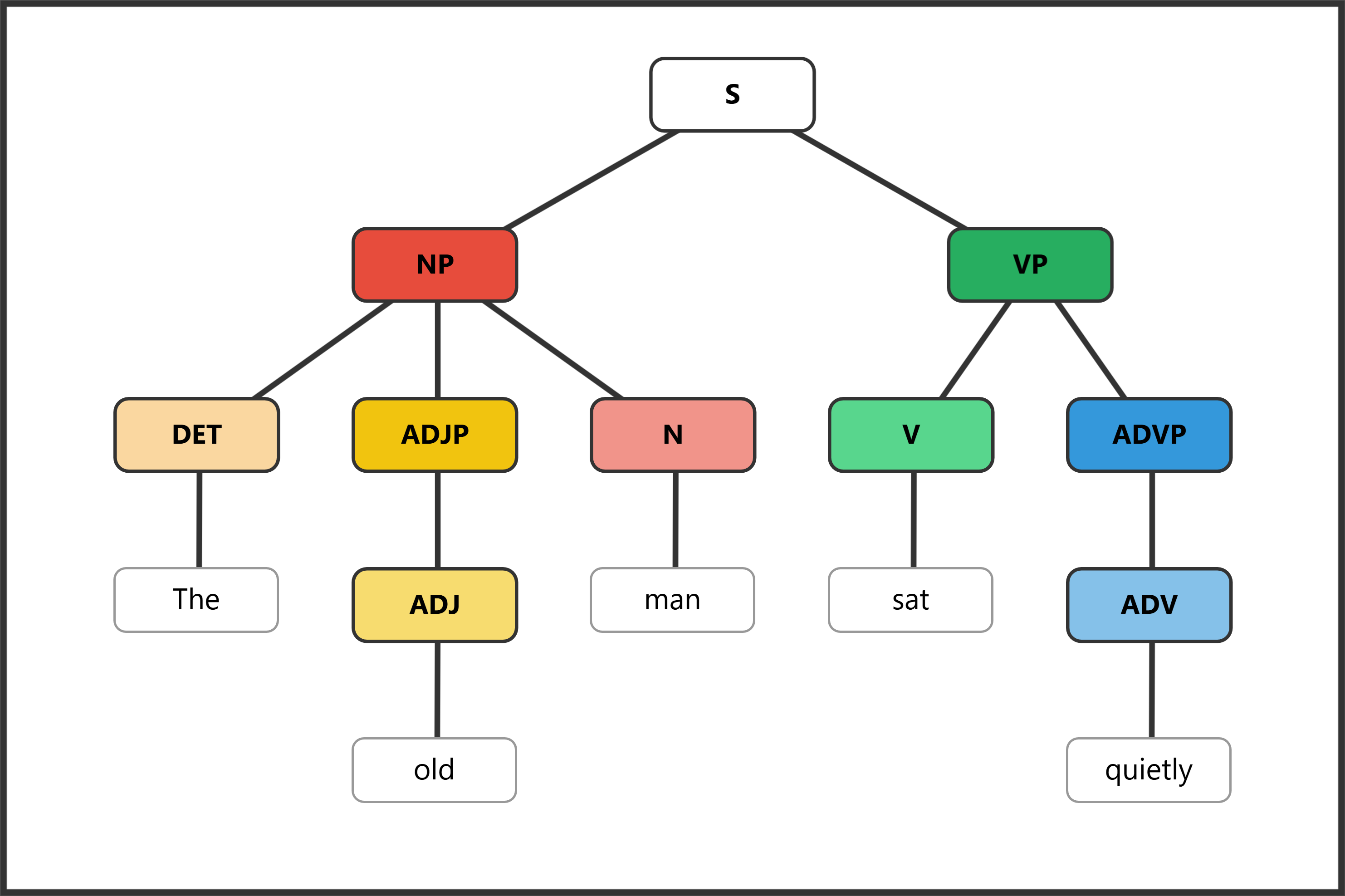
[S [NP [DET The] [ADJP [ADJ old]] [N man]] [VP [V sat] [ADVP [ADV quietly]]]]
Step 5—Complete the sentence table:
| Role | Subject | Predicate | |||
|---|---|---|---|---|---|
| Phrase | NP | VP | ADVP | ||
| Word | The | old | man | sat | quietly |
| POS | DET | ADJ | N | V | ADV |
Subsection 7.7.2 Bottom-Up Analysis
In a bottom-up analysis, you start with the individual words and build upward toward the full sentence.
-
Step 1—Label each word’s POS: Go through the sentence word by word and assign a part of speech to each (N, V, DET, ADJ, ADV, PREP, PRON, etc.).
-
Step 2—Group words into phrases: Look for clusters of words that form units. A DET + N forms an NP. An ADV alone can be an ADVP. A PREP + NP forms a PP.
-
Step 3—Identify phrase relationships: Determine which phrases are parts of larger phrases. Does an ADJP modify a noun inside an NP? Does an ADVP modify a verb inside the VP? Does an NP serve as the object inside a VP?
-
Step 4—Build up to S: Combine the subject NP and the VP under a single S node.
-
Step 5—Complete the sentence table: Fill in POS, Phrase, and Role for each word.
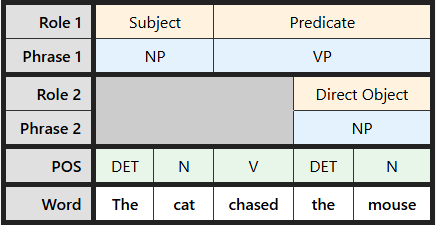
Worked Example: "The cat chased the mouse.".
Step 1—Label each word’s POS: The = DET, cat = N, chased = V, the = DET, mouse = N.
Step 2—Group words into phrases:
-
“The cat” → NP (DET + N)
-
“the mouse” → NP (DET + N)
-
“chased” → V (the head of the VP)
Step 3—Identify phrase relationships: The V “chased” takes the NP “the mouse” as its object, so together they form the VP: “chased the mouse”.
Step 4—Build up to S: The subject NP “The cat” and the VP “chased the mouse” combine under S.
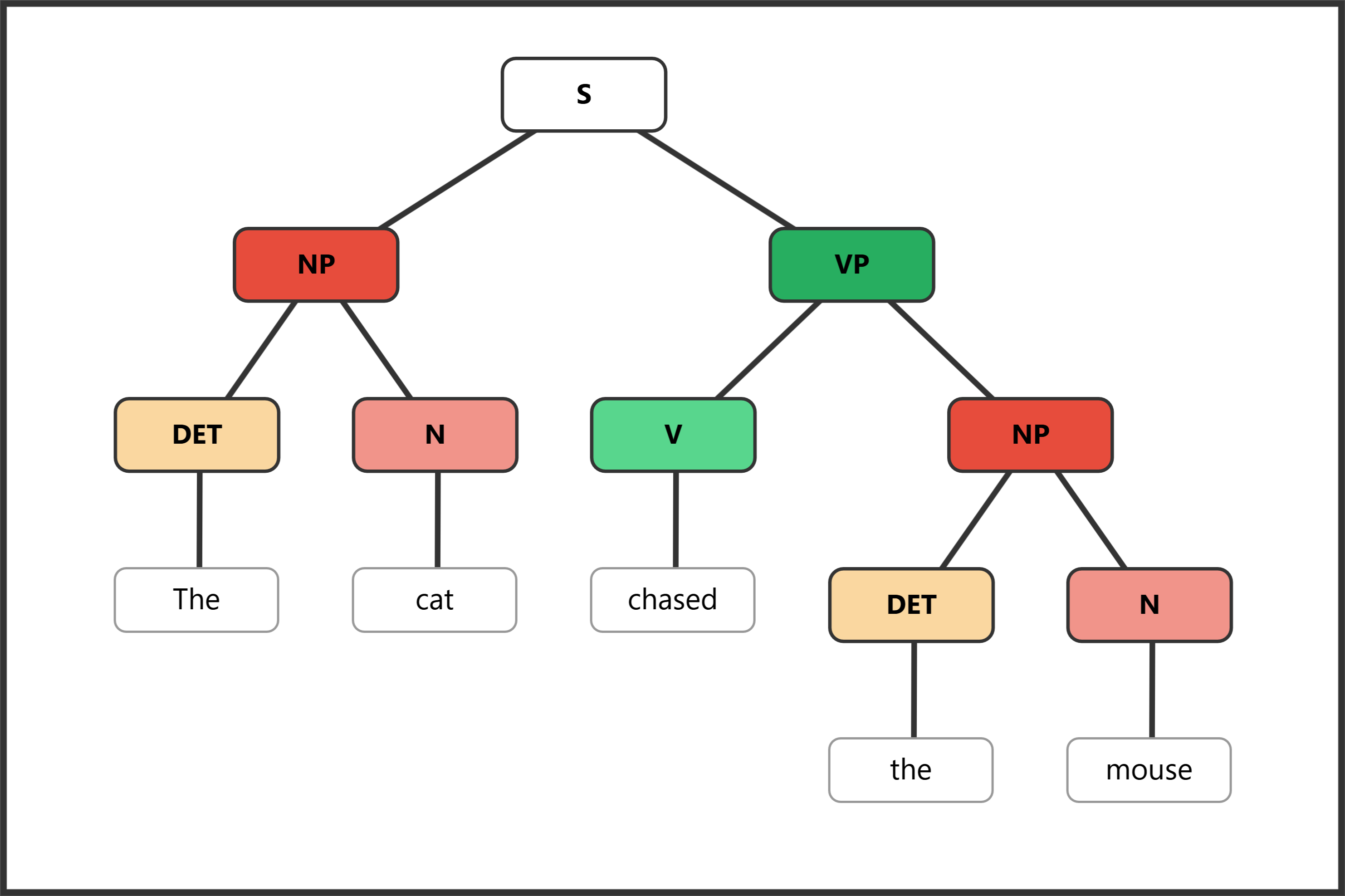
[S [NP [DET The] [N cat]] [VP [V chased] [NP [DET the] [N mouse]]]]
Step 5—Complete the sentence table:
| Role | Subject | Predicate | |||
|---|---|---|---|---|---|
| Phrase | NP | VP | NP | ||
| Word | The | cat | chased | the | mouse |
| POS | DET | N | V | DET | N |
Which Approach Should You Use?
Top-down analysis works well when you can quickly identify the subject and predicate—the big picture is clear, and you work inward to the details. Bottom-up analysis works well when the structure is less obvious or when you want to be systematic—you start with what you know for certain (individual words) and build from there.
Most experienced analysts use a blend of both approaches. They may start top-down by splitting S into NP and VP, then switch to bottom-up within the NP to identify modifiers and their arrangement. The important thing is not which approach you use, but that you arrive at a consistent, well-formed tree that accounts for every word in the sentence.

