Section 12.1 Adverbs vs. Adverbials: Form vs. Function
If someone asks you to find the adverbials in a sentence, you might instinctively look for words ending in -ly. That is a reasonable first instinct—but it conflates two different things. An adverb is a type of word—a part of speech (Chapter 5). An adverbial is a role in a sentence—any word, phrase, or clause that functions to modify a verb, adjective, adverb, or entire sentence. Keeping these two ideas separate is the foundation of everything in this chapter.
Adverb as Form.
An adverb is a part of speech—a word class with particular morphological and syntactic characteristics. Adverbs often end in -ly, can modify verbs, adjectives, or other adverbs, and cannot appear between a determiner and a noun. Examples: quickly, carefully, often, very, however.
Adverbial as Function (Role in a Sentence).
An adverbial is a functional category—a role in a sentence. Any structure that modifies a verb, adjective, adverb, or sentence is functioning as an adverbial, regardless of its form. The key insight: all adverbs functioning as modifiers are adverbials, but not all adverbials are adverbs.
Consider an adverb filling the adverbial role:
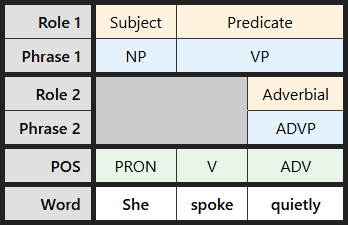
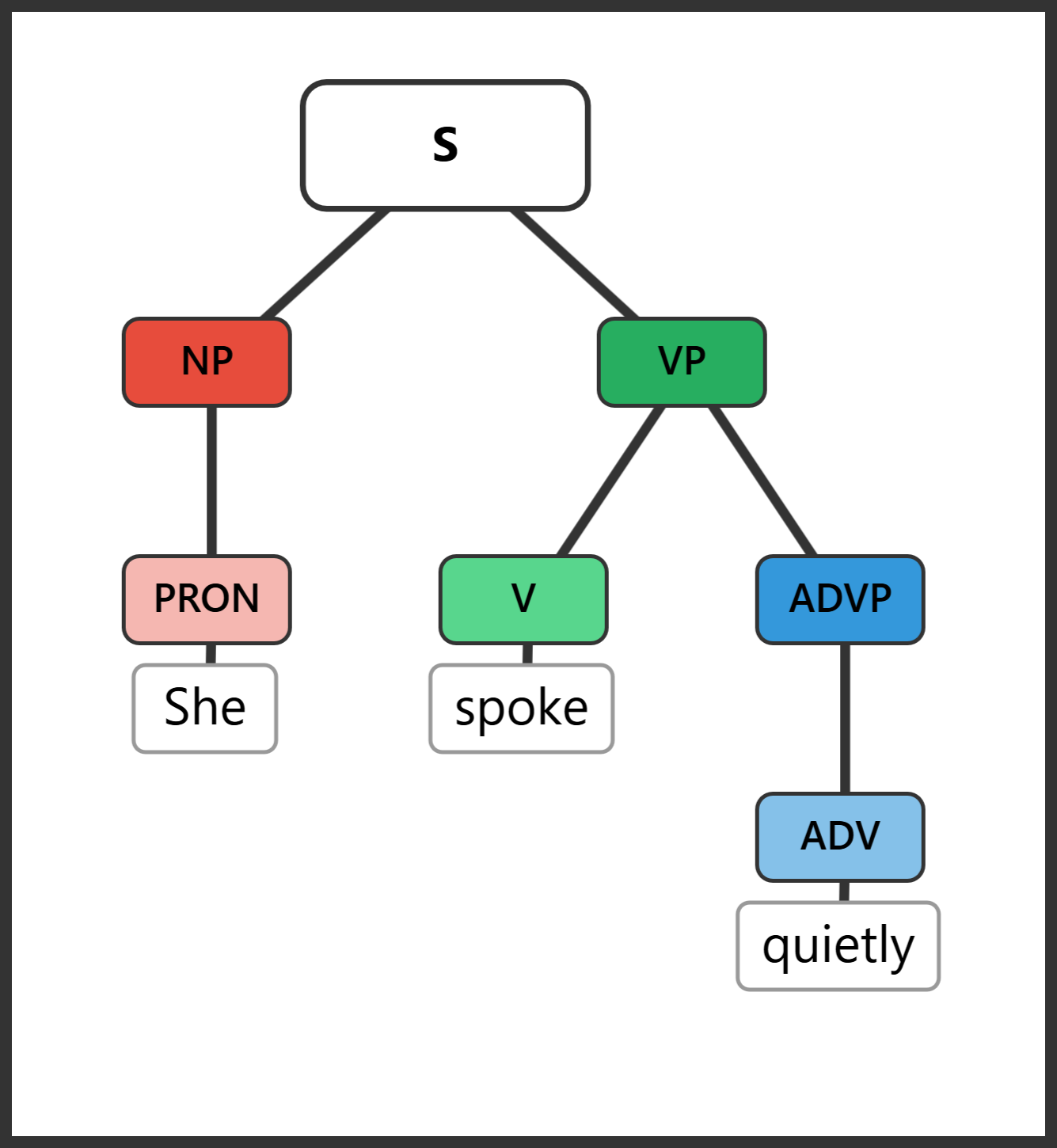
[S [NP [PRON She]] [VP [V spoke] [ADVP [ADV quietly]]]]
Now compare a prepositional phrase filling the same adverbial role:
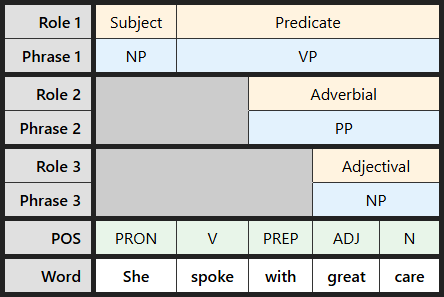
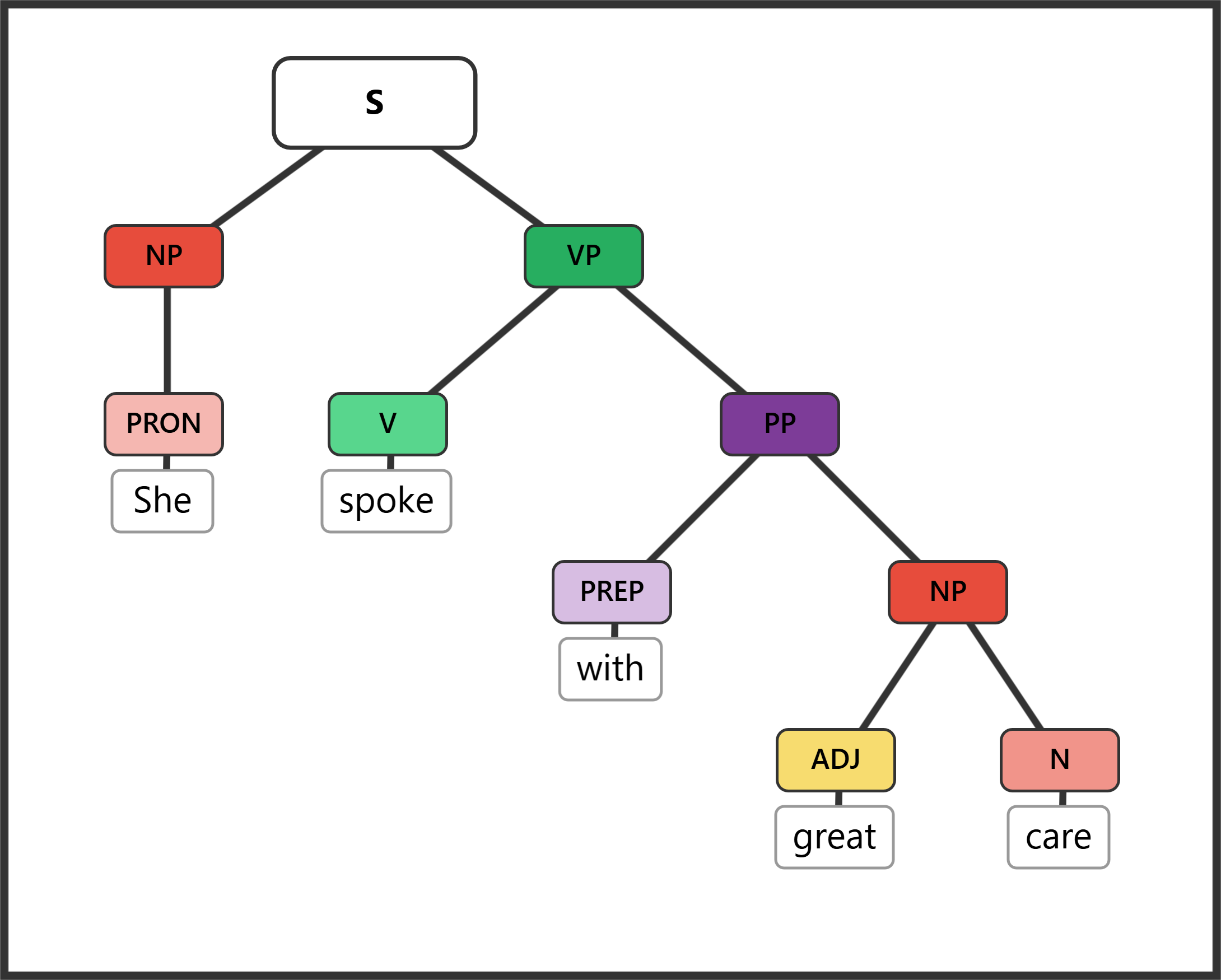
[S [NP [PRON She]] [VP [V spoke] [PP [PREP with] [NP [ADJ great] [N care]]]]]
Both quietly and with great care answer the question how? and both fill the adverbial slot in the clause. Their forms are different—an adverb phrase and a prepositional phrase—but their function is the same.
Semantic Roles.
In addition to their structural form, adverbials are classified by the type of information they provide—their semantic role. Chapter 5 introduced these roles in the context of adverbs. The same roles apply to all adverbial structures:
| Semantic Role | Question Answered | Example |
|---|---|---|
| Time | When? How long? How often? | yesterday, for hours, often |
| Place | Where? In what direction? | downtown, in Boston, north |
| Manner | How? In what way? | quietly, with care, gracefully |
| Reason | Why? For what reason? | because of the noise |
| Purpose | For what purpose? | to stay healthy, for the meeting |
| Condition | Under what conditions? | if it rains, in case of emergency |
| Concession | Despite what? | although she tried, despite the rain |
| Result | With what result? | so hard that the roads flooded |
See Chapter 5 for a fuller treatment of these categories. The rest of this chapter focuses on the structural forms that fill the adverbial role and how their position in the sentence affects meaning.

