Section 9.7 Complex Sentences
A complex sentence contains one independent clause and at least one dependent (subordinate) clause. Unlike compound sentences, complex sentences create a hierarchy—one idea is primary, another is supporting.
Independent vs. Dependent Clauses.
An independent clause expresses a complete thought:
-
The power flickered.
-
Everyone looked up.
A dependent clause has a subject and predicate but cannot stand alone:
-
When the power flickered (What happened?)
-
Because she had other plans (Why?)
The subordinating word (when, because, although, if, since) transforms an independent clause into a dependent one, making it lean on a main clause for completion.
Creating Complex Sentences.
“Everyone looked up when the power flickered.”
“She declined because she had other plans.”
The dependent clause provides context, explanation, condition, or timing for the main clause.
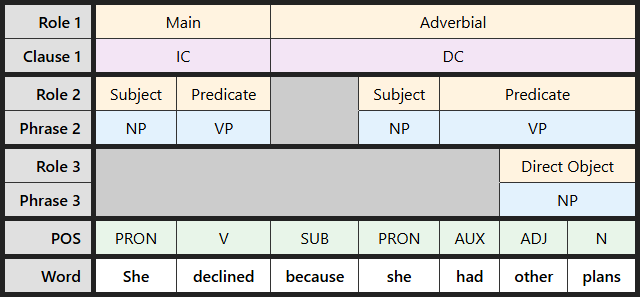
The labeling table and tree diagram below show the structure of She declined because she had other plans — a complex sentence with the dependent clause following the main clause:
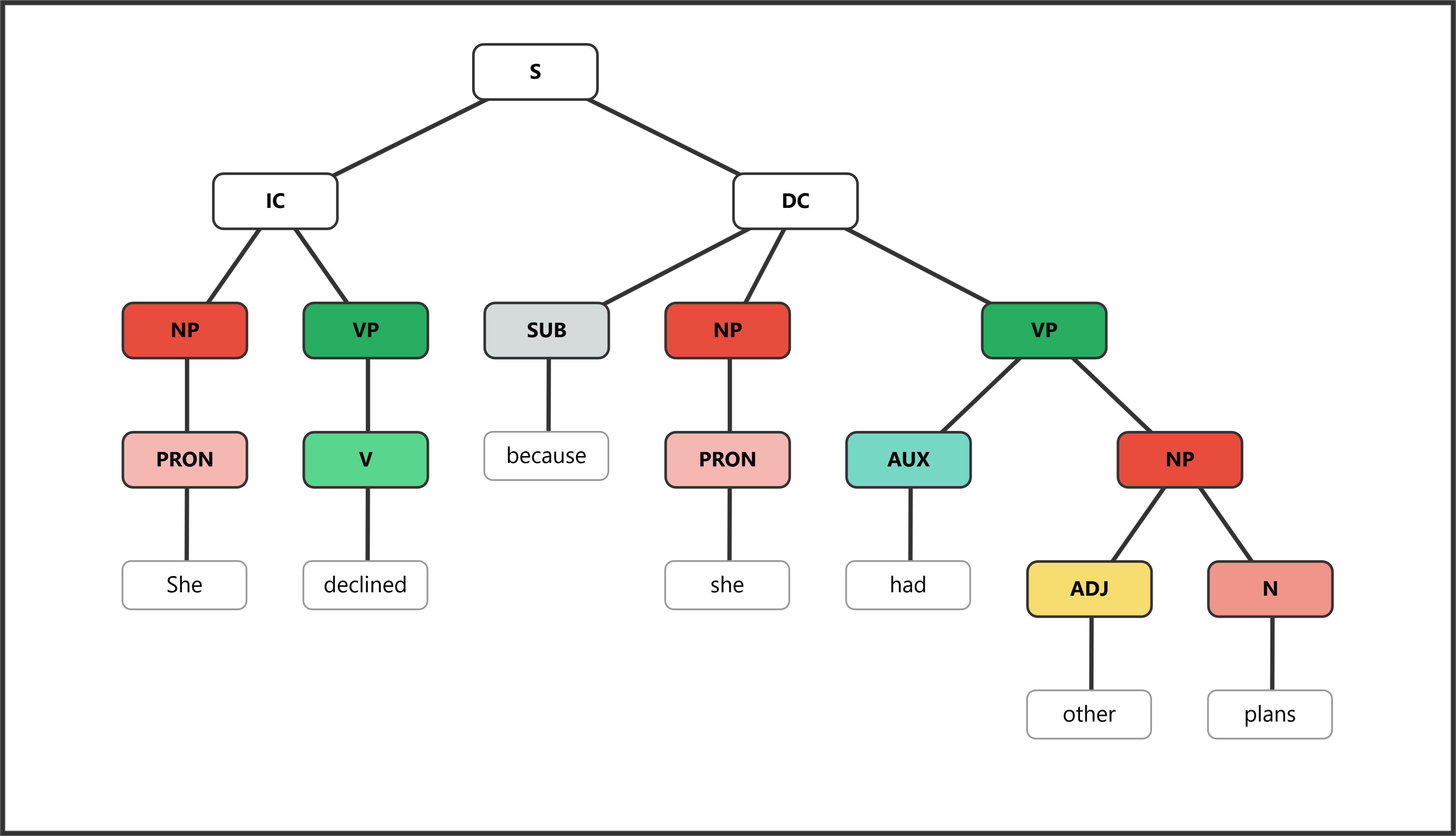
[S [IC [NP [PRON She]] [VP [V declined]]] [DC [SUB because] [NP [PRON she]] [VP [AUX had] [NP [ADJ other] [N plans]]]]]
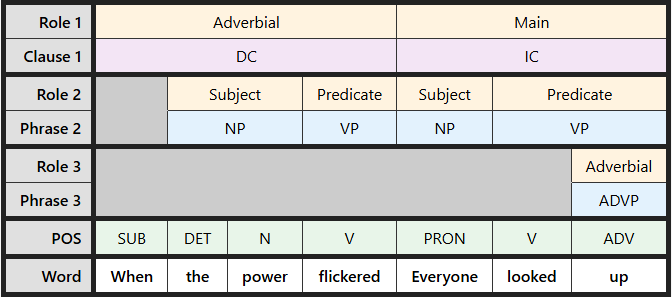
When the dependent clause comes first, the structure looks like this — When the power flickered, everyone looked up:
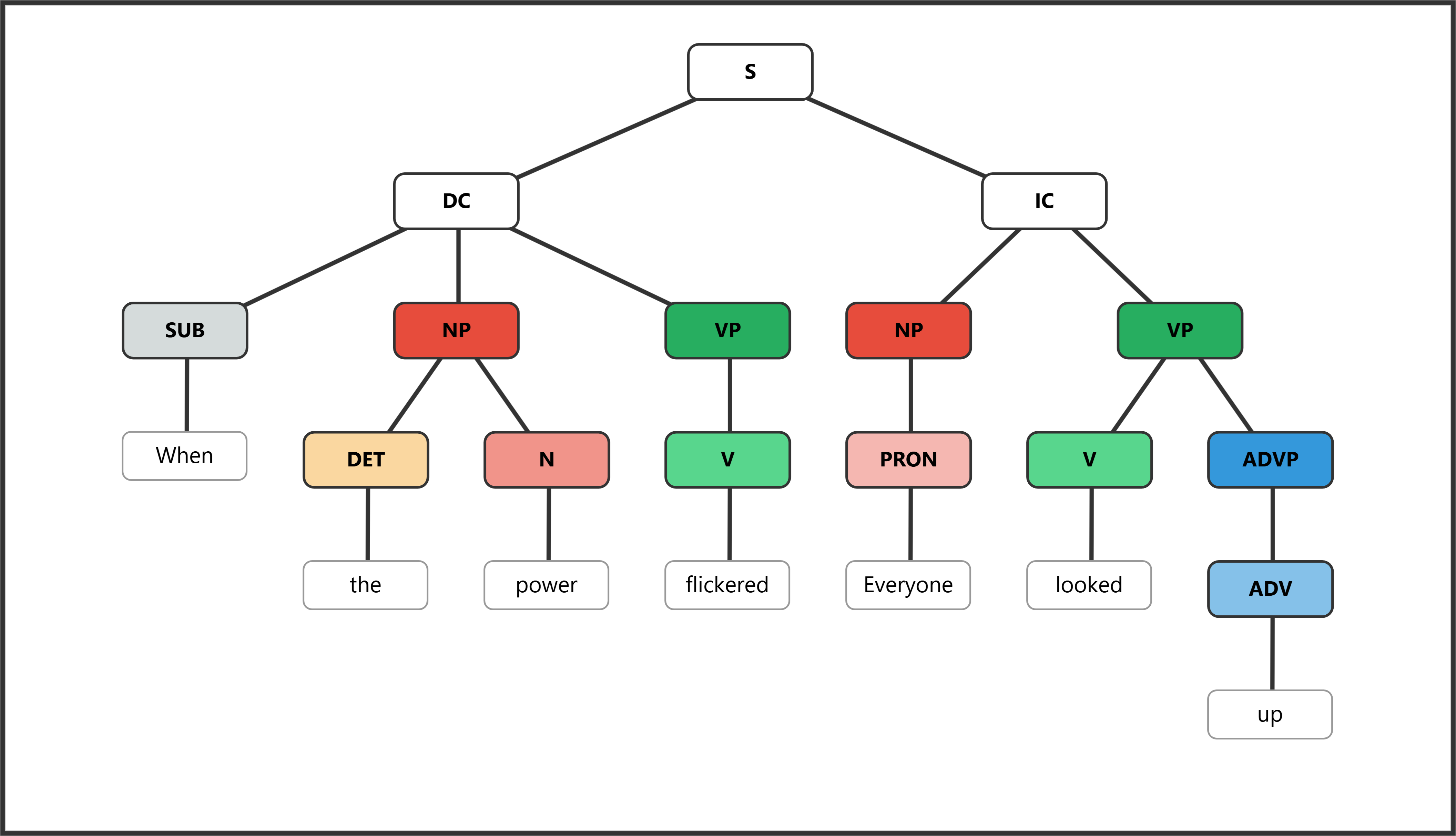
[S [DC [SUB When] [NP [DET the] [N power]] [VP [V flickered]]] [IC [NP [PRON Everyone]] [VP [V looked] [ADVP [ADV up]]]]]
Clause Roles in Complex Sentences.
In the labeling tables above, the independent clause receives the role Main—it carries the primary idea. The dependent clause receives the role Adverbial. Why "Adverbial"? Because adverbial dependent clauses function like adverbs: they modify the main clause by telling when, why, how, or under what conditions the main event occurred. Just as an adverb like quickly modifies a verb, an adverbial clause like because she had other plans modifies the entire main clause.
This role distinction reflects the hierarchy of a complex sentence: the Main clause is the foreground, and the Adverbial clause is the background—supporting, explaining, or qualifying the main idea.
Why Use Complex Sentences?
Complex sentences are particularly powerful when you want to signal exactly how two events or ideas relate. The subordinating conjunction does that work: because signals cause, although signals concession, when signals timing. A compound sentence with and leaves the relationship implicit—the reader infers it. A complex sentence with because makes it explicit.
Subordination also guides emphasis. When you place an idea in a dependent clause, you push it into the background; the independent clause stays in the foreground. This is how skilled writers keep readers focused on what matters: background information—context, conditions, causes—goes into subordinate clauses, while the main point stands on its own. A series of compound sentences gives every idea equal grammatical weight, which can make all ideas feel equally important, diluting the emphasis you want. Subordination lets you make the hierarchy of your ideas visible in the grammar of your sentences.
The Flip Test.
One of the most reliable ways to identify a complex sentence—and to confirm that a clause is dependent—is the flip test: move the dependent clause to the front of the sentence. If the result is grammatical and requires a comma, you have a complex sentence with a movable dependent clause.
Start with: “She declined because she had other plans.”
Flip it: “Because she had other plans, she declined.” ✓
The flipped version is grammatical and takes a comma after the dependent clause. This confirms that because she had other plans is a dependent clause and the sentence is complex.
Try it with a compound sentence:
Start with: “She declined, and he went alone.”
Flip: “And he went alone, she declined.” ✗
Moving a coordinating conjunction to the front produces an ungrammatical result—confirming that there is no subordinate clause to flip.
The flip test is a practical diagnostic tool. When you are unsure whether a sentence is compound or complex, try flipping what comes after the conjunction. If it can move to the front and remain grammatical, it is a dependent clause and the sentence is complex.
Subordinating Conjunctions.
Subordinating conjunctions are the words that transform an independent clause into a dependent one. They attach to the beginning of a clause and make it unable to stand alone—it now needs a main clause to complete it. But they do more than create grammatical dependence: they also specify the relationship between the dependent clause and the main clause.
That relationship is entirely a function of which conjunction is used. Because she practiced expresses cause. Although she practiced expresses concession. When she practiced expresses timing. The grammar is identical in all three cases—a subject and a predicate preceded by a subordinating word—but the meaning shifts dramatically. Choosing a subordinating conjunction is choosing how to frame the relationship between your ideas.
Common subordinating conjunctions, grouped by the relationship they signal:
| Relationship | Subordinating Conjunctions |
|---|---|
| Time | when, while, before, after, until, since, as, once, whenever, as soon as |
| Cause/Reason | because, since, as, given that, now that |
| Contrast | although, though, even though, while, whereas, even if |
| Condition | if, unless, provided that, in case, assuming that, as long as |
| Purpose | so that, in order that |
| Manner | as, as if, as though |
A few items in the table deserve special attention. The word since appears in both the time row and the cause/reason row, because it can signal either relationship depending on context: Since the storm, the streets have flooded (time) versus Since you’ve already eaten, skip dessert (cause). Similarly, as and while each appear in multiple categories. When you encounter these ambiguous words, use the surrounding context to determine which relationship is intended. A reliable check is to substitute an unambiguous conjunction—because for cause, when for time—and see whether the meaning holds.

